

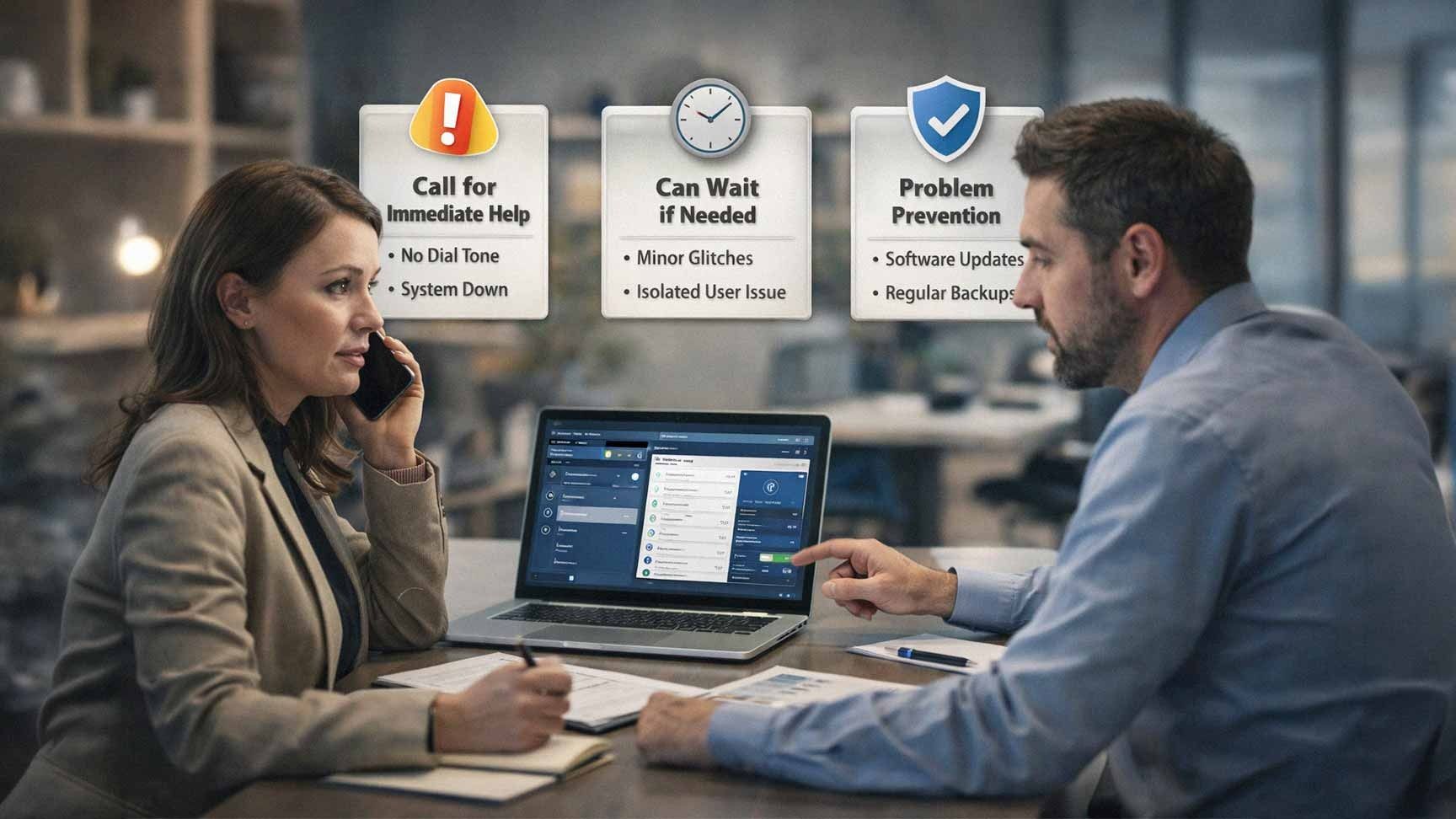
Modern VoIP phone systems are reliable when properly configured. But problems still happen. Calls drop mid-conversation. Audio sounds robotic or choppy. Users get locked out. Features stop working. Then a bill arrives with charges that do not make sense.
Most businesses eventually face the same question: Is this something we fix internally, or is it time to call our phone system provider?
The answer matters more than people realize. According to CIO.com, escalating issues too quickly can actually deter problem-solving and bypass solutions that could have resolved the issue faster. On the other hand, waiting too long when a serious issue is developing allows the problem to grow, affect more users, and damage the customer experience.
Getting the timing right keeps your communication running smoothly without burning resources on unnecessary support calls. This guide breaks down exactly when to call your VoIP support provider, when to wait, and what to handle on your own.
Call Immediately: Your Entire Phone System Is DownIf your whole phone system goes offline, do not spend hours troubleshooting. Call your VoIP support provider immediately.
Signs of a full outage include:
- No inbound or outbound calls working for any user
- All phones showing registration errors simultaneously
- Your cloud PBX portal is inaccessible
- Call routing is failing across all departments
A full outage is not a minor inconvenience. It directly affects revenue, customer service, and your team's ability to communicate internally. Every minute of downtime has a measurable cost.
Your provider should have a documented escalation path for critical service interruptions. If they do not, that is worth a conversation on its own. A good VoIP partner — one with 24/7 local support — will have a clear protocol for exactly this scenario.
Call Immediately: Multiple Users Are Experiencing Dropped Calls
One dropped call could be a fluke. Two or three might still be coincidence. But when multiple users across your office start reporting the same problem at the same time, that is a signal worth acting on quickly.
Contact your VoIP support provider promptly if you notice:
- Frequent call drops across different users or departments
- Mid-call disconnections happening consistently
- Repeated registration failures on multiple phones
These symptoms can point to several underlying causes:
- Network configuration issues that have recently changed
- Provider-side service interruptions affecting your region or infrastructure
- SIP trunk instability
- Firewall conflicts that are blocking or misrouting VoIP traffic
Waiting allows the problem to compound. More calls get affected. More customers have poor experiences. If you are running a business where the phone is central to how you operate, getting this in front of support quickly is always the right call.

Call Immediately: You Suspect a Security Breach or Toll Fraud
VoIP security incidents require an urgent response. This is not a "call soon" situation — it is a drop-everything situation.
Contact your VoIP provider right away if you notice:
- Unusual international call activity, especially to destinations you do not recognize
- Large, unexpected spikes in outbound call volume
- Unknown extensions appearing in your system
- Admin login alerts or notifications you did not trigger
- Unauthorized changes to your call routing or configuration
VoIP systems are internet-connected, which means they carry the same security exposure as any other networked application. Toll fraud — where attackers exploit your phone system to make international calls at your expense — is a real and well-documented risk in 2026. Bills can spike thousands of dollars before anyone notices.
A good VoIP support team can quickly disable affected accounts, block suspicious outbound destinations, and help you understand how the breach occurred. Time is the biggest factor here. The faster you escalate, the less financial and operational damage occurs.
Call Soon: Call Quality Problems That Keep Coming Back
Call quality issues are not always emergencies, but they absolutely should not be ignored. If your team regularly deals with poor audio, that is not just a nuisance — it is affecting how your business sounds to customers.
Contact your VoIP provider if you experience:
- Echo during calls
- Delayed or out-of-sync audio
- Robotic, choppy, or distorted sound
- One-way audio where only one party can hear the other
- Intermittent crackling or static
These symptoms are typically related to:
- Jitter — inconsistent packet delivery causing audio timing issues
- Latency — the delay between when someone speaks and when the other party hears it
- Packet loss — data dropping before it reaches the destination
- Bandwidth congestion — too many applications competing for the same connection
- Quality of Service (QoS) configuration — network traffic not being prioritized correctly for voice.
Your provider can pull call logs and network performance metrics to isolate the root cause. What feels like a vague "bad connection" often has a very specific and fixable cause once the right data is in front of the right person.
As TechRepublic points out,how well a VoIP provider handles issues like dropped calls and inconsistent call quality — and how quickly they resolve them — is one of the most telling indicators of provider quality. If your provider shrugs at persistent call quality complaints, that is a red flag.
Call Soon: Features Are Not Working the Way They Should
Modern VoIP and UCaaS platforms like RingCentral and Intermedia Unite include a wide range of features: auto attendants, voicemail transcription, call recording, mobile apps, CRM integrations, and more. When these features break, they do not halt operations entirely — but they create friction that adds up over time.
Call your provider if:
- Your auto attendant is routing callers to the wrong destination
- Voicemail transcription has stopped working or is producing errors
- Call recording is no longer capturing conversations
- Your mobile app is not syncing with your desk phone
- CRM or help desk integrations have broken
Feature issues often have straightforward fixes — a configuration change, an app update, or a sync reset. But they are easy to overlook until someone in leadership realizes they have been missing recorded calls for three weeks. Staying on top of these issues keeps your workflows intact.
Call When Your Bill Does Not Look Right
Billing confusion is one of the most commonly overlooked reasons to contact your VoIP provider, and it deserves more attention than it gets.
Reach out to your provider if you notice:
- Unexpected international call charges
- Per-user fees that have changed without explanation
- Overage charges you cannot trace back to actual usage
- Duplicate line items
- New fees that were not discussed when you signed your agreement
Reviewing your bill with your provider prevents financial surprises from becoming financial problems. Transparent providers will walk you through every charge clearly. If yours cannot explain a line item, that is worth pressing on.
Call Before You Make Major Network Changes
This one is proactive, not reactive — and it is one of the most important calls you can make.
Contact your phone system provider before you:
- Switch internet service providers
- Upgrade or replace your firewall
- Modify router or switch configurations
- Open a new office location
- Bring on significant numbers of remote workers
- Add or remove a large number of users
VoIP performance is tightly dependent on your network configuration. A firewall upgrade that goes smoothly in every other respect can silently break SIP signaling if QoS settings are not carried over correctly. Your provider can advise you on what needs to be reconfigured, tested, or updated before the change happens — not after you lose phone service.
Issues You Can Often Handle Internally First
Not every issue requires you to pick up the phone. Minor problems your internal team can look into before escalating include:
- Rebooting a single phone — resolves many individual registration or software glitches
- Replacing a faulty Ethernet cable — a surprisingly common cause of audio problems on a specific phone
- Checking headset connections — loose or failing headsets cause audio issues that look like network problems
- Restarting the user's app — fixes most softphone and mobile app sync issues
- Verifying the user's internet connection — especially for remote workers, a basic speed and stability check often reveals the real culprit
- Checking for a known outage — most reputable VoIP providers maintain a public status page; check there first
If these basic steps do not resolve the issue in a few minutes, escalate. Internal troubleshooting is useful when it is quick and targeted. It is not useful when it delays getting a real fix by half a day.
How to Make Support Calls More Productive
When you do contact your VoIP support provider, the quality of information you bring to the call directly affects how quickly the issue gets resolved.
Before or during your support call, be ready to share:
- Exactly when the problem started — a specific time and date is far more useful than "recently"
- How many users are affected — one person or everyone?
- Whether anything changed before the issue started — new equipment, a network change, a software update
- Any error messages that appeared on phones, apps, or admin portals
- Call examples — specific call records with timestamps if you have them
The more precise your description, the faster your provider can identify the source of the problem. This is especially true for call quality issues, where the difference between "calls sound bad sometimes" and "calls to external mobile numbers drop at the 4-minute mark" can cut troubleshooting time significantly.
What Good VoIP Support Actually Looks Like
It is worth taking a moment to set expectations clearly. A responsive, capable VoIP support provider should offer:
- 24/7 availability — phone system issues do not follow business hours
- Dedicated account management — someone who knows your specific setup and history
- Clear escalation paths — you should never be left wondering who handles a critical outage
- Transparent billing — every charge should be explainable
- Proactive communication — your provider should alert you to planned maintenance, regional disruptions, and anything that might affect your service
If your current provider consistently falls short in these areas, that is worth evaluating. Switching VoIP providers mid-contract has real costs, but so does staying with one that does not support you well.
Frequently Asked Questions About VoIP Support
How quickly should my VoIP provider respond to a critical outage?
For a full system outage, response time should be immediate — meaning acknowledgment within minutes and active troubleshooting within the hour at most. If your provider's SLA does not specify response times for critical issues, ask them to clarify before you need to test it.
What is toll fraud and how do I know if it is happening to me?
Toll fraud occurs when unauthorized parties gain access to your phone system and use it to make calls — often international calls to high-cost destinations — at your expense. Signs include sudden spikes in call volume, unfamiliar outbound numbers in your call logs, or a bill that is dramatically higher than usual. Contact your provider immediately if you see any of these signs.

Can my internet provider cause VoIP call quality issues?
Yes, absolutely. VoIP traffic requires low latency, low packet loss, and consistent bandwidth. If your internet service is experiencing congestion, instability, or routing changes, it will affect call quality. Your VoIP provider can help you determine whether the issue originates on their side or your network side.
Should I contact my VoIP provider or my IT team first?
It depends on the issue. For anything that looks network-related — call quality, registration errors on a single device, app sync issues — start with your IT team or internal network check. For anything affecting multiple users simultaneously, billing, security, or features you cannot access in the admin portal, go straight to your VoIP provider.
How often should I review my VoIP bill?
Every month. Billing errors and unauthorized charges are much easier to dispute within 30 days. Set a regular reminder to review your invoice line by line, especially if your team size or usage patterns have changed recently.
What information should I have ready before calling VoIP support?
Have the following ready: the date and time the issue started, a list of affected users or phones, any error messages displayed, a description of recent network or configuration changes, and specific call examples with timestamps if relevant. The more detail you provide upfront, the faster your provider can isolate the problem.
Is it worth switching VoIP providers if support is consistently poor?
If you regularly experience delayed responses, unresolved recurring issues, or unexplained billing changes, then yes — evaluating alternatives is reasonable. Look for providers with documented NPS scores, clear SLA terms, and dedicated account management. Long-term relationships with a provider who knows your environment are genuinely valuable, but only if that provider is actually delivering.
The Bottom Line
Knowing when to call your VoIP provider — and when to handle things yourself — is one of those operational details that pays off quietly every day. You avoid unnecessary downtime by escalating the right issues fast. You avoid wasting support resources by handling the small stuff internally. And you build a more productive relationship with your provider when you show up to support calls prepared.
If you are evaluating your current phone system setup or wondering whether your provider is meeting the bar, AIS works with businesses across Las Vegas, Southern California, and surrounding regions to design, deploy, and support VoIP and UCaaS solutions built around how your team actually works.
Ready to talk about your phone system?
Schedule a Free Consultation or Contact AIS Today to connect with a local telecom specialist.
Topics:
