
Many businesses choose to lease copiers because it spreads costs over time and avoids a large upfront purchase. On the surface, copier leases seem straightforward. A monthly payment covers the machine, service, and supplies. You sign the contract, the equipment shows up, and everyone moves on.
In reality, copier lease pricing varies widely — even for similar devices. Two businesses can lease nearly identical copiers and pay very different monthly rates. The difference usually comes down to contract structure, usage assumptions, service coverage, and optional features that quietly increase costs over the life of the agreement.
Understanding what drives up the cost of an office copier lease helps you negotiate better terms, choose the right equipment, and avoid surprises after the contract is signed. Let's break it all down.
How Copier Lease Pricing Works
A copier lease typically includes two parts. The lease payment covers the hardware. A separate service agreement covers maintenance, repairs, and consumables like toner. These two agreements work together, but they are priced independently.
When businesses focus only on the monthly lease payment, they often overlook service costs that grow over time. The total cost of ownership depends on both agreements and how well they align with your actual usage patterns.
As a general benchmark, the monthly payment on a 36-month copier lease typically runs around 4% to 5% of the machine's purchase price. So a copier that retails for $8,000 might lease for $320–$400 per month on hardware alone — before service is factored in. That service agreement is where a lot of the variation happens.
Factor 1: Copier Size and Speed
One of the biggest drivers of lease cost is the size and performance level of the copier itself.
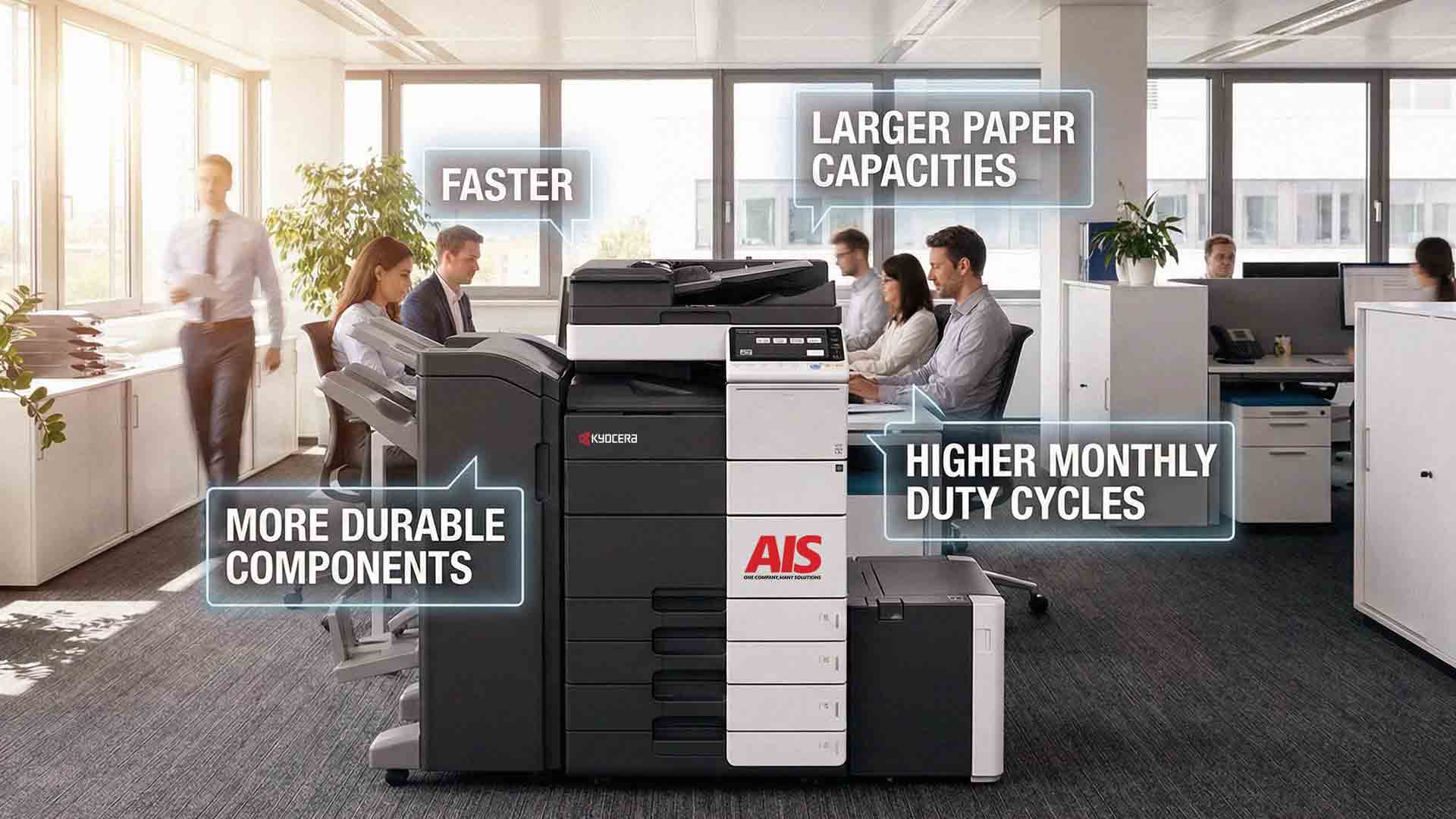
Entry-level machines designed for small offices cost far less than high-volume multifunction devices built for larger teams. Higher-performance copiers typically include:
- Faster print speeds (measured in pages per minute)
- Larger paper capacities and finishing options
- More durable internal components
- Higher monthly duty cycles
If a copier is oversized for your needs, you're paying for capacity you'll never use. If it's undersized, overuse leads to higher service costs and accelerated wear on parts. Choosing the right device for your actual workload is one of the most effective ways to control your lease cost from day one.

Factor 2: Monthly Print Volume Assumptions
Copier leases and service agreements are built around estimated monthly print volumes. If your actual usage exceeds those estimates, costs rise quickly.
Overage charges kick in when you print more pages than your contract allows. These charges may seem small on a per-page basis — often $0.01 to $0.02 per black-and-white page and $0.08 to $0.15 per color page — but they add up fast in busy offices.
On the flip side, businesses that consistently print far less than expected still pay for unused capacity. That's money left on the table every single month.
Accurate volume forecasting before you sign is essential. If you're unsure what your current print volume is, ask your provider to help you run a print assessment. At AIS, this is a standard part of our process before recommending any device. You can schedule a free consultation here to get started.
Factor 3: Color Printing Usage
Color printing is one of the most expensive aspects of a copier lease, and it's also one of the most underestimated.
Color toner costs significantly more to produce and replace than black-and-white toner. Many businesses are surprised to learn how often employees default to printing in color — especially when color printing isn't actively managed or restricted at the device level.
Copier leases often include:
- Separate per-page pricing for color versus black-and-white output
- Automatic color detection that bills accordingly
- Higher overage rates for color pages that exceed the contract allowance
Without enforced color controls or default settings that favor black-and-white, color costs accumulate month after month. Setting color printing restrictions at the device level — and reviewing usage reports regularly — can meaningfully reduce your service agreement costs over a 36- to 60-month lease.
Factor 4: Service and Maintenance Coverage
Not all service agreements are created equal. This is one area where the fine print really matters.
Basic service plans cover routine maintenance and parts. More complete plans include labor, toner and supplies, response time guarantees, and priority support. Costs increase when a service agreement includes:
- Faster guaranteed response times (same-day versus next-business-day)
- On-site priority support windows
- Extended service hours, including evenings and weekends
- Coverage for multiple devices under one agreement
- Support for older or higher-mileage equipment
Here's the catch: some of the lowest monthly lease payments in the market are paired with expensive or limited service contracts. A low hardware payment can look attractive right up until the machine breaks down and the repair bill isn't covered.
Always evaluate the total monthly cost — hardware lease plus service agreement — before comparing proposals. A slightly higher lease payment that includes a strong service plan often costs less overall than a stripped-down plan with unpredictable repair expenses.
Factor 5: Contract Length
Longer lease terms often reduce monthly payments but increase your total spend. Shorter terms raise monthly rates but give you more flexibility.
Common lease lengths in 2026 range from 36 to 60 months, with 48-month terms growing in popularity for mid-range devices. Here's how to think about it:
- 36-month leases offer the most flexibility and align better with technology refresh cycles
- 48-month leases balance payment affordability with reasonable upgrade timing
- 60-month leases have the lowest monthly payments but lock you into technology that may be outdated well before the contract ends
Longer terms also make mid-lease upgrades more expensive. If your business grows and you need a higher-capacity device in year three of a five-year lease, the buyout or upgrade fees can be significant. For most SMBs, a 36- to 48-month term offers the best balance of cost control and flexibility.
Factor 6: Equipment Add-Ons and Optional Features
Optional hardware features increase upfront equipment cost, which flows directly into your monthly lease payment.
Common add-ons that raise the price include:
- Finishers and staplers for automated document finishing
- Large-capacity paper drawers for high-volume environments
- Fax modules (still used in healthcare, legal, and regulated industries)
- High-security print release hardware for compliance-sensitive environments
- Specialty paper handling for envelopes, labels, or wide-format output
Not every office needs every feature. Before agreeing to add-ons, ask specifically how each one will be used. Features that seemed useful at signing often go unused for the full lease term — and you pay for them every single month regardless.
Factor 7: Lease Structure and Residual Value
There are different types of copier leases, and the structure affects your total cost.
The two most common are:
- Fair Market Value (FMV) leases — At the end of the term, you return the equipment, purchase it at fair market value, or upgrade to new equipment. Monthly payments are typically lower.
- $1 Buyout leases — You own the equipment at the end of the term for $1. Monthly payments are higher because you're essentially financing the full purchase price.
FMV leases generally make more sense for businesses that want to stay current with technology. $1 buyout leases work better when you plan to keep the device long-term or have specific reasons to own the equipment outright.
Understanding which structure you're signing determines both your monthly payment and what happens at lease end. Signing a $1 buyout lease when you actually want the flexibility to upgrade is a common and expensive mistake.

Factor 8: Vendor Markup and Market Positioning
Finally, pricing varies by vendor. Some dealers apply significant markup to equipment, service agreements, or both. Others compete on lower margins but offset through add-on fees.
Working with a provider that offers transparent, itemized pricing — and that takes the time to understand your actual usage before recommending a device — is one of the most reliable ways to avoid overpaying.
At AIS, we've maintained a 96% Net Promoter Score and have been ranked #1 in North America for client satisfaction. Our average client relationship is over seven years. That track record reflects how we approach pricing: honestly, with long-term relationships in mind rather than short-term transactions.
If you want a second opinion on a proposal you've already received, or you're starting fresh and want to understand what fair pricing looks like, contact AIS today.
What You Can Do Right Now
Before signing any copier lease, take these steps:
- Audit your current print volume — Know your monthly black-and-white and color page counts
- Request itemized pricing — See the hardware lease and service agreement costs separately
- Compare total monthly cost — Not just the hardware payment
- Evaluate contract length carefully — Shorter terms offer more flexibility
- Ask about overage rates — Understand exactly what you'll pay if you exceed your volume estimate
- Review add-ons line by line — Question anything you don't have a specific use for
A few hours of due diligence before you sign can save your business thousands of dollars over a 36- to 60-month agreement.
Frequently Asked Questions About Copier Lease Costs
What is a typical monthly payment for an office copier lease?
Monthly lease payments vary widely based on equipment size, features, and contract length. A basic desktop multifunction device might lease for $75–$150 per month. Mid-range office copiers typically run $200–$500 per month. High-volume production devices can exceed $1,000 per month. These figures cover hardware only — service agreements are priced separately.
Is it better to lease or buy a copier?
For most SMBs, leasing makes sense because it preserves working capital, includes maintenance coverage, and makes it easier to upgrade technology over time. Buying outright may be more cost-effective for businesses with stable, long-term needs and the capital to absorb upfront costs. The right answer depends on your cash flow, growth trajectory, and how quickly the technology will need to be replaced.
What is a fair market value (FMV) copier lease?
A fair market value lease means you return the equipment at the end of the term and can choose to purchase it at its appraised market value, renew the lease, or upgrade to new equipment. Monthly payments are typically lower than a $1 buyout lease. FMV leases are a good fit for businesses that want the option to stay current with technology every 36–48 months.
How do overage charges work on a copier lease?
Most copier service agreements include an allowance for a set number of pages per month. If you exceed that allowance, overage charges apply on a per-page basis. Black-and-white overages typically range from $0.01 to $0.02 per page. Color overages are higher, often $0.08 to $0.15 per page. Overage charges can significantly increase your effective monthly cost if your print volume is underestimated at signing.
Can I negotiate copier lease terms?
Yes. Lease terms, monthly payment amounts, service agreement inclusions, overage rates, and contract length are all negotiable. Starting with an accurate picture of your actual print volume puts you in a stronger negotiating position. Working with a reputable dealer who prioritizes long-term relationships over one-time sales also increases your chances of getting fair, sustainable terms.
What happens at the end of a copier lease?
At the end of a copier lease, your options typically include returning the equipment, purchasing it (at fair market value or for $1 depending on your lease structure), or renewing for another term. It's important to understand your end-of-lease obligations before signing, including any notice requirements. Missing a notice deadline can result in your lease automatically renewing for another term.
How do I know if I'm overpaying on my current copier lease?
Start by separating your hardware payment from your service agreement cost and comparing both against market benchmarks for your equipment category. If you're unsure what fair pricing looks like, an independent review from a trusted provider can help. AIS offers free consultations to help businesses evaluate their current agreements and identify whether they're getting good value.
Ready to Get Honest Answers on Your Copier Lease?
At AIS, we believe you deserve clear, straightforward answers about what you're paying and why. Whether you're starting a new search, evaluating a proposal, or wondering if your current lease is working in your favor, we're here to help.
Schedule a Free Consultation — Talk through your copier needs with a local AIS account manager who will give you straight answers, not a sales script.
Contact AIS Today — Reach our team in Las Vegas, Southern California, and surrounding regions. Local support, 24/7 availability, and a 96% satisfaction rating from businesses just like yours.
Topics:
