
Printing rarely feels expensive day to day. Paper gets reordered. Toner cartridges get swapped out. Copier invoices get paid. Monthly service bills arrive. Life goes on.
But without real-time visibility into what's actually happening across your print environment, costs accumulate quietly in the background — and many businesses don't catch it until the damage is done.
Most companies only realize printing is expensive when:
- Overage charges show up on a service invoice
- Department budgets blow past expectations
- Toner usage spikes with no clear explanation
- Print volume climbs and nobody knows why
The good news? Real-time print cost monitoring solves all of this. When you have live data, you can spot trends before they become financial problems — and make decisions based on facts instead of gut feelings.
This guide walks you through exactly how to do it.
What Actually Drives Print Costs?
Before you can monitor print costs in real time, you need to know what you're looking at. Print is not a single line item. It's a combination of overlapping variables that blend together into one confusing monthly bill.
Common cost factors include:
- Cost per page under your service agreement
- Color vs. black-and-white printing (color can cost 5–10x more per page)
- Print volume per department — some departments print far more than others
- Overage charges when you exceed contracted page volumes
- Toner and supply consumption between scheduled replenishments
- Paper usage and waste
- Maintenance calls outside normal service coverage
- Equipment lease payments
Without data, all of these costs blend together and look like one vague printing expense. With structured monitoring, each variable becomes measurable — and manageable.
What Does Real-Time Print Monitoring Actually Mean?
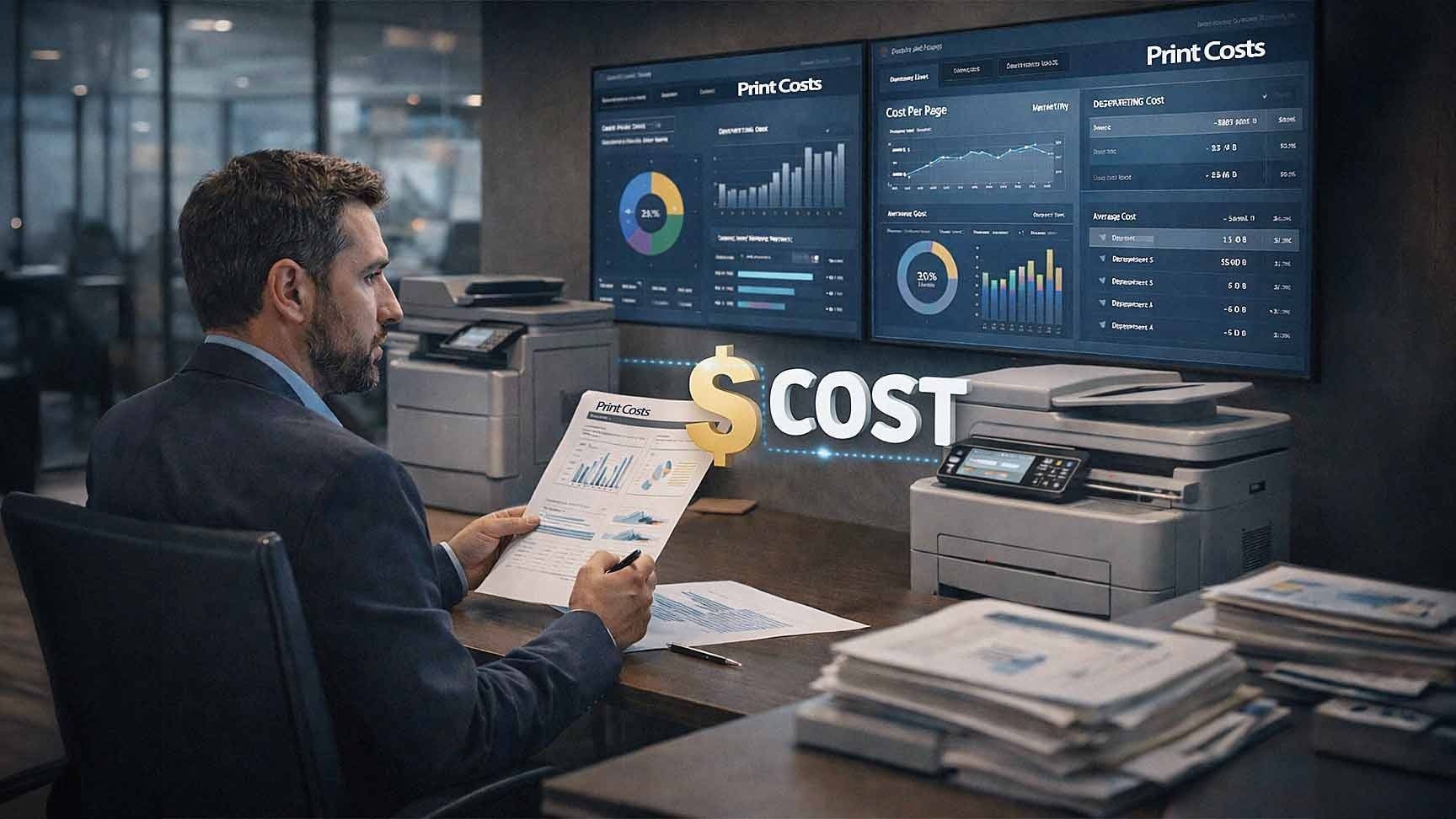
Real-time monitoring means having immediate visibility into print activity instead of waiting for end-of-month meter reads or quarterly reviews.
Modern print management systems provide:
- Live device usage tracking — see what's being printed right now
- Per-user print reporting — know who is printing what
- Department-level cost breakdowns — assign costs to the right budget owners
- Alerts for high usage — get notified before costs spike
- Color print tracking — identify exactly how much color volume you're generating
- Cost-per-page calculations updated as jobs are sent
This visibility transforms printing from a passive, invisible expense into an actively managed cost center. That shift alone can change how your team thinks about printing — which tends to change behavior.

Use Print Management Software as Your Foundation
Print management software is the core tool behind real-time cost tracking. Without it, you're essentially flying blind — relying on copier meter reads that only tell you what happened, not why or how.
These systems monitor:
- Who is printing
- What is being printed (document type, page count, color usage)
- How often printing occurs
- Which devices are being used most heavily
- Estimated cost per job in real time
The granular data this software produces lets managers identify excessive usage quickly, compare devices, and make informed decisions about where to cut costs.
Many modern platforms also integrate directly with managed print service agreements. According to Gartner reviews in 2026, Xerox Managed Print Services carries a 4.7 out of 5 rating based on 137 user reviews, and HP Managed Print Services holds a 4.5 out of 5 rating based on 183 reviews — both reflecting strong user satisfaction with visibility tools, proactive monitoring, and cost accountability features.
At AIS, we help clients deploy print management tools that work alongside Xerox and HP equipment so the data you're collecting is accurate, actionable, and tied to the devices you already own.
Track Cost Per Page Across Every Device
Most copier service agreements operate on a cost-per-page model. That means every page printed has a price — and color pages cost significantly more than black-and-white.
Monitoring cost per page in real time helps you:
- Identify high-cost devices that are pulling your average up
- Compare color vs. monochrome usage across the fleet
- Evaluate lease efficiency — are you getting value from every device?
- Spot abnormal print spikes before they generate overage charges
If color print volume increases unexpectedly — say, a department starts printing full-color reports internally — your cost per page rises immediately. Real-time reporting lets you act during the increase instead of reacting after you see it on the next invoice.
Set Usage Alerts and Thresholds
One of the most practical things you can do is configure usage alerts. Most print management platforms let you set thresholds that trigger notifications when something unusual happens.
Alerts can notify administrators when:
- Print volume exceeds a set threshold for the day, week, or billing period
- Color usage spikes beyond your normal baseline
- A specific department increases output unexpectedly
- A device shows abnormal activity — like a single user sending 500 pages in an hour
Proactive alerts prevent surprises. Instead of reacting after costs have already increased, you can step in while the spike is still happening. That's the difference between managing your print environment and being managed by it.
Monitor Print Activity by Department
Department-level tracking is one of the most underused features in print management, and it's one of the most valuable.
When you can break down print costs by department, you can:
- Allocate costs accurately instead of burying them in overhead
- Compare usage trends between teams doing similar work
- Identify departments with heavy color usage that could be adjusted
- Adjust budgets based on actual data rather than historical estimates
Without department tracking, printing looks like a shared cost with no owner. Nobody is accountable. When departments can see their own print costs, accountability improves — and behavior tends to follow.
Identify and Reduce Wasteful Print Behavior
A significant portion of print costs come from unnecessary printing. This is worth paying attention to because it's largely preventable.
Common waste patterns include:
- Printing emails and short digital communications
- Duplicate print jobs sent multiple times
- Large color graphics used for internal presentations that never need to be printed
- Unclaimed print jobs left sitting in output trays
Secure print release is one of the most effective tools for reducing this type of waste. Users authenticate at the device before a job prints — which means if someone forgets about a job or decides they don't need it, nothing gets printed. Unclaimed jobs are automatically deleted after a set period.
The impact adds up. Reducing unnecessary print jobs directly lowers your cost per page and reduces supply consumption over time.
Integrate Real-Time Reporting With Finance
Print monitoring isn't just useful for IT and operations. Finance teams benefit significantly from having visibility into print trends.
Real-time dashboards give leadership the ability to:
- Forecast supply purchases based on actual consumption rates
- Predict overage charges before they show up on an invoice
- Identify seasonal spikes and plan accordingly
- Adjust departmental budgets using real data instead of estimates
When print becomes predictable, it becomes plannable. That's a meaningful shift for any finance team trying to bring tighter control to operating expenses.
Monitor Supply Levels Automatically
Modern printers and copiers report toner and supply levels in real time. When this data is connected to a print management platform or managed print service, you get automatic alerts before supplies run out.
This matters because:
- Unplanned supply shortages disrupt operations
- Emergency toner orders often cost more than scheduled replenishments
- Running a device low on toner can cause print quality issues and, in some cases, device damage
When you're working with a managed print provider like AIS, supply monitoring happens automatically. Toner gets shipped before you run out. You don't have to think about it — which means you don't have to deal with the consequences of not thinking about it.
How AIS Helps Businesses Monitor Print Costs in Real Time
At AIS, we work with SMBs across Las Vegas, Southern California, and surrounding regions to build print environments that are visible, accountable, and cost-effective.
Our approach includes:
- Fleet assessment — we audit your existing devices, agreements, and usage patterns
- Print management software deployment — we configure tools that match your environment
- Custom reporting and dashboards — built around the metrics that matter to your team
- Proactive alerts and monitoring — so you know about issues before we do
- Dedicated account managers — real people who know your business and your devices
- 24/7 local support — not a call center, not a ticket queue
Our clients stay with us for an average of 7+ years. That's not an accident — it's the result of building systems that actually work and supporting them over the long term.
If you're not sure what your print environment is costing you right now, that's a good place to start. Schedule a free consultation and we'll help you find out.
Frequently Asked Questions About Monitoring Print Costs in Real Time
What is real-time print monitoring?
Real-time print monitoring means having live visibility into print activity across your devices — including who is printing, what they're printing, how much it costs, and which devices are being used. Instead of reviewing data after the fact, you can see it as it happens and respond immediately.
How much can real-time print monitoring actually save a business?
Savings vary depending on your current environment, but many businesses find that real-time monitoring reduces unnecessary print volume by 20–30% within the first year. The biggest gains typically come from eliminating waste, reducing unclaimed print jobs, and shifting color printing behavior.
What software do I need to monitor print costs in real time?
There are several print management platforms available, including tools from Xerox, HP, and independent vendors. The right choice depends on your existing devices, your team size, and your reporting needs. AIS can help you evaluate options and configure the right system for your environment.

Can I monitor print costs without replacing my existing devices?
In most cases, yes. Many print management platforms work with existing networked printers and copiers. You don't necessarily need new equipment — you need the right software and configuration. A fleet assessment will tell you what's compatible with your current devices.
How do usage alerts help with print cost control?
Usage alerts notify you when print activity crosses a threshold you've defined — like a department exceeding its monthly page budget or color usage spiking unexpectedly. Alerts let you act in real time rather than reacting to surprises on a monthly invoice. They're one of the simplest and most effective tools for proactive cost management.
Is department-level print tracking hard to set up?
It depends on your environment and the platform you use. For most businesses, department-level tracking requires assigning print jobs to cost centers or user groups within the software. AIS handles the configuration and setup so your team doesn't have to figure it out independently.
What's the difference between managed print services and print management software?
Print management software is a tool — it gives you visibility into your print environment. Managed print services (MPS) is a service model where a provider like AIS actively manages your entire print environment: devices, supplies, maintenance, monitoring, and reporting. MPS typically includes print management software as part of a broader service package.
Take Control of Your Print Costs
Print costs are one of the most manageable operating expenses in your business — when you have the right data. Real-time monitoring gives you that data, and a good print management partner helps you act on it.
If you're ready to stop guessing and start managing, contact AIS today or schedule a free consultation. We'll help you build a print environment you can actually see — and actually control.
Topics:
