
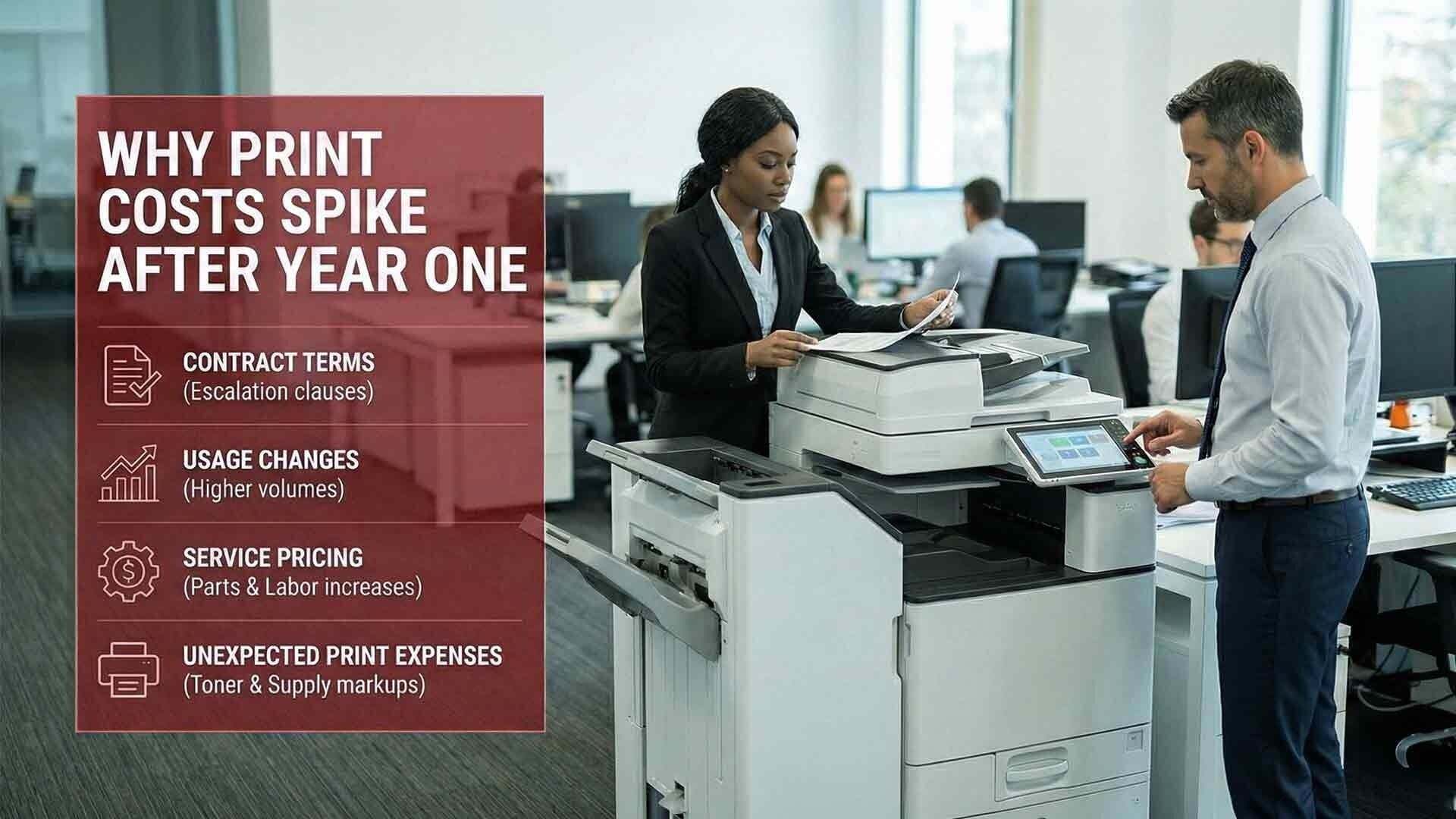
Many businesses feel genuinely confident after their first year in a copier or managed print lease. Monthly payments are predictable. Service calls are rare. Supplies show up on time. Leadership checks the box and moves on.
Then something shifts.
Invoices start climbing. Overage line items appear. A service charge shows up that wasn't there six months ago. Someone in accounting flags it, and suddenly there's a meeting about why printing feels so much more expensive even though the equipment hasn't changed.
This is one of the most common conversations we have with businesses across Las Vegas, Southern California, and the surrounding region. And here's the honest truth: most print cost spikes after year one are predictable — and preventable. You just need to know where to look.
How Copier Lease Pricing Is Actually Structured
Before we get into the reasons costs climb, it helps to understand how these contracts are built in the first place.
Copier leases and managed print agreements are priced around assumptions made at signing. Those assumptions typically include:
- Expected monthly print volume — how many pages you'll print per month
- Color-to-black-and-white ratio — what percentage of those pages will be in color
- Average service and maintenance needs — how often the machine will need attention
- Contracted cost per page (CPP) — what you'll pay for every page printed within your allowance
Year one usually tracks closely with those estimates. You're a new client. Volume is relatively predictable. The equipment is fresh. Everything holds together.
After that, real-world usage takes over — and the gap between your contract assumptions and your actual behavior starts to widen.
Reason 1: Print Volume Grows Quietly in the Background
Business Growth Changes Printing Habits
This one catches companies off guard more than almost anything else. As your business grows, your print volume grows with it. New employees print onboarding materials, training documents, internal reports, and compliance paperwork. Processes evolve. Departments expand.
The problem is that these changes happen gradually. Nobody makes a conscious decision to print more. It just happens, page by page, month by month.
And those incremental increases matter. Most leases include a monthly page allowance (sometimes called a "minimum" or "base volume"). Once you exceed that allowance, you're paying overage rates on every additional page — rates that are often significantly higher than your base CPP.

Seasonal and Project-Based Printing Adds Pressure
Many SMBs experience concentrated printing periods around audits, fiscal year-end reporting, major proposals, or busy seasons. These spikes can push usage well beyond contracted limits in a single billing cycle. If your contract isn't designed to flex with that kind of volume, overages accumulate fast.
Reason 2: Color Printing Becomes the Default
Most Copiers Are Set to Print in Color Out of the Box
This is a subtle but expensive detail. Many copiers are installed with color printing enabled as the default setting. Employees print emails, web pages, spreadsheets, and internal memos in full color without thinking twice about it.
Color pages typically cost three to five times more than black-and-white pages on a CPP basis. When color usage creeps up across an entire organization, the bill follows quickly.
Client-Facing Materials Shift the Mix
As businesses mature, they naturally produce more polished, branded materials. Proposals look more professional. Presentations get upgraded. Sales collateral gets redesigned. All of that skews your color-to-black-and-white ratio away from what was assumed when your contract was signed.
Without print rules or department-level controls in place, color usage becomes one of the largest — and least visible — drivers of post-year-one cost increases.
Reason 3: Overage Rates Are Higher Than You Think
Overage pricing is one of the most underread sections of any print contract. When you exceed your contracted volume:
- Per-page overage rates are typically higher than your standard CPP
- Charges often apply retroactively across the entire billing cycle once the threshold is crossed
- Costs escalate quickly during busy months when volume spikes
Most businesses don't notice overage pricing until an invoice lands that's noticeably higher than usual. At that point, the charges have already accumulated.
If you're not sure what your overage rate is, that's worth checking today. Pull out your contract and look specifically for language around "excess usage charges" or "overage cost per page." The difference between your standard rate and your overage rate may surprise you.
Reason 4: Wear and Service Needs Increase After Year One
Wear and Tear Becomes More Noticeable
In the first year, everything is fresh. Parts are new. Issues are rare. Equipment performs cleanly, and service calls are minimal. That changes.
Over time, usage accumulates. Rollers wear down. Fusers cycle thousands of times. Paper feeds start to slip. Drum units reach end-of-life. Service visits that were once rare become routine, and some of those visits carry costs that weren't obvious at the start of the agreement.
Coverage Gaps Surface
Not all service agreements are built the same. Some exclude:
- Certain internal components once they reach a usage threshold
- Labor charges outside of standard business hours
- Damage attributed to "excessive wear"
- Parts that fall outside the standard service tier
When those exclusions apply, additional charges appear on your invoice. If you weren't watching for them during contract review, they can be genuinely confusing when they show up.
Reason 5: Supplies Usage Accelerates as Printing Habits Evolve
Toner consumption is tied to page coverage, not just page count. A page filled with dense graphics or full-bleed color consumes dramatically more toner than a page of plain text. As your team prints more image-heavy documents, presentations, and client materials, toner depletes faster than the contract anticipated.
This leads to a cascading effect:
- More frequent toner shipments, which may fall outside your agreement's supply terms
- Higher supply costs if you're purchasing outside of contract
- Additional service visits when equipment needs attention more often
These changes often don't surface until well into year two, once printing habits have fully settled into their new normal.
Reason 6: Contract Auto-Adjustments and Annual Price Escalations
Most print agreements include built-in price adjustments that take effect after year one. These are usually disclosed in the contract — but they're easy to miss buried in the fine print.
Common adjustments include:
- Annual CPP increases tied to inflation indices or supplier pricing
- Service rate escalations as equipment ages into higher maintenance tiers
- Minimum usage resets that require you to pay for pages you didn't print if volume dips below a threshold
These aren't necessarily unfair, but they are often surprising. If you signed a three-year or five-year agreement without reading the escalation clause carefully, year two and beyond may look quite different from year one.
What You Can Do About It Right Now
Understanding why costs spike is useful. Knowing what to do about it is better. Here's where to start:
1. Audit Your Actual Print Volume
Pull the last six months of invoices and compare actual page counts to your contracted allowance. Look for patterns — which months went over, by how much, and in which departments.
2. Check Your Color-to-Black-and-White Ratio
Many modern copiers can generate usage reports that break down color versus black-and-white printing. If color is running higher than expected, work with your provider to implement print rules that default to black and white for internal documents.
3. Read Your Overage and Escalation Clauses
Find the sections of your contract that address excess usage charges, annual adjustments, and service exclusions. If you can't locate them, ask your provider directly. You have a right to that information.
4. Talk to Your Provider Before Renewal
If you're heading into year two or approaching a contract renewal, that's your window to renegotiate volume allowances, CPP rates, and service terms based on your actual usage data — not the estimates from day one.
5. Consider a Managed Print Assessment
A managed print assessment looks at your entire print environment — volume, device mix, supply usage, and contract terms — and identifies where you're overpaying. It's one of the most straightforward ways to get a clear picture of what's actually driving costs.
How AIS Approaches Print Cost Transparency
At AIS, we work with SMBs across Las Vegas, Southern California, and surrounding regions to make print costs predictable from day one — and to keep them that way. Our managed print agreements are built around your actual usage data, not generic assumptions. We monitor volume, flag overage risks before they hit your invoice, and provide regular reviews so you're never caught off guard by year-two surprises.
Our clients stay with us for an average of seven-plus years — not because they're locked in, but because the relationship actually works. If your current print agreement has started to feel unpredictable, we'd be glad to take a look.
Frequently Asked Questions
Why does my copier lease cost more in year two than it did in year one?
Several factors typically converge after year one: print volume increases as your business grows, color printing becomes more common, overage charges accumulate when you exceed your contracted page allowance, and many agreements include annual price escalation clauses that take effect after the first year.

What are overage charges on a copier lease?
Overage charges are fees applied when your monthly print volume exceeds the page allowance built into your contract. Overage rates are typically higher than your standard cost per page, and in many agreements, they apply retroactively across the entire billing cycle once you cross the threshold.
How can I find out what my overage rate is?
Look for language in your contract around "excess usage," "overage cost per page," or "pages above contracted minimum." If you can't locate it, contact your provider and ask them to clarify the exact overage rate and when it triggers.
Is it normal for color printing to drive up my print costs?
Yes, and it's one of the most common cost drivers we see. Color pages typically cost three to five times more than black-and-white pages. When employees print in color by default — emails, spreadsheets, internal reports — the cost impact adds up quickly across an entire organization.
Can I renegotiate my copier lease if my costs have increased significantly?
It depends on where you are in your contract term. If you're approaching renewal or a mid-term review window, you often have room to renegotiate volume allowances and CPP rates based on actual usage. Even mid-contract, some providers will work with you if the original assumptions are significantly off.
What is a managed print assessment, and should I get one?
A managed print assessment is a structured review of your entire print environment — devices, volume, supply usage, and contract terms. It identifies where you're overspending and where your contract no longer reflects your actual needs. If your print costs have increased without a clear explanation, an assessment is a good starting point.
How does AIS help businesses control print costs long-term?
AIS builds managed print agreements around your actual usage data rather than generic estimates. We monitor volume, provide usage reports, flag overage risks proactively, and conduct regular reviews to make sure your contract still fits your business. Our clients across Las Vegas and Southern California rely on that kind of ongoing visibility to keep print costs predictable.
*Have questions about your current print agreement or want to understand what's driving your costs?*
Topics:
