
You signed the lease. You agreed to a monthly payment. Then the invoice came in higher than expected. Again.
If this sounds familiar, you are not alone. One of the most common frustrations we hear from businesses in Las Vegas, Southern California, and surrounding areas is that their copier lease payment changed — and nobody warned them it would.
The truth is, most office copier leases are not as simple as a flat monthly fee. They include both fixed and variable components, and understanding the difference between the two is what separates businesses that control their print costs from businesses that get surprised every quarter.
This article breaks down exactly why your copier lease payment changes, what to watch for in your contract, and how to manage your costs more effectively going forward.
What Is Actually Included in a Copier Lease Payment?
Before you can understand why the number changes, you need to understand what you are paying for in the first place.
A typical copier lease agreement bundles several charges together:
- Equipment lease payment — the monthly cost to use the physical machine
- Service and maintenance agreement — covers repairs, technician visits, and parts
- Cost per page (CPP) — a per-print charge for every page your team produces
- Supplies — often toner, and sometimes other consumables depending on your contract
Some of these are fixed. Others fluctuate based on how you use the machine and what happens in the market. Most of the payment changes you experience come from the variable side of this equation.
Fixed Costs vs. Variable Costs: Know the Difference
Fixed Costs
Fixed costs are locked in when you sign the contract. They typically include:
- Monthly equipment lease payment — this should not change during the original lease term
- Base service agreement fee — a flat monthly charge for standard maintenance coverage
These numbers stay the same unless you modify the agreement, add equipment, or let the lease roll into a renewal period.

Variable Costs
Variable costs shift based on usage, market conditions, and contract terms. These include:
- Cost per page charges — billed based on actual volume
- Overage fees — triggered when you exceed your contracted page allowance
- Toner and supply usage — especially relevant in managed print contracts
- Service adjustments — pricing tied to labor costs, parts availability, or rate clauses
This is where most surprises live. If your monthly bill went up and you are not sure why, the answer is almost always sitting in the variable cost section of your agreement.
7 Reasons Your Copier Lease Payment Changes
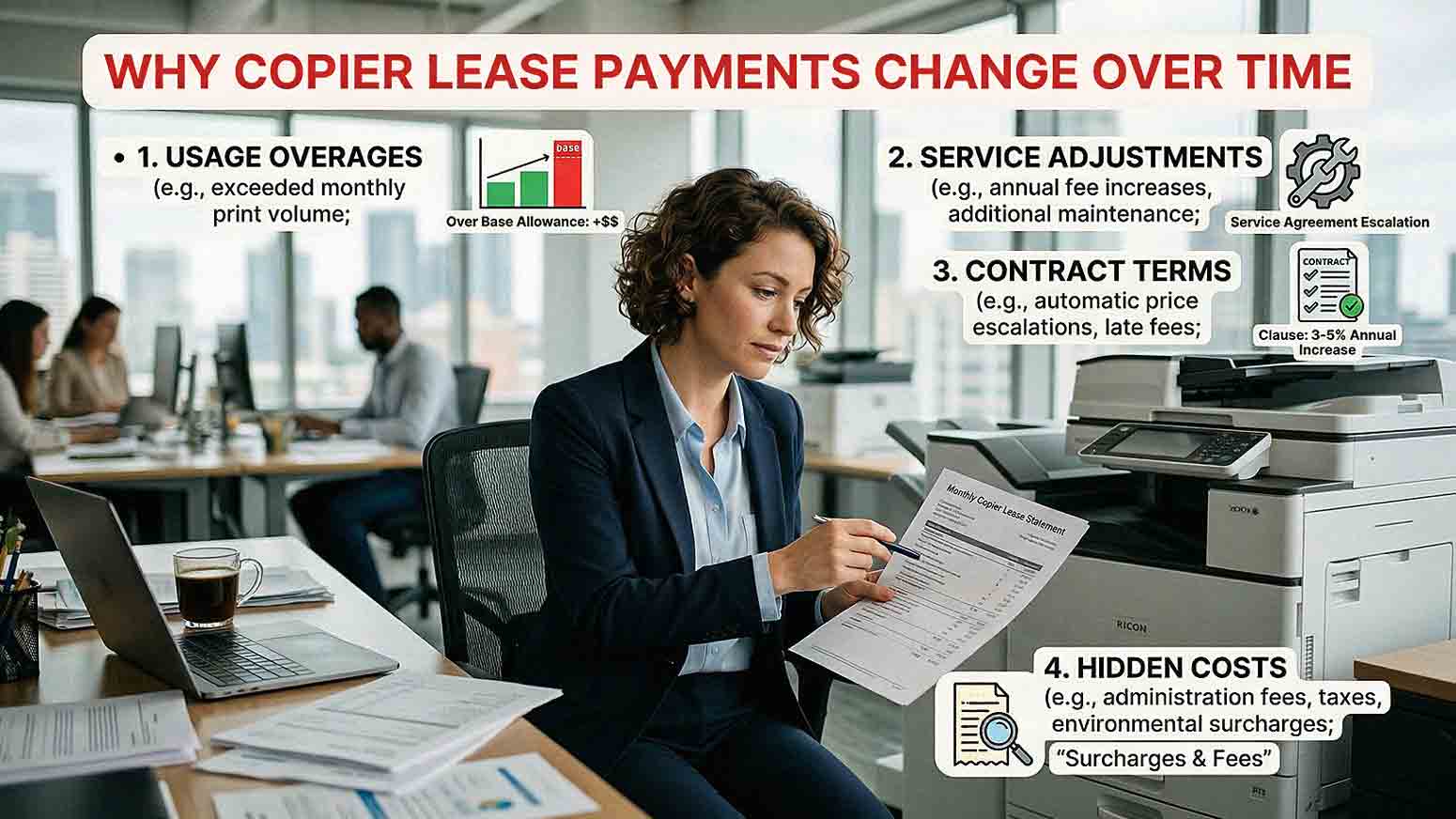
Reason 1: You Exceeded Your Monthly Page Allowance
This is the single most common reason copier lease costs increase, and it catches businesses off guard more often than you would think.
Most contracts set a monthly page allowance — say, 2,000 black and white pages and 500 color pages. Every page you print beyond that threshold triggers an overage charge. Those charges can add up fast, especially during:
- Seasonal spikes — tax season, end-of-quarter reporting, product launches
- Team growth — more employees means more printing
- New workflows — onboarding a new client or project that generates heavy documentation
The fix here is simple: track your actual monthly print volume against your contracted allowance. If you are consistently hitting overages, renegotiating your volume tier is almost always more cost-effective than continuing to pay overage fees month after month.
Reason 2: Your Color Printing Volume Increased
Color pages cost significantly more than black and white. On most agreements, the cost per page for color printing runs three to five times higher than monochrome. That gap matters.
Common triggers for a shift toward more color printing include:
- Marketing materials being printed in-house
- Presentations and proposals with graphics
- Reports and dashboards pulled directly from software
- Internal documents that default to color in print settings
Even a modest increase in color volume — say, an extra 200 color pages per month — can add a meaningful dollar amount to your bill over time. One easy win: audit your default print settings and switch non-essential documents to black and white by default.
Reason 3: Service Agreement Adjustments
Service agreements are not always locked in forever. Many contracts include language that allows the service pricing to adjust over time, often tied to:
- Increased technician labor costs
- Parts availability and replacement pricing
- Annual escalation clauses — some contracts build in a 3–5% annual rate increase
This is especially relevant in 2026, as supply chain normalization after years of parts shortages has not fully eliminated cost pressure on service components. Technician labor markets remain tight in many regions, and those costs get passed along somewhere.
Always read the fine print in your service agreement. Look specifically for language like "rates subject to adjustment" or "annual escalation" — these phrases tell you that your service cost is not actually fixed.
Reason 4: Toner and Supply Price Changes
In managed print environments, toner and supplies are often bundled into your monthly cost per page rate. But that does not mean the pricing stays static. Supply costs can change due to:
- Manufacturer price adjustments on toner cartridges and drums
- Usage surges — high-coverage documents (like graphics-heavy PDFs) consume toner faster than standard text pages
- Formula changes in how your supply usage is calculated within the contract
According to Deloitte's lease accounting research, variable lease payments tied to usage or consumption are measured at the rate in effect at the time of the transaction — meaning what you pay can shift as your usage patterns and supplier pricing shift. This is standard practice, but it is worth knowing so you are not caught off guard.
Reason 5: Contract Renewal or Automatic Rollover
This one costs businesses real money, and it is entirely preventable.
Most copier leases include an automatic renewal clause. If you do not take action before the end of your term, the contract rolls over — sometimes at a higher rate, sometimes under updated terms, and often into month-to-month billing that runs higher than your original locked-in rate.
Common renewal-related cost increases include:
- New pricing tiers at the start of a renewal term
- Month-to-month billing premiums — leasing companies charge more for flexibility
- Loss of negotiating leverage — dealers know you are already locked into the equipment
Set a calendar reminder at least 90 days before your lease end date. That window gives you time to evaluate your options — renew, renegotiate, upgrade, or switch providers — without being pressured into unfavorable terms.
Reason 6: Adding Devices or Upgrading Equipment
If your business expands during the lease term and you add a second copier, upgrade to a higher-capacity machine, or bring on additional print locations, your monthly payment will increase. That is expected — but it should always be documented.
What to watch for:
- Make sure any equipment additions are reflected in a formal contract amendment
- Confirm the new monthly total in writing before the change takes effect
- Understand whether adding equipment resets your lease term or runs alongside the original agreement
These details matter when it comes time to exit the lease or negotiate renewal terms.
Reason 7: Fees That Were Not Obvious at Signing
Some copier lease agreements include charges that are technically disclosed but easy to miss in a long contract. These can include:
- Administrative or billing fees
- Delivery, installation, or setup charges
- Late payment fees
- Meter read adjustment fees — charged when self-reported meter reads are inaccurate
- Early termination fees — relevant if you try to exit the lease before the end of the term
None of these are necessarily unfair, but they can add real dollars to your monthly cost over time. Before you sign any new agreement, ask your account manager to walk you through every line item — not just the headline monthly payment.
How to Protect Yourself Going Forward
Whether you are evaluating a new copier lease or trying to get a handle on an existing one, here are the most effective steps you can take:
- Track your monthly print volume so you know whether your contracted allowance actually fits your usage
- Read the escalation clauses in your service agreement before you sign
- Set a renewal reminder well in advance of your contract end date
- Ask for a full cost breakdown — not just the base lease rate, but the total cost of ownership including CPP, service, and supplies
- Work with a provider that explains these things up front — because a partner worth keeping will not hide the variable cost details from you
At AIS, we have built our reputation on transparency. Our clients stay with us an average of 7+ years because they trust that the numbers we quote are the numbers they pay — and when something changes, we explain why.
Frequently Asked Questions
Why did my copier lease payment go up when I did not change anything?
The most likely culprits are overage charges from exceeding your monthly page allowance, a service agreement escalation clause that kicked in, or an automatic contract renewal that changed your rate. Pull your latest invoice and compare it line by line against your original agreement to find the specific cause.
Are copier lease payments fixed or variable?
Most copier leases include both. The equipment lease portion is typically fixed for the lease term. The service, cost per page, and supply components are often variable and can change based on usage, market conditions, or contract terms.

What is an overage charge on a copier lease?
An overage charge is a per-page fee applied when your monthly print volume exceeds the page allowance specified in your contract. If your contract allows 2,000 pages per month and you print 2,400, you pay overage rates on those 400 extra pages. These rates are typically higher than your standard cost per page.
Can a copier lease company raise my rates mid-contract?
It depends on your contract language. The fixed equipment lease payment generally cannot change. However, service agreements often include escalation clauses that allow annual rate adjustments. Always read those sections carefully before signing.
What happens if I go over my color page allowance?
Color overages are billed at your contracted color overage rate, which is typically several times higher than the standard black and white rate. If you are consistently exceeding your color allowance, renegotiating your contract tier is usually more cost-effective than continuing to pay overage fees.
How do I know when my copier lease renews?
Check your contract for the end date and any automatic renewal terms. Most leases require you to provide written notice 30–90 days before the end of the term if you do not want to renew. Missing that window can lock you into another term or roll you into month-to-month billing at a higher rate.
Is it better to lease or buy a copier?
Both options have real trade-offs. Leasing keeps upfront costs low, includes service coverage, and makes it easier to upgrade equipment over time. Buying outright may cost less over the long run but requires capital upfront and means you are responsible for service costs. The right answer depends on your cash flow, print volume, and how quickly your technology needs change. A trusted advisor can help you model both scenarios with your actual numbers.
The Bottom Line
Your copier lease payment does not have to be a mystery. When you understand the difference between fixed and variable costs, read the escalation clauses, and track your actual usage against your contracted allowance, you take control of your print budget.
If you are looking at your invoice right now and something does not add up, we are happy to help you make sense of it — no pressure, no sales pitch.
Schedule a Free Consultation and let one of our local account managers walk through your current agreement with you.
Or if you prefer, Contact AIS Today and we will get back to you the same business day.
Topics:
