Office copiers have a way of disappearing into the background. As long as documents print and copies come out clean, no one gives them a second thought. Then something shifts. Performance drops. Service calls pile up. Overage charges show up on the monthly statement. Print quality starts to look off. The lease term quietly expires.
Suddenly, your business is staring down an unexpected capital decision with no runway to plan.
That reactive cycle is expensive and avoidable. Budgeting for office copier upgrades puts you back in control. Instead of scrambling when a device fails, you're making strategic decisions on your timeline, with your numbers in hand.
This guide walks you through exactly how to do that — step by step.
Understand the Full Cost of Copier Ownership First
Before you can budget intelligently, you need to know what you're actually paying. Most businesses look at their monthly lease payment and call it a day. That's a mistake.
The true cost of owning or leasing a copier includes:
- Monthly lease payments
- Cost per page charges (color vs. monochrome)
- Overage fees when you exceed your contracted volume
- Maintenance contracts and service agreements
- Supply expenses — toner, drums, paper
- Downtime costs — lost productivity when a device is out of service
- End-of-lease fees — sometimes significant if not reviewed in advance
When you add all of these together, many businesses discover their "affordable" copier is costing significantly more than the lease payment suggests. Full cost visibility is where smart budgeting starts.
Step 1: Review Your Current Lease Agreements
Pull out every copier contract your business holds. If you can't find them easily, that's the first problem to solve.
Review each agreement for:
- Lease expiration date — and any automatic renewal clauses
- Monthly payment amount
- Included monthly print volume
- Overage cost per page for both color and black-and-white
- What the maintenance contract covers — and what it excludes
- End-of-lease terms — buyout options, return conditions, fees
Automatic renewal clauses are where businesses get burned most often. Many copier leases include a clause that renews the contract — sometimes for another full term — if you don't provide written notice 90 to 180 days before expiration. Missing that window locks you in.
Start your copier upgrade planning 6 to 12 months before any lease ends. That window gives you negotiating leverage and enough time to evaluate options without pressure.
Step 2: Analyze Your Print Volume Trends
Your print volume tells you whether you're over-equipped, under-equipped, or in the right range. Neither extreme is good for your budget.
Look at your data and ask:
- What's your average monthly print volume across all devices?
- What's your color-to-monochrome ratio — and is that ratio appropriate for your work?
- Are there seasonal spikes that push you into overage territory regularly?
- Are there departments printing far more than others?
If your volume has grown consistently over the past year or two, your current device may already be undersized. You're probably absorbing overage fees every month without realizing how much they're adding up.
On the other hand, if your business has shifted toward digital workflows and paperless processes, you may be locked into a lease for a device capacity you no longer need. That's money left on the table.
Print data removes the guesswork. Ask your current provider or dealer for a usage report — any reputable vendor should be able to provide one.

Step 3: Evaluate Device Age and Expected Lifecycle
Copiers follow predictable lifecycles. Planning around those timelines is one of the simplest ways to avoid reactive spending.
Here are general benchmarks:
- Leased copiers: typical upgrade cycle of 3 to 5 years
- Purchased copiers: typical useful life of 5 to 7 years
As devices age beyond those windows, a few things happen consistently:
- Maintenance frequency increases
- Parts become harder to source and more expensive
- Downtime risk rises — and so does the cost of that downtime
- Service technician time increases even under a maintenance contract
- Energy consumption often increases compared to modern alternatives
Lifecycle planning means you're scheduling replacement before reliability declines — not after a critical failure forces your hand. A failure at the wrong moment can mean lost proposals, delayed closings, or stalled operations. That's rarely worth the money saved by pushing off an upgrade.
Step 4: Compare Repair Costs Against Replacement Costs
This is the inflection point most businesses miss. At a certain moment, continuing to repair an aging device costs more than upgrading to something new.
To find that point, calculate:
- Annual maintenance expenses over the past 12 to 24 months
- Cost of downtime — how many hours were lost, and what's the hourly cost of that disruption?
- Employee productivity impact — reprints, workarounds, time spent waiting
- Supply waste from poor print quality or jams
Compare that total to what a predictable monthly lease payment on a modern device would cost. For many businesses, the math favors upgrading sooner than they expect.
When repair costs start trending upward quarter over quarter, that's your signal to start the budgeting conversation — not to wait for the next breakdown.
Step 5: Factor In What Modern Devices Can Do
A copier upgrade isn't just about printing faster. Modern multifunction devices offer capabilities that directly support business operations in ways older equipment simply can't match.
Newer devices in 2026 often include:
- Secure print release — documents only print when the user authenticates at the device
- End-to-end encryption for print and scan jobs
- Cloud integration with platforms like Microsoft 365, Google Workspace, and SharePoint
- Workflow automation — scan directly into business applications, reduce manual data entry
- Advanced scanning with OCR and intelligent document routing
- Lower energy consumption — modern devices frequently carry ENERGY STAR certification and use significantly less power than equipment from 5+ years ago
These features aren't just conveniences. In regulated industries, secure print release and encryption may be compliance requirements. For any business handling sensitive documents, they reduce real risk.
When you're building your budget, consider the operational value of upgraded capabilities alongside the hardware cost. The ROI extends well beyond page counts.
Step 6: Decide Between Leasing and Purchasing
Your acquisition model shapes your budget structure significantly. There's no universally right answer — it depends on your cash position, tax strategy, and how often you want to refresh hardware.
Leasing typically offers:
- Predictable monthly operating expenses
- Easier hardware refresh at end of term
- Lower upfront capital requirement
- The ability to bundle service and supplies into one payment
- Potential operating expense treatment for tax purposes (consult your accountant)
Purchasing typically offers:
- No ongoing payment once paid off
- Full ownership and depreciation benefits
- Freedom from lease terms and renewal clauses
- Higher upfront investment
- Separate service agreements needed
For most small and mid-sized businesses, leasing is the more practical path. It preserves capital, keeps payments predictable, and makes it easier to stay current with technology. But if you're running a stable, low-volume environment and have the capital available, purchasing can make sense for the right device.
Talk through both scenarios with a trusted advisor — not just the sales rep — before committing.
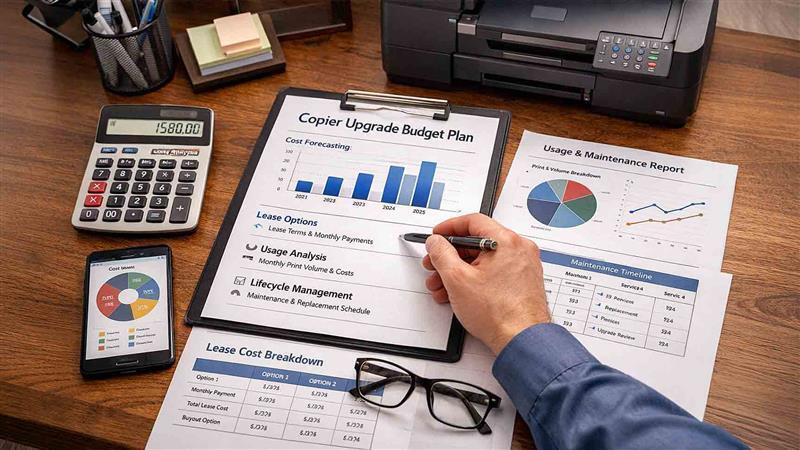
Step 7: Build a Multi-Year Upgrade Plan
If your business operates more than one copier, you have an opportunity to be strategic about timing. Staggering upgrades across fiscal years prevents large capital expenditures from stacking on top of each other.
A simple example for a three-device office:
- Year 1: Replace the high-volume production device with the highest mileage and service history
- Year 2: Upgrade department-level copiers approaching end of lease
- Year 3: Consolidate or replace underutilized devices based on updated volume data
This approach smooths your spending, keeps budget predictability high, and lets you evaluate each replacement decision on its own terms rather than trying to solve everything at once.
Multi-year planning also makes it easier to have the budget conversation with leadership or finance. A phased roadmap is far easier to approve than a large one-time ask.
Step 8: Build Contingency Into Your Budget
Things don't always go according to plan. A high-volume device fails earlier than expected. A lease auto-renews before you catch it. A new department comes online and print demand spikes.
Budget for contingency by:
- Adding 10 to 15 percent to your projected annual copier spend as a buffer
- Keeping a short list of preferred replacement options ready so you're not starting from scratch during a crisis
- Reviewing your copier budget at least annually — not just at lease renewal time
A little cushion goes a long way when the unexpected happens.
Working With the Right Vendor Makes All of This Easier
Budgeting for copier upgrades is simpler when you have a vendor partner who gives you straight answers — and proactively brings you data before you have to ask.
At AIS, we work with businesses across Las Vegas, Southern California, and surrounding regions to make copier decisions predictable. We provide print volume analysis, lifecycle assessments, and honest comparisons between leasing and purchasing — without pushing you toward whatever happens to be in stock.
Our clients average a 7+ year relationship with us because we prioritize long-term fit over short-term transactions. And with 24/7 local support and dedicated account managers, you're never left handling a copier problem on your own.
Ready to get ahead of your next upgrade? Schedule a Free Consultation and we'll review your current equipment, lease terms, and print data together.
Frequently Asked Questions About Budgeting for Copier Upgrades
How far in advance should I start budgeting for a copier upgrade?
Start at least 6 to 12 months before your lease expires. That window gives you time to review usage data, compare options, and negotiate without being under pressure. If your lease has an automatic renewal clause, you may need to act even earlier — check your contract for required notice periods.

What's the average cost of leasing a business copier in 2026?
Lease costs vary significantly based on device capability and volume. Entry-level multifunction devices may lease for $100 to $200 per month, while mid-range workgroup copiers typically run $250 to $500 per month. High-volume production devices can run higher. Always factor in cost per page and service fees when comparing total costs.
Should I lease or buy my next copier?
For most SMBs, leasing makes more sense. It keeps payments predictable, lowers upfront costs, and makes hardware refresh easier at end of term. Purchasing can work well for stable, low-volume environments where you have capital available and prefer long-term ownership. Talk to your accountant about the tax treatment of each option.
How do I know if my current copier is costing me too much to maintain?
Track your total annual maintenance spend — service calls, parts, downtime costs, wasted supplies — and compare it to what a new lease would cost monthly. If your repair costs are trending upward each quarter, that's a strong signal it's time to evaluate replacement. A good rule of thumb: when annual repairs approach or exceed 30 to 40 percent of the device's original value, replacement usually wins.
What happens if I don't plan for a copier upgrade and my device fails?
You're likely looking at emergency service costs, expedited shipping for parts, rental or loaner equipment expenses, and significant lost productivity. In some cases, you may be forced into a less-than-ideal lease to get a replacement device quickly. Reactive decisions are almost always more expensive than planned ones.
Can I negotiate overage fees or monthly payment amounts on a copier lease?
Yes — but your leverage is strongest before you sign or renew. Once you're locked in, options are limited. Before any lease renewal, pull your usage data, compare competitive offers, and come to the table prepared. A reputable dealer will work with you on volume tiers and pricing rather than locking you into terms that don't reflect your actual usage.
What modern copier features should I be budgeting for in 2026?
Prioritize secure print release, cloud integration (especially if your team uses Microsoft 365 or Google Workspace), and workflow automation capabilities. If your business handles sensitive documents, encryption and user authentication features may also be compliance requirements worth building into your budget conversation.
Topics:
