
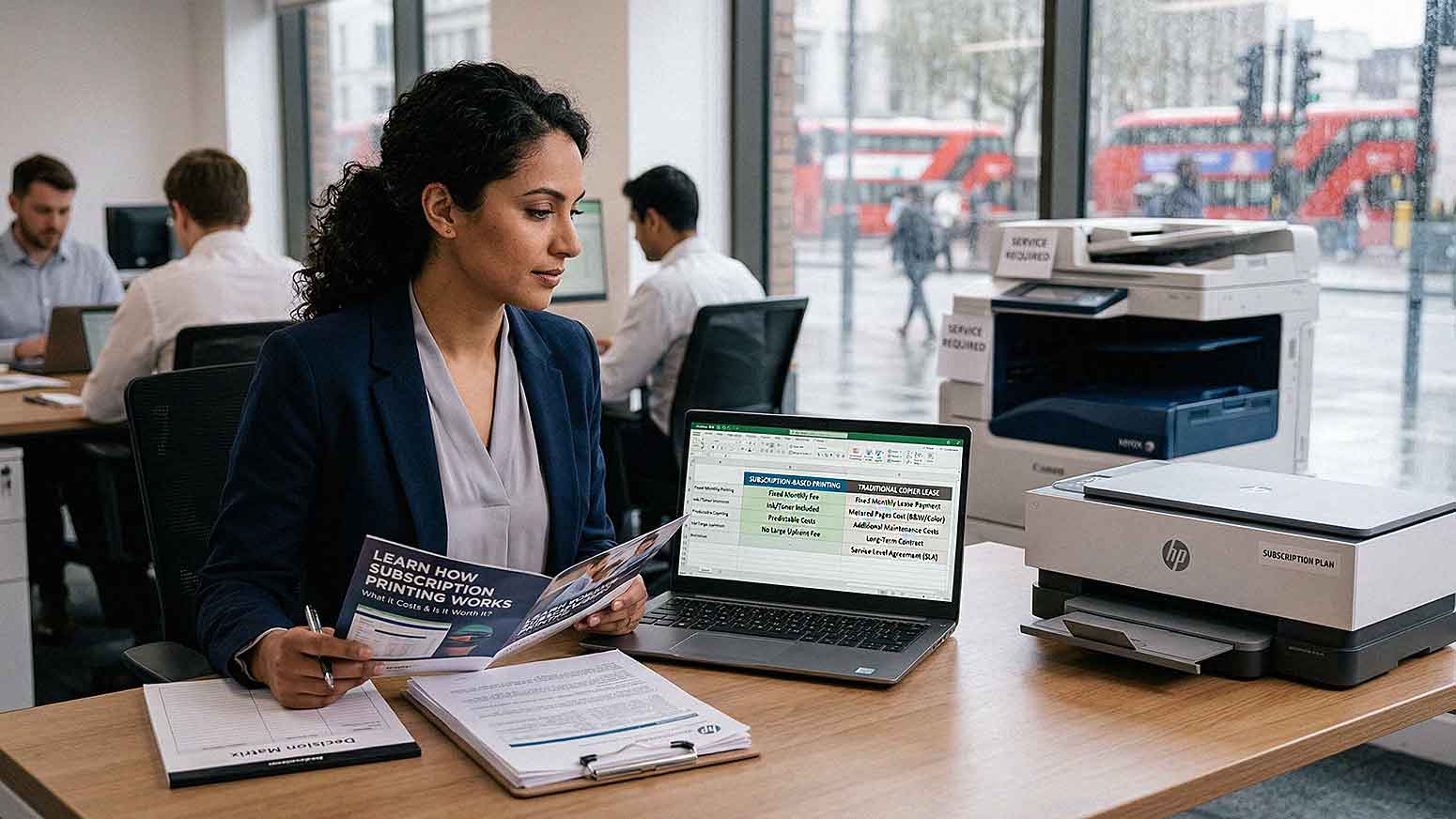
Businesses are rethinking how they pay for office technology. High upfront costs and rigid multi-year leases feel less attractive when flexible, subscription-based models have become the norm for software, phones, and cloud services. It only makes sense that printing would follow the same path.
Subscription-based printing offers a predictable monthly fee that bundles equipment, service, and supplies into one plan. It sounds simple. But the real question is whether it actually delivers value for *your* business — compared to traditional leasing or managed print services — or whether the simplicity comes with trade-offs that cost you more over time.
This article answers that question honestly. We'll walk through what subscription printing includes, who it works best for, where the hidden costs tend to appear, and how to decide if it's the right move in 2026.
What Is Subscription-Based Printing
Subscription-based printing is a model where businesses pay a recurring monthly fee for their printing services. That fee typically covers:
- Printer or copier equipment
- Maintenance and service
- Toner and supplies
- A set number of printed pages per month
Instead of paying separately for each component — equipment lease here, service contract there, toner order somewhere else — everything is combined into one recurring payment. The goal is simplicity.
This model overlaps with managed print services (MPS), but isn't identical. Subscription printing tends to be marketed with more straightforward, consumer-friendly pricing. Managed print services often go deeper — auditing your entire print environment, optimizing device placement, and tracking usage across departments. Both are worth understanding before you decide.

How Subscription Printing Differs From Traditional Leasing
Traditional copier leases and subscription models share some DNA, but the experience is quite different in practice.
Subscription-based printing typically offers:
- Bundled pricing for equipment and usage
- Shorter or more flexible contract terms
- A single, simplified monthly bill
- Automatic toner replenishment in many plans
Traditional leases often involve:
- A separate equipment lease agreement (often 36–60 months)
- A separate service and maintenance contract
- Cost-per-page billing that fluctuates with volume
- More negotiating and vendor coordination upfront
The subscription model wins on simplicity. But "simple" doesn't always mean "cheaper." The details of what's included — and what triggers overage charges — matter a lot.
What's Typically Included in a Printing Subscription
Most subscription plans include a core set of services. You can generally expect:
- Equipment usage (the printer or copier itself)
- Toner or ink replacement
- Routine preventive maintenance
- Service and technical support
- A monthly page allowance
Some plans, especially those positioned as managed print services, also include:
- Remote device monitoring
- Automatic supply replenishment triggered by usage data
- Monthly or quarterly usage reporting
- Help desk support
- Fleet management across multiple devices or locations
Understanding exactly what's in your plan is the most important step before signing anything. Two plans priced at the same monthly rate can include very different levels of service.
The Pros of Subscription-Based Printing
Predictable Monthly Costs
This is the headline benefit — and it's a real one. Fixed monthly payments make budgeting easier. There are no surprise toner orders, no unexpected service calls billed separately, and no quarterly invoices that require explanation. For small and mid-sized businesses that want clean, predictable operating expenses, that simplicity has genuine value.
Research from McKinsey & Company supports this: companies that shift to subscription models benefit from more predictable, renewable cost structures — and vendors who deliver services at scale through a shared platform can pass operational efficiency on to customers. That's the theory behind subscription printing working in your favor.
Simplified Management
Bundled services reduce the administrative overhead of managing printing. Instead of juggling multiple vendors, contracts, and invoices, you have:
- One invoice each month
- Automatic supply management (no one has to remember to order toner)
- A single point of contact for service issues
For businesses without a dedicated IT team or office manager handling technology, this is a meaningful time-saver.
Lower Upfront Investment
Subscription models typically eliminate large upfront equipment costs. You can access modern, high-quality printers or multifunction copiers without a capital expenditure. That matters for
- Businesses preserving cash flow for other priorities
- Growing companies that don't want to own depreciating hardware
- Organizations that prefer operating expenses over capital expenses for accounting purposes
This can be especially useful for startups, expanding teams, or businesses opening a new location.
Access to Current Technology
Because the equipment is part of the subscription, many providers upgrade devices at natural intervals. You're less likely to be stuck on outdated hardware as your needs evolve.
The Cons of Subscription-Based Printing
Potential for Higher Long-Term Costs
Predictability and total cost are not the same thing. When you add up monthly payments over three to five years, subscription-based printing can cost more than a traditional lease — especially if your print volume is high and stable.
This is worth running the numbers on before you commit. A simple spreadsheet comparing total cost of ownership over 36 or 60 months, including estimated overages, will tell you a lot.
Overage Charges Can Add Up Fast
Most subscription plans include a monthly page allowance. If you exceed it, you pay per additional page. Those overage rates vary widely by provider, and they can accumulate quickly if your print volume spikes — around a big project, an event, or a busy quarter.
Monitoring usage consistently is still important, even with a subscription plan. If you're regularly going over your allowance, it's worth renegotiating your plan tier rather than absorbing ongoing overage fees.
Not All Plans Are Flexible
The word "subscription" implies flexibility, but not every plan delivers it. Some agreements include:
- Fixed device options with limited room to upgrade
- Restrictions on where or how equipment can be used
- Early termination fees if your needs change
- Limited customization for businesses with specific workflows or high-volume requirements
Read the contract carefully. A plan that works well for a 10-person office may not scale cleanly to a 50-person team.
You're Dependent on the Provider
With a subscription model, you're trusting the provider to deliver supplies, service, and support consistently. If response times are slow or supply shipments are delayed, your business feels it. This makes choosing the right provider — one with a strong local service presence — critically important.
When Subscription-Based Printing Makes Sense
Subscription models tend to be the right fit when:
- Your print volume is predictable and stays within a consistent range month to month
- You want simplified billing and fewer vendors to manage
- You prefer operating expenses over capital expenditures
- You lack internal resources to manage supplies, maintenance, and service coordination
- You're a growing business that doesn't want to own hardware as your needs change
For many small and mid-sized businesses, the combination of convenience, predictability, and lower upfront investment makes subscription printing genuinely worthwhile.
When Traditional Models or Managed Print Services May Be a Better Fit
Subscription printing isn't the right answer for everyone. Consider a traditional lease or a more structured managed print services agreement when:
- Your print volume is high and stable — the economics of a traditional cost-per-page model may be more favorable
- You need custom configurations — specialized workflows, high-volume production printing, or industry-specific requirements may not fit neatly into subscription tiers
- You want granular control over equipment, service levels, and contract terms
- You manage multiple locations and need a coordinated fleet strategy
- You want a deeper audit of your full print environment before committing to a model
A managed print services provider can assess your actual usage, identify waste, and recommend the model — subscription, lease, or hybrid — that makes the most financial sense for your situation specifically.
How to Evaluate a Subscription Printing Plan Before You Sign
If you're leaning toward a subscription model, here's what to look at closely before committing:
- What exactly is included? Get a line-by-line breakdown. Don't assume supplies and maintenance are covered just because the plan sounds all-in.
- What is the monthly page allowance? Compare it honestly against your actual print volume — not your best-month volume.
- What are the overage rates? Calculate what your bill looks like if you go 20% or 30% over your allowance.
- What are the contract terms? Look for flexibility, upgrade options, and termination clauses.
- What does service look like? Ask about response times, local technician availability, and how support requests are handled.
- Who is the equipment from? Reputable brands like Xerox, Kyocera, and HP offer reliable hardware with strong support ecosystems.
What AIS Offers
At AIS, we work with small and mid-sized businesses across Las Vegas, Southern California, and surrounding regions to find the right printing model — not just the easiest pitch. Whether that's a subscription-based plan, a traditional lease, or a fully managed print services agreement, we start with your actual usage and business goals.
We partner with industry-leading brands including Xerox, Kyocera, and HP to provide equipment that fits a range of environments, from small offices to multi-location operations. Our team handles service, supplies, and support — and because we're local, response times are real, not theoretical.
Our clients stay with us for an average of 7+ years, and we hold a 96% Net Promoter Score — the highest in North America for client satisfaction in our category. That's not because we oversell. It's because we match businesses with solutions that actually work for them.
If you're evaluating your printing setup and aren't sure which model fits best, schedule a free consultation and we'll walk through it with you.
Frequently Asked Questions About Subscription-Based Printing
What's the difference between subscription-based printing and managed print services?
Subscription-based printing typically refers to a bundled monthly plan that covers equipment, toner, and a page allowance — often with simpler, fixed pricing. Managed print services (MPS) goes further: it usually includes an audit of your existing print environment, optimization recommendations, fleet management across multiple devices, and more customized service levels. The two models overlap, but MPS tends to be more tailored to larger or more complex environments.
Is subscription-based printing cheaper than buying a printer outright?
It depends on how long you keep the printer and how much you print. Buying equipment outright has lower long-term costs if you maintain it well and your needs stay consistent. Subscription models tend to cost more in total over several years but eliminate upfront costs and shift maintenance responsibility to the provider. For many businesses, the trade-off in convenience and predictability is worth it.
What happens if I exceed my monthly page allowance?
Most plans charge a per-page overage fee. The rate varies by provider and plan, but overage costs can add up quickly if you're regularly printing more than your allowance covers. It's worth tracking your actual print volume before selecting a plan tier — and revisiting your plan if you're consistently going over.
Can I upgrade my equipment mid-subscription?
This depends on your contract. Some subscription plans include equipment refresh options at certain intervals or allow upgrades for a fee. Others are more rigid. Always ask about upgrade paths and any associated costs before signing.
Are subscription printing plans available for businesses with multiple locations?
Yes, though the complexity increases. Some providers offer multi-site subscription plans that cover fleets across locations with centralized billing and management. This is worth asking about directly, especially if you have more than one office or anticipate expanding.
What brands of printers are typically available through subscription plans?
Major manufacturers including HP, Xerox, and Kyocera offer equipment through subscription and managed print arrangements. HP's Instant Ink program, for example, offers plans starting at $1 per month for low-volume personal or small office use, scaling up from there. Business-grade subscription plans through providers like AIS typically feature commercial-grade multifunction devices from Xerox, Kyocera, or HP.

How do I know if a subscription plan is the right fit for my business?
Start with your actual print volume — not an estimate, but real data if you have it. Then compare the total cost of a subscription plan against a traditional lease over 36–60 months, factoring in likely overages. If the numbers are close and the convenience matters to you, a subscription makes sense. If you print a high, consistent volume and want maximum control, a traditional model or managed print services agreement may serve you better.
The Bottom Line
Subscription-based printing is a legitimate and often smart option for small and mid-sized businesses that want predictable costs, simplified management, and lower upfront investment. It's not the right fit for every situation — high-volume operations, complex workflows, or businesses that want maximum control may find better value elsewhere.
The most important thing is making the decision based on your actual usage and total cost of ownership, not just the appeal of a simple monthly number.
If you want a straightforward conversation about which printing model makes sense for your business, contact AIS today or schedule a free consultation. We'll look at what you're actually printing, what you're currently paying, and where there's room to do better.
Topics:
