

VoIP phone systems are often sold as a cost-saving alternative to traditional phone service. And honestly, for most businesses, the savings are real — especially in year one. You cut the cord on legacy hardware, consolidate your communication tools, and watch your monthly telecom bill drop.
Then something shifts.
A year or two in, you start noticing the bill is a little higher than it used to be. Nobody made one big decision that caused it. There was no single invoice that looked alarming. Instead, costs crept up slowly through small additions, plan adjustments, usage growth, and fees that were easy to overlook.
This is one of the most common frustrations businesses share when they talk to us about their telecom setup. Understanding exactly what drives VoIP pricing higher over time puts you back in control. This article breaks it down clearly so you can plan better, audit smarter, and choose a provider that offers transparency rather than confusion.
How VoIP Pricing Is Actually Structured
Before you can understand what drives costs up, it helps to understand how VoIP pricing is built in the first place.
Most VoIP services use a per-user or per-seat pricing model. Each user gets a base set of calling features and a domestic usage allowance. According to TechRepublic, typical VoIP pricing in 2026 runs around $25 per seat per month, though you'll find plans ranging from $10 to $40 depending on the features included and the provider you choose.
For context, Forbes notes that some entry-level plans — like Zoom Phone's starting tier — begin as low as $16–$18 per user per month on annual contracts. Enterprise-grade platforms with advanced analytics, call center features, or deep CRM integrations often push closer to $35–$40 per seat.
That base price typically includes:
- Per-user licenses
- Call routing and voicemail
- Domestic calling allowances
- Basic support
What it often does not include is just as important. International calling, premium support, advanced features, hardware, and regulatory fees are frequently separate. And that's where the real story begins.
8 Reasons Your VoIP Pricing Increases Over Time
1. Adding Users Without Reviewing Your Plan
Growth is a good problem to have. But every new hire added to your phone system increases your monthly cost. That math is straightforward. What catches businesses off guard is what happens over time when users are added but never removed.
Former employees, temporary contractors, and seasonal workers all accumulate as inactive users on your account. Most VoIP providers keep billing for those seats until you explicitly cancel them.
What you can do: Schedule a quarterly user audit. Cross-reference your phone system licenses against active HR records. Even finding two or three ghost users on a $25/seat plan saves $75 a month — $900 a year — without changing anything else.
2. Feature Creep
VoIP platforms are feature-rich by design. Call recording, advanced analytics, call queues, auto-attendants, mobile apps, CRM integrations, SMS capabilities — these are often sold as optional add-ons at an extra monthly cost per user.
Here's how feature creep works in practice: A manager asks for call recording to help with training. A couple months later, someone requests a call queue for the front desk. Then the sales team wants CRM integration. Each request makes sense individually. Each one adds $2–$8 per user per month.
Over 18 months, you've added five features you requested for good reasons. But are all five still actively used? Probably not.
What you can do: Build a simple feature usage log. Before renewing or expanding your contract, review which add-ons are actually generating value. Remove what you don't use. A six-month check-in with your account manager should include this conversation.
3. Higher Call Volume and Usage Overages
Many VoIP plans include domestic calling within defined usage limits. As your team grows and your business activity increases, call volume naturally follows. That growth can push you into:
- Overage charges on per-minute or metered plans
- Higher-tier usage plans that cost more than your original tier
- Automatic tier bumps that some providers apply without clear notice
International calling adds another layer of variability. Rates vary significantly by destination country and carrier. Without monitoring usage reports regularly, international charges can climb fast and quietly.
What you can do: Pull your usage reports monthly — not quarterly. Align your plan tier with actual average usage rather than low-end estimates. If your team regularly exceeds a plan's allowances, it's usually more cost-effective to move up to the next tier proactively rather than absorb recurring overage fees.

4. Carrier Fees and Regulatory Charges
Even the most modern cloud-based VoIP platforms rely on underlying telecom carrier infrastructure. Those carriers face their own cost pressures — regulatory fees, network maintenance, compliance requirements — and those costs get passed downstream.
You'll typically see these as line items on your invoice labeled things like:
- Federal Universal Service Fund (USF) contributions
- E911 service fees
- State and local telecom surcharges
- Regulatory recovery fees
These charges are usually small on a per-user basis — often $1–$4 per seat — but they're not controlled by your VoIP provider directly, and they do tend to increase incrementally over time. Across a 50-person organization, that adds up.
What you can do: Don't ignore the line items below the main charges on your invoice. Ask your provider for a plain-language explanation of each fee. Reputable providers will walk you through every charge without hesitation.
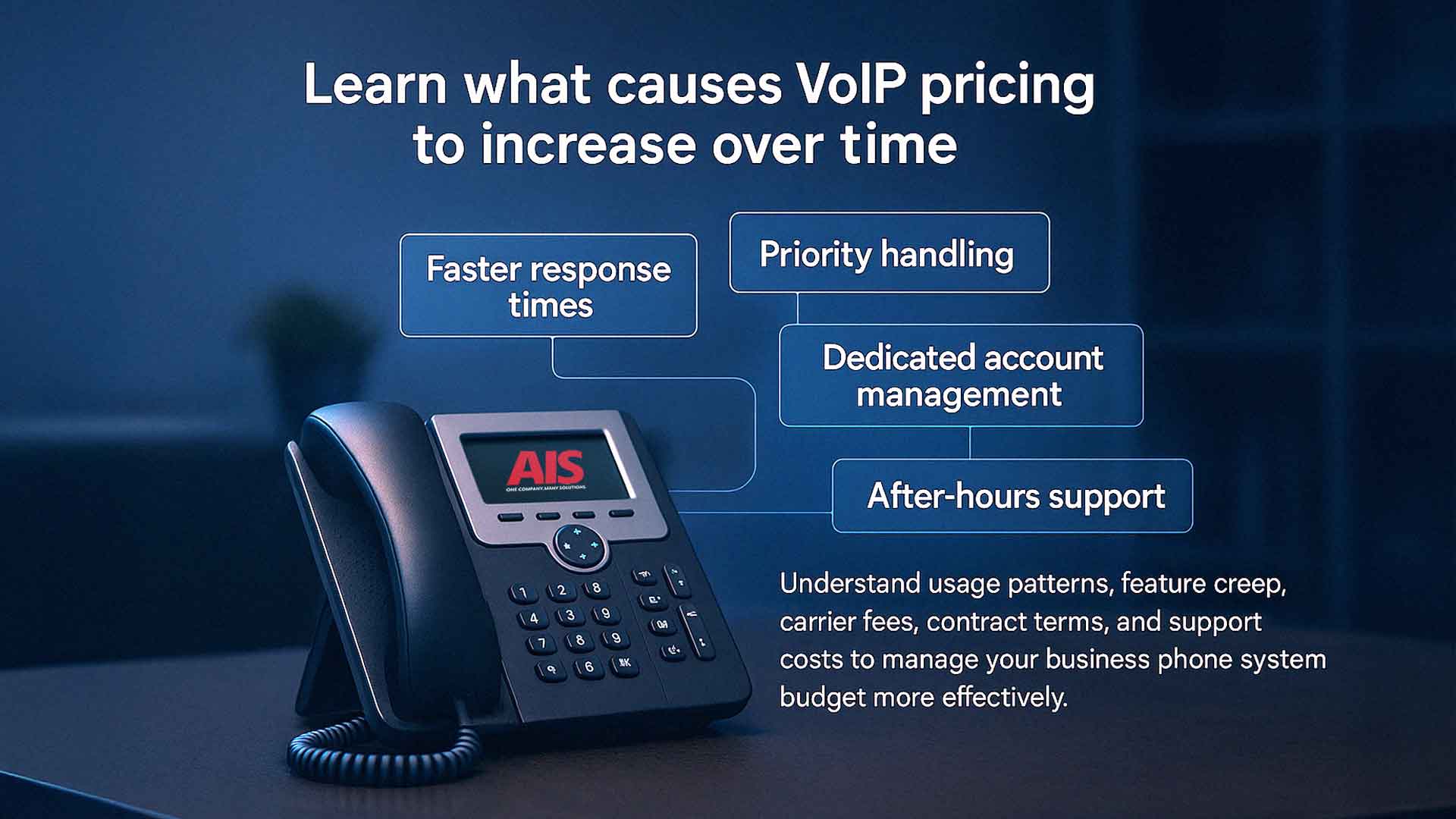
5. Support and Service Level Upgrades
Standard support is included in most base VoIP plans. But as your business becomes more dependent on your phone system, the tolerance for downtime drops — and so does patience with slow support response times.
Businesses often upgrade their support tier to gain:
- Faster response time guarantees
- Priority ticket handling
- A dedicated account manager
- After-hours and weekend coverage
These upgrades improve reliability and reduce the cost of disruption. But they do increase monthly costs. The key question to ask is whether the upgrade aligns with how mission-critical your phone system actually is.
If your team spends significant time on client calls and a phone outage means lost revenue, premium support pays for itself quickly. If your VoIP system is primarily internal, standard support may be sufficient.
6. Hardware and Device Changes
VoIP pricing conversations often focus entirely on the software subscription. But hardware has its own cost lifecycle.
Over time, hardware costs can increase through:
- Device replacements when phones fail or become outdated
- New model pricing that has increased since your original purchase
- Warranty and maintenance extensions
- Provisioning fees for setting up new devices
- Adapter costs for conference rooms or shared workspaces
Desk phones from leading providers like Intermedia or RingCentral-compatible devices can range from $80 to $400+ per unit depending on the model and features. A growing team that adds ten new workstations a year is looking at real hardware spend on top of software licensing.
What you can do: Build hardware refresh costs into your annual technology budget rather than treating them as surprise expenses. Ask your provider about device leasing programs or bundled hardware options that smooth those costs out over time.
7. Contract Renewals at Higher Rates
Many businesses sign initial VoIP contracts with introductory or promotional pricing. When the contract renews — typically after 12 or 24 months — the pricing resets to standard rates.
Unless you actively renegotiate, you're likely moving from a promotional rate to a higher standard rate at renewal. This is one of the sneakiest ways VoIP costs increase because the change is entirely predictable if you read the contract, but easy to miss if you don't.
What you can do: Flag your contract renewal date when you sign. Set a calendar reminder 90 days before renewal so you have time to review your usage, compare options, and negotiate from a position of knowledge rather than a position of inertia.
8. Platform and Ecosystem Expansion
Modern VoIP platforms don't just handle calls. They increasingly serve as unified communications hubs connecting voice, video, messaging, and integrations with tools like Microsoft Teams, Salesforce, and your CRM.
As your business adopts more of these integrations and communication channels, the cost of the platform expands to match. That expansion usually delivers real value — but it also means comparing your current bill to your original quote and wondering where the difference went.
Understanding that VoIP pricing naturally scales with usage and capability helps set expectations early. The goal is to make sure the value you're receiving grows proportionally to the cost — not just the cost.
What Transparent VoIP Pricing Looks Like
The best VoIP relationships are built on transparency, not confusion. When you work with a provider who prioritizes your long-term satisfaction, you should expect:
- Clear invoices with plain-language explanations of every charge
- Proactive usage reviews before you hit overage thresholds
- Regular account check-ins — not just when something breaks
- Honest renewal conversations that give you enough time to make good decisions
- Dedicated account management so you always have someone who knows your account
AIS clients benefit from exactly this kind of relationship. With a 96% NPS score and an average client relationship of over 7 years, our approach is built on long-term partnership — not transactional sales. We work with leading telecom platforms including Intermedia and RingCentral to match businesses with solutions that fit both their current needs and their growth trajectory.
Frequently Asked Questions About VoIP Pricing
How much does VoIP typically cost per user in 2026?
Most businesses pay between $20 and $40 per user per month for a full-featured VoIP plan. Entry-level or basic plans can start around $10–$18 per user, while enterprise-tier plans with advanced features, analytics, and integrations can exceed $40 per seat. TechRepublic pegs the average around $25 per seat as a reasonable planning benchmark.
Why is my VoIP bill higher than my original quote?
The most common reasons are added users, feature add-ons, usage overages, and regulatory fees that weren't included in the original per-seat quote. Your original quote likely reflected base license costs only. A full invoice includes carrier fees, taxes, and any premium support or features you've added over time.
Can I negotiate VoIP pricing at renewal?
Yes — and you should. Contract renewals are the best opportunity to renegotiate pricing, remove unused features, and right-size your plan. Going into a renewal without reviewing your usage data is one of the most common ways businesses end up overpaying. Set a 90-day reminder before your contract ends so you have leverage.

What are the most common "hidden" VoIP fees?
Watch for Federal USF contributions, E911 fees, state and local surcharges, regulatory recovery charges, and device provisioning fees. These are usually small per-user charges but they're real costs that add up at scale. A transparent provider will explain each one clearly.
Is VoIP still cheaper than a traditional phone system?
For most SMBs, yes — VoIP is still a more cost-effective option than maintaining legacy PBX hardware and traditional phone lines. The key is actively managing your VoIP plan over time rather than assuming cost savings are automatic. Left unmanaged, a VoIP plan can become surprisingly expensive as users, features, and usage grow.
How often should I review my VoIP plan?
At a minimum, conduct a quarterly user and feature audit to remove inactive accounts and unused add-ons. Do a more thorough plan review at least 90 days before your annual contract renewal. If your business is growing or changing significantly, review more frequently.
What should I look for in a VoIP provider to avoid pricing surprises?
Look for providers who offer transparent, itemized invoicing, proactive account management, and a willingness to explain every line item. Ask about renewal pricing before you sign the initial contract. Working with a local provider or managed services partner — rather than a purely online platform — gives you access to a real person who knows your account and can advocate for your interests at renewal time.
The Bottom Line on VoIP Pricing Over Time
VoIP pricing increases are rarely the result of one bad decision. They're usually the cumulative result of small, reasonable choices made over months and years — adding a feature here, a user there, upgrading support when something breaks.
The businesses that keep their VoIP costs under control aren't the ones who signed the best initial deal. They're the ones who actively manage their platform, review usage regularly, and work with a provider who treats them as a long-term partner rather than a recurring transaction.
If your VoIP bill has been climbing and you're not sure why, or if you're approaching a contract renewal and want a clear picture of whether you're getting the right value — we'd love to help.
Schedule a Free Consultation with the AIS team and let's take a hard look at what you're paying, what you're actually using, and where a smarter setup could save you money.
Or if you'd prefer to reach out directly, Contact AIS Today — our team is ready to help.
Topics:
