In many organizations, IT and business leadership operate in completely separate conversations. IT talks about firewalls, backups, servers, and cloud migrations. Leadership talks about revenue, margins, customer retention, and growth targets. Neither group is wrong—but when these conversations don't connect, technology spending gets classified as overhead instead of investment.
That's a costly misclassification.
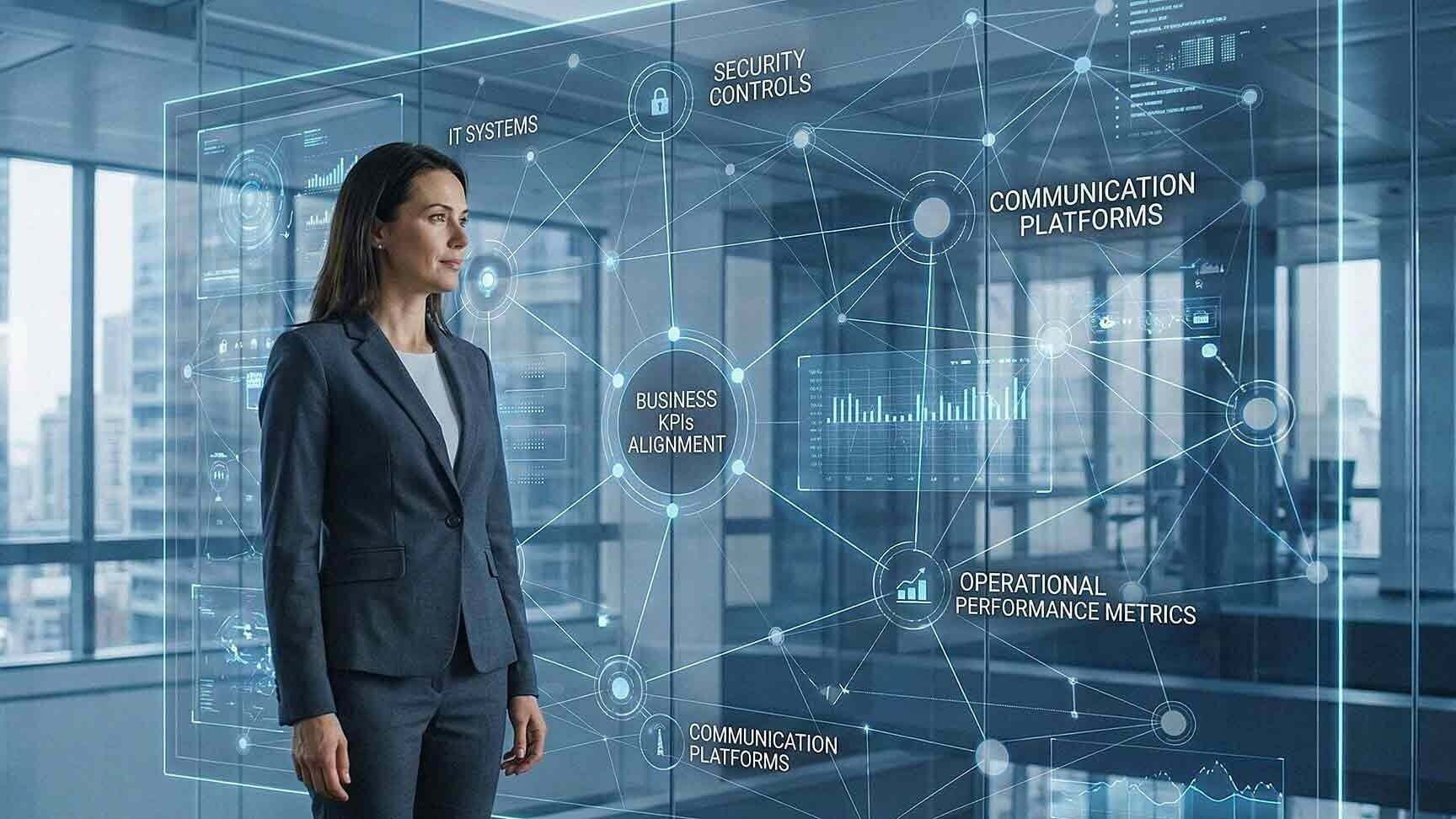
The connection between IT strategy and business KPIs determines whether your technology drives measurable results or simply keeps the lights on. Understanding that connection changes how you budget, how you plan, and how you evaluate every technology decision your organization makes.
According to Gartner, CIOs who fail to link KPIs and IT metrics to business outcomes risk losing both influence and funding. That's not just a leadership problem—it's a strategic one that affects the entire organization.
What Are Business KPIs?
Key Performance Indicators, or KPIs, measure how effectively your business achieves its goals. They give leadership a clear, quantifiable view of performance across every function.
Common business KPIs include:
- Revenue growth
- Gross margin
- Customer acquisition cost
- Customer retention rate
- Employee productivity
- Operational efficiency
- Downtime frequency
- Security incident rate
- Time-to-market for new products or services
Technology directly influences many of these metrics—even when the connection isn't immediately obvious. A slow network affects employee productivity. A data breach affects customer retention. An outdated phone system affects revenue. The thread runs through all of it.
What Is an IT Strategy?
An IT strategy defines how technology supports your business objectives over time. It's not a list of tools you're currently using. It's a forward-looking plan that connects infrastructure decisions to real business outcomes.
A structured IT strategy typically includes:
- Infrastructure planning and lifecycle management
- Cybersecurity controls and risk management
- Software selection and application roadmaps
- Budget forecasting and cost optimization
- Vendor management and service level accountability
- Scalability planning for growth
When your IT strategy is deliberately aligned with business KPIs, technology investments stop being line items and start becoming measurable contributors to growth and stability. Without that alignment, you're essentially flying blind—spending on technology without a clear picture of what return you're getting.
How IT Strategy Directly Impacts Revenue Growth
Revenue depends on speed, reliability, and communication. Your customers need to reach you. Your team needs to move fast. Your systems need to stay up.
A well-structured IT strategy supports revenue growth through:
- Reliable systems that prevent downtime during peak sales periods
- Scalable phone and communication platforms that handle increased call and message volume without dropped connections or missed opportunities
- Secure customer data management that protects trust and avoids breach-related revenue loss
- Fast internal collaboration tools that reduce time wasted on back-and-forth communication
Here's a concrete example. If your systems crash during peak sales hours, every minute of downtime has a dollar value attached to it. If a security incident exposes customer data, the financial fallout goes far beyond the immediate response costs—it erodes the trust that drives repeat business and referrals.
A mature IT strategy reduces this operational friction before it has a chance to affect your top line.
IT Strategy and Operational Efficiency KPIs
Operational efficiency measures how effectively your organization uses its resources. It's one of the KPIs most directly influenced by your technology choices—and one of the most measurable.
IT strategy improves efficiency by:
- Automating repetitive tasks that consume employee time without creating value
- Standardizing systems across departments to reduce training time and support burden
- Reducing manual processes that introduce error and slow down workflows
- Improving integration between platforms so data flows automatically instead of being re-entered by hand
Consider a business running three separate platforms that don't talk to each other. Employees manually move data between systems, make errors, and spend hours on reconciliation. Aligning those systems—or replacing them with integrated alternatives—can cut that labor cost significantly and improve the accuracy of the data leadership uses to make decisions.
Efficiency improvements like these directly affect cost-per-transaction and margin KPIs, two metrics leadership cares about deeply.
The Link Between IT Strategy and Downtime Metrics
Downtime is one of the most direct and measurable connections between IT and business performance. If your KPIs include uptime percentage or operational availability, your IT strategy is either helping you hit those targets or holding you back from them.
Proactive IT strategy addresses downtime through:
- 24/7 monitoring and alerting so problems are caught before they cascade
- Redundant systems that keep operations running when a component fails
- Backup and disaster recovery planning that defines exactly how fast you can restore operations after an incident
- Hardware lifecycle management that replaces aging equipment before it fails at the worst possible time
The National Institute of Standards and Technology (NIST) notes that structured risk management frameworks significantly reduce operational disruption and security exposure. Organizations that adopt proactive IT practices rather than reactive break-fix approaches see measurable improvements in uptime and a corresponding improvement in productivity and customer satisfaction KPIs.
Every hour of unplanned downtime carries a cost—in lost productivity, missed transactions, and employee frustration. Reducing that exposure isn't just an IT win. It's a business win.
Cybersecurity and Risk-Based KPIs
Security incidents don't just create IT headaches. They create financial and reputational consequences that show up directly in your business metrics.
Risk-related KPIs your leadership may already be tracking include:
- Number of security incidents per quarter
- Mean time to detect and respond to threats
- Compliance audit outcomes
- Data breach frequency and severity
- Cyber insurance premium trajectory
An effective IT strategy addresses these metrics through:
- Multi-factor authentication (MFA) to reduce unauthorized access
- Endpoint detection and response (EDR) tools that identify threats in real time
- Patch management that closes vulnerabilities before they're exploited
- Security awareness training that reduces the risk of phishing and social engineering
- Regular backup testing to confirm recovery is actually possible when needed
Without structured security planning, risk-related KPIs trend in the wrong direction. And in 2026, the cost of a data breach—averaging over $4.8 million globally according to IBM's Cost of a Data Breach Report—makes cybersecurity an undeniable business priority, not just an IT one.
Employee Productivity and Technology Alignment
Employee productivity is one of the most sensitive KPIs when it comes to technology. Slow systems, unreliable access, and poor collaboration tools don't just frustrate employees—they add up to hours of lost output every week, across every team in your organization.
IT strategy affects productivity through:
- Reliable network performance that doesn't bottleneck work
- Cloud accessibility that gives employees what they need from wherever they're working
- Remote and hybrid work enablement with secure, seamless access
- Standardized devices that reduce configuration issues and IT support tickets
- Clear, responsive support processes so problems get solved fast instead of lingering
If employees spend 30 minutes a day waiting for systems to load, dealing with connectivity issues, or waiting on IT support, that's measurable lost time. For a team of 50 people, that's 25 person-hours daily—time that isn't going toward revenue-generating activity.
An aligned IT strategy removes these obstacles systematically. CIO.com notes that ROI continues to be the central metric associated with technology transformation—and employee productivity is one of the clearest places that ROI shows up.
How to Start Aligning IT Strategy with Business KPIs
If your IT strategy and business KPIs are currently running as separate conversations, here's a practical path to bring them together.

1. Map Your Top Business KPIs to Technology Dependencies
Start by identifying which KPIs matter most to leadership. Then work backward to identify which systems, processes, and people support—or threaten—those metrics.
2. Audit Your Current IT Environment
Understand what you have, what's working, and where gaps exist. An honest audit often reveals legacy systems, unpatched vulnerabilities, and redundant tools that are quietly costing you performance.
3. Set Technology Benchmarks That Mirror Business Goals
If your business goal is to reduce customer churn by 10%, your IT benchmark might be 99.9% uptime on customer-facing systems. If your goal is to improve employee productivity, your benchmark might be reducing IT support ticket resolution time.
4. Build a Roadmap, Not Just a Maintenance Plan
IT strategy should include a forward-looking roadmap—not just a schedule for replacing equipment when it breaks. What capabilities do you need in 12 months? 36 months? What investments support those capabilities?
5. Review Regularly
Business goals shift. Technology evolves. Your IT strategy should be reviewed at least annually—ideally quarterly—to ensure alignment hasn't drifted.
Working With a Managed IT Partner to Drive KPI Alignment
Most small and mid-sized businesses don't have the internal resources to manage IT strategy at this level of depth. That's where a managed IT partner changes the equation.
A strong managed IT services provider doesn't just keep your systems running. They help you connect your technology decisions to your business outcomes—bringing strategic thinking to conversations that used to stop at "the server is back up."
At AIS, we work with SMBs across Las Vegas, Southern California, and surrounding regions to build IT strategies that map directly to the business metrics our clients care about. With a 96% NPS score and an average client relationship of over seven years, our approach is built on accountability, transparency, and measurable results—not just managed maintenance.
We offer 24/7 local support with dedicated account managers who know your business, your goals, and your technology environment. That continuity means your IT strategy actually evolves with your business instead of drifting behind it.
Frequently Asked Questions: IT Strategy and Business KPIs
What is the difference between IT metrics and business KPIs?
IT metrics measure the performance of technology systems—uptime, ticket resolution time, patch compliance. Business KPIs measure overall business health—revenue, retention, efficiency. The goal is to connect these two layers so that IT investments can be evaluated in terms of business outcomes, not just technical benchmarks.
How do I know if my IT strategy is aligned with my business goals?
A simple test: ask your IT team or provider to explain how their current priorities connect to your top three business objectives. If they can't make that connection clearly, alignment is likely missing. A well-aligned IT strategy should be able to show how each initiative supports a specific business outcome.
What role does cybersecurity play in business KPIs?
Cybersecurity directly affects KPIs related to risk, compliance, and operational continuity. A security incident can damage customer retention, increase operational costs, and create regulatory consequences. Organizations that invest in proactive security see better outcomes across all of these metrics.
How often should an IT strategy be reviewed?
At a minimum, your IT strategy should be reviewed annually. However, quarterly check-ins are more effective, especially in environments where business goals or technology options are changing rapidly. Major business events—acquisitions, expansions, significant headcount changes—should also trigger a strategic review.
Can a small business benefit from IT strategy alignment, or is this only relevant for enterprises?
IT strategy alignment matters at every size. In fact, small and mid-sized businesses often have more to gain because they typically have fewer resources to absorb the cost of misaligned technology spending or unexpected downtime. A focused IT strategy helps SMBs get more value from limited budgets.
What KPIs should I prioritize when building an IT strategy?
Start with the KPIs that leadership already tracks and cares about most. Common starting points include uptime and availability, employee productivity, security incident rates, and operational efficiency metrics. From there, map each one to the technology dependencies that influence it.

How does a managed IT services provider help with KPI alignment?
A managed IT provider brings external expertise, monitoring tools, and strategic planning capabilities that most SMBs don't have in-house. The best providers act as a strategic partner—connecting technology decisions to business outcomes, providing regular reporting, and proactively recommending improvements before problems arise.
Ready to Connect Your IT Strategy to Real Business Results?
If your technology and your business goals feel like separate conversations, it's time to bring them together. AIS works with SMBs across Las Vegas and Southern California to build IT strategies that are accountable to real business outcomes—not just technical checklists.
Schedule a Free Consultation to talk through where your IT strategy stands and where it could be working harder for your business.
Or Contact AIS Today to connect with a dedicated account manager who knows your market and your challenges.
Topics:
