
Your IT team keeps everything running. When systems work, no one notices. When something breaks, everyone notices — and that pressure builds, day after day.
Most internal IT teams are stretched thin. They handle support tickets, security alerts, system maintenance, vendor relationships, and long-term planning. Often all at once, often with the same headcount they had two or three years ago.
Burnout is not just an HR problem. It is an operational problem, a security problem, and a growth problem. If your IT team feels like they are always behind, there is a reason — and it is not because they are not working hard enough.
This article breaks down why IT burnout happens, what it costs your business, and what you can actually do to fix it.
What IT Burnout Actually Looks Like
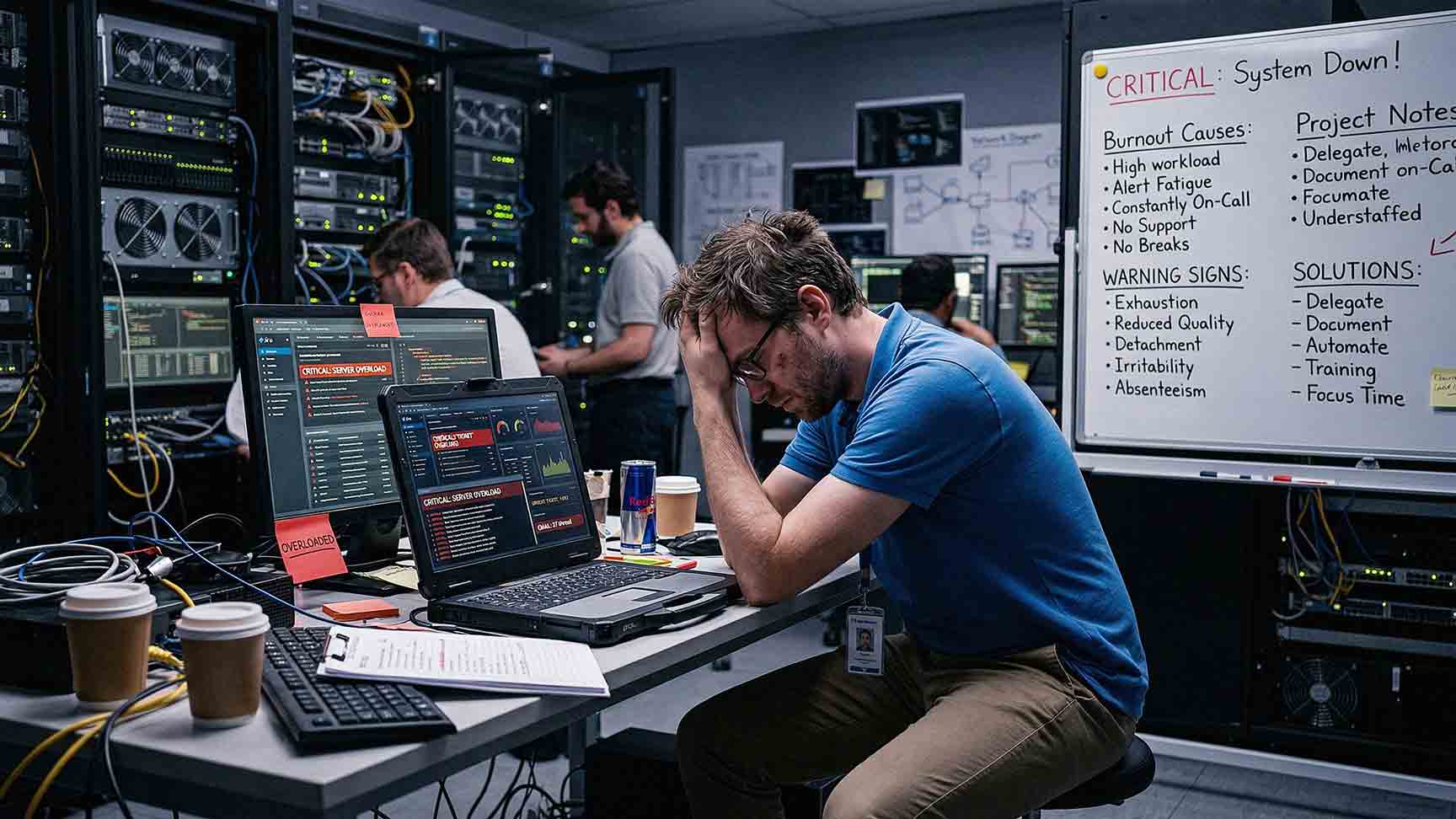
Burnout does not always look like someone walking out the door. More often, it shows up quietly — in ways that are easy to dismiss until they become serious.
Watch for these warning signs:
- Slower response times on support tickets and helpdesk requests
- Repeated problems that never seem to get permanently resolved
- Increased mistakes on routine tasks
- Disengagement from projects or strategic conversations
- Higher turnover on your IT team
- Low morale that starts bleeding into other departments
When your IT team is overwhelmed, performance drops — and that affects everyone in your organization, not just the IT department.

Why Internal IT Teams Burn Out
Burnout rarely has a single cause. It usually builds from several overlapping pressures that compound over time. Here are the most common ones.
Too Many Responsibilities, Too Little Time
Internal IT teams are expected to do it all. On any given day, your IT staff might be:
- Responding to helpdesk tickets
- Managing servers, networks, and cloud infrastructure
- Handling cybersecurity monitoring and incident response
- Supporting new software rollouts or hardware deployments
- Working on long-term planning and budgeting
These responsibilities do not pause for each other. When everything is urgent, nothing gets the focused attention it deserves. Quality suffers, and so does the team.
The Reactive Work Trap
According to the IT Trends 2025 Industry Report from Auvik, 58% of IT professionals say they spend half or more of their work week managing end-user support tickets alone. That is more than half of every week consumed by reactive work — before any strategic or proactive tasks even begin.
This cycle is exhausting. When your team spends most of their time chasing problems, they never get the space to prevent them. And the more issues pile up, the more reactive they become. It feeds itself.
Chronic Understaffing
Some internal IT teams are simply not sized for the work they carry. One or two people may be responsible for an entire business's technology environment. As the company grows, the workload grows — but the team size often does not.
This gap is where burnout accelerates fastest. There is no buffer. Every person on the team is a single point of failure.
High Expectations, Low Visibility
IT is expected to solve problems fast. But when everything is running smoothly, the work is invisible. There are no thank-you emails for the breach that did not happen or the outage that was quietly prevented.
This creates a lose-lose dynamic: problems get noticed, solutions do not. Over time, that pressure without recognition wears people down.
Cybersecurity Never Sleeps
According to a 2026 Forbes Tech Council report, the conventional wisdom that burnout comes from long hours alone misses the bigger picture. The deeper issue is the nature of the work itself — especially in cybersecurity, where the threats change constantly, the stakes are always high, and there is rarely a clean resolution.
IT teams responsible for security are essentially managing a moving target. Ransomware, phishing campaigns, zero-day vulnerabilities — the threat environment does not take weekends off. And most internal IT teams do not have a dedicated security specialist. Everyone carries that weight.
No Clear Strategy or Roadmap
Without a defined IT roadmap, teams operate in survival mode. Decisions get made reactively, not strategically. This leads to:
- Short-term fixes that create long-term problems
- Repeated incidents that were never fully resolved
- Budget decisions made under pressure instead of with planning
- A team that feels like they are never moving forward
When IT is always in firefighting mode, morale erodes — and so does the quality of your technology infrastructure.
The Business Cost of IT Burnout
Burnout does not stay contained in the IT department. It spreads through your entire organization in ways that are hard to see until the damage is done.
More Downtime
An overworked team has less time for preventive maintenance. Small issues go unaddressed. Minor system warnings get ignored. Eventually, those small things become big failures — and the downtime that follows costs far more than prevention would have.
Greater Security Exposure
Cybersecurity tasks — patch management, vulnerability scans, access reviews, threat monitoring — require consistent attention. When your team is overwhelmed, those tasks slip. That increases your exposure to threats that are actively looking for gaps in exactly those areas.
Slower Business Growth
When IT cannot keep pace with business needs, new projects stall. Technology becomes a bottleneck rather than a growth driver. Departments wait on IT for approvals, implementations, and troubleshooting that should move faster.
Frustration Across the Company
When IT is slow to respond, employees across every department feel it. Productivity drops. Frustration builds. And that frustration often gets directed at the IT team — which only makes the pressure worse.
How to Actually Fix IT Burnout
Here is the honest answer: telling your team to work smarter is not a fix. The structural causes of burnout require structural solutions. Here is what actually works.
Shift from Reactive to Proactive IT
The goal is to prevent problems before they interrupt your business. That means:
- Continuous system monitoring that catches issues before users do
- Scheduled preventive maintenance on hardware, software, and network infrastructure
- Automated patch management so updates happen on a schedule, not in a crisis
Proactive IT does not eliminate all incidents, but it reduces them significantly — and that changes the daily experience for your team.
Define Priorities and Set Clear Expectations
Not every task carries the same weight. When your team has clear priorities — and the authority to say "this is not urgent" — they can work more effectively and with less stress.
Build a simple tiering system for requests. Communicate it to the rest of the organization. This reduces the constant pressure of every task feeling equally important.
Invest in the Right Tools
Manual processes burn through time and create errors. Automation, remote monitoring and management (RMM) platforms, and centralized ticketing systems help smaller IT teams handle a higher volume of work without increasing headcount.
The right tools do not replace your team — they give your team leverage.
Build a Real IT Roadmap
A technology roadmap gives your team direction and gives your leadership team visibility. It should include:
- Planned upgrades and hardware refresh cycles
- Budget forecasting for the next 12–36 months
- Defined security milestones
- Goals tied to business growth
A roadmap moves IT from reactive to strategic. It also makes it easier to justify budget requests because decisions are tied to business outcomes rather than emergency situations.
Add Support Through Managed IT Services
One of the most effective ways to reduce burnout is to share the workload with an experienced external partner. Managed IT Services give your internal team:
- 24/7 monitoring and support so your people are not the only safety net
- Dedicated expertise in areas like cybersecurity, compliance, and infrastructure
- Scalable resources that grow with your business without requiring new hires
- Strategic guidance from experienced engineers and account managers
At AIS, we work alongside internal IT teams — not in place of them. Many of our clients have one or two internal staff members who handle day-to-day user support while we manage infrastructure, security, monitoring, and strategic planning. The result is a more sustainable workload and a team that can actually do their best work.
Schedule a Free Consultation to talk about how Managed IT Services from AIS might fit your organization.
Frequently Asked Questions About IT Team Burnout
1. How do I know if my IT team is burned out versus just having a bad week?
Burnout is a pattern, not a moment. If you are seeing slower response times, repeated mistakes, disengagement, or higher turnover over several weeks or months — that is burnout. A bad week looks different: it has a clear cause and bounces back. Burnout does not bounce back on its own without structural change.
2. Can one or two IT employees really handle everything for a small business?
It depends on the size and complexity of your environment. For most growing SMBs, one or two IT staff members can handle day-to-day user support effectively — but they will struggle to also manage infrastructure, cybersecurity, vendor relationships, and strategic planning without additional support. That gap is where Managed IT Services add the most value.
3. Is Managed IT Services a replacement for my internal IT team?
No. Managed IT Services works best as a complement to your internal team, not a replacement. Your internal staff understands your culture, your users, and your day-to-day needs. A managed services partner brings broader technical expertise, 24/7 coverage, and resources that most internal teams cannot provide on their own. Together, the two are more effective than either alone.
4. How does proactive IT monitoring actually reduce burnout?
When your systems are being monitored continuously, many problems get caught and resolved before anyone notices them. That means fewer emergency tickets, fewer late-night calls, and less time spent in crisis mode. Over time, this shifts your team's experience from reactive to productive — which is a significant quality-of-life change.
5. What does an IT roadmap include, and who creates it?
An IT roadmap is a documented plan for your technology environment over the next one to three years. It covers hardware refresh cycles, software upgrades, security improvements, and budget projections. At AIS, our team works collaboratively with your leadership and IT staff to build a roadmap that aligns with your business goals — not just your tech needs.
6. What industries does AIS serve with Managed IT Services?
AIS serves small and mid-sized businesses across a wide range of industries in Las Vegas, Southern California, and surrounding regions. Our clients include professional services firms, healthcare organizations, financial services companies, manufacturing businesses, and more. If you rely on technology to run your business, we can help.

7. How quickly can Managed IT Services make a difference?
Most clients see a measurable difference within the first 30 to 60 days. Monitoring gets set up, recurring issues start getting addressed proactively, and your internal team begins to feel the relief of having backup. The longer-term benefits — fewer incidents, stronger security posture, better planning — build over time as we get to know your environment and your goals.
IT burnout is not a personal failure. It is a structural problem — and it has structural solutions. When your team is carrying more than any small group of people can sustainably manage, the answer is not to push harder. It is to rethink how IT is supported.
Whether that means better tools, clearer priorities, a real technology roadmap, or partnering with a managed services provider, the goal is the same: give your IT team the capacity to do their best work without burning out in the process.
At AIS, we have been helping SMBs build sustainable IT environments for years. We hold a 96% Net Promoter Score — the highest in North America for client satisfaction — and our average client relationship lasts more than seven years. That does not happen by accident. It happens because we treat your IT environment like it is our own.
Schedule a Free Consultation — or Contact AIS Today to talk with a local expert about what your IT team really needs.
Topics:
