
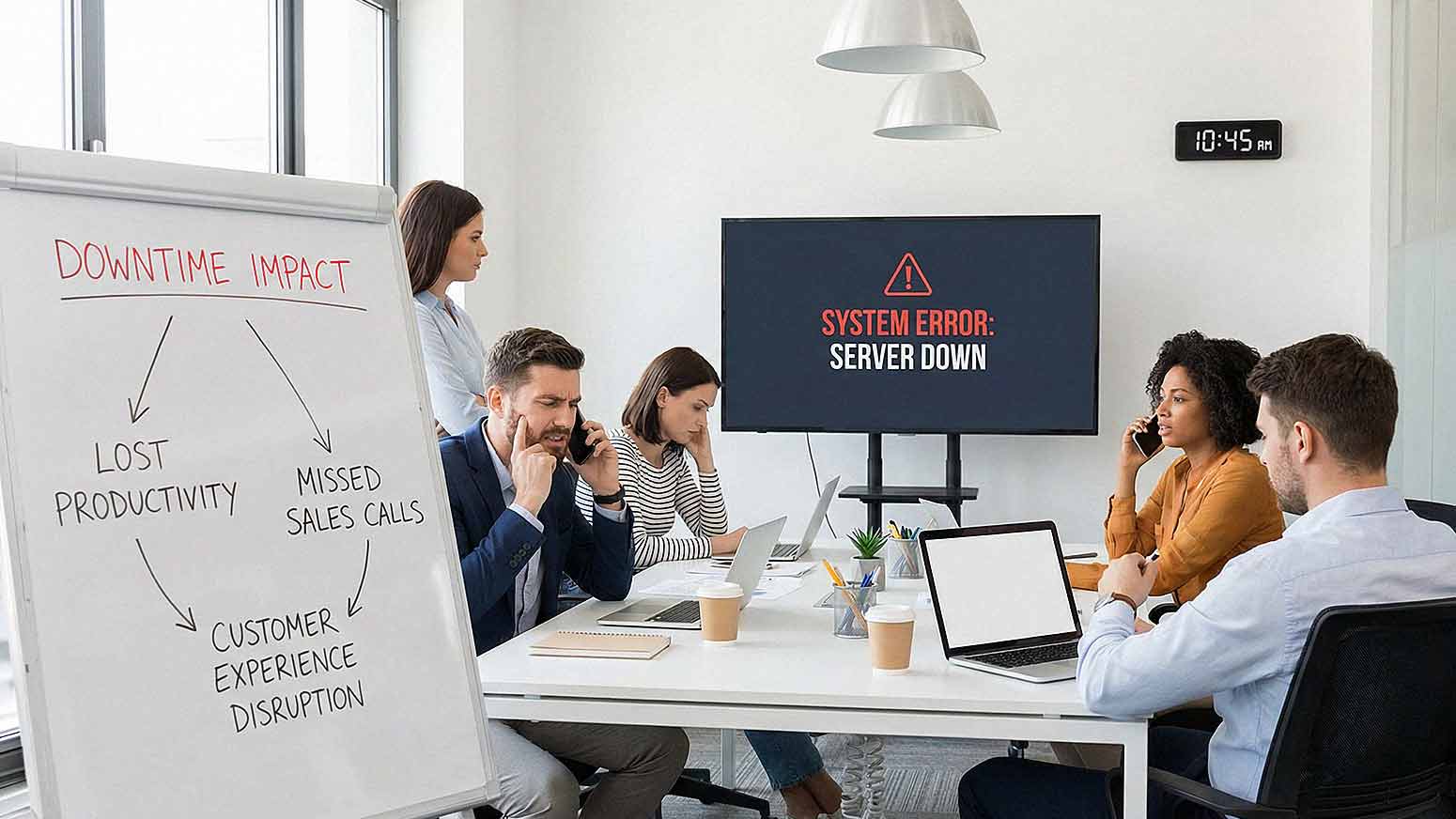
Most businesses treat downtime as a minor headache. The system goes down, work pauses, IT fixes it, and everyone moves on. What rarely gets discussed openly — or quantified honestly — is what that window of unavailability actually costs you.
It's not just an inconvenience. It's a revenue event.
And the numbers are harder to ignore than most business owners expect. According to a Splunk study covered by TechRepublic, unplanned downtime costs the world's largest companies $400 billion annually — roughly 9% of their annual profits. A corresponding report from CIO.com puts the average annual downtime cost for large enterprises at $200 million per year.
You might be thinking: "We're not a Fortune 500 company. Those numbers don't apply to us."
Fair point. But here's what does apply: the *mechanisms* that cause downtime — failed servers, internet outages, cybersecurity incidents, software crashes — are just as present in small and mid-sized businesses as they are in enterprise organizations. And for an SMB, a few hours of downtime can represent a far larger percentage of daily revenue than it does for a large corporation. The proportional hit is often worse.
This article breaks down exactly how downtime impacts revenue, with real-world examples, a look at the hidden costs most businesses overlook, and practical steps you can take to reduce your exposure.
What Counts as Office Technology Downtime?
Downtime isn't limited to a crashed server or a complete internet outage. It refers to any period when your systems are unavailable, degraded, or not functioning in a way that supports normal business operations.
Common causes include:
- Internet and network outages
- Server or hardware failures
- VoIP and phone system disruptions
- Software application crashes or update failures
- Cybersecurity incidents (ransomware, data breaches, phishing-related lockouts)
- Printer or copier failures in high-volume or document-dependent workflows
- Cloud service interruptions from third-party platforms your team relies on daily
Even short, partial disruptions count. A sales team that can't access the CRM for 90 minutes isn't fully offline — but they're also not operating at full capacity. That gap adds up.
The Direct Revenue Impact: What Actually Stops Working
When systems go down, revenue-generating activity often stops with them. That connection is more direct than most business owners acknowledge until they're sitting in the middle of an outage trying to manually process orders.
Here's what commonly breaks down:
- Order processing halts — customers can't buy, staff can't fulfill
- Incoming calls go unanswered — prospects reach voicemail or give up
- Payment processing fails — transactions can't complete
- Client deliverables are delayed — deadlines get missed
- Customer-facing portals go dark — self-service options disappear
For any business that depends on technology to generate revenue — which in 2026 means essentially every business — downtime isn't just a back-office problem. It's a front-office, customer-facing, revenue-impacting event.
Real Example: A Retail Business Losing Sales During a POS Outage
Picture a mid-sized retail store in Las Vegas averaging $2,500 per hour in sales during peak hours. The network goes down during a Saturday afternoon rush. Payment terminals stop responding. Customers can't complete purchases. Staff scramble for workarounds that don't fully exist.
After two hours, the system is restored. But here's what the business actually lost:
- $5,000 in direct lost sales during the outage window
- Unknown number of customers who walked out and went to a competitor
- Staff overtime costs for employees staying late to handle the backlog
- Potential negative reviews from frustrated customers who experienced the breakdown
The immediate, measurable loss is $5,000. The long-term loss — in repeat customers and reputation — is harder to calculate but very real.

Real Example: A Professional Services Firm Missing Client Opportunities
A consulting or legal firm depends on two things above almost everything else: communication and accessibility. If a client can't reach you when they need you, they start looking for someone who's available.
During a VoIP and email outage lasting three hours:
- Incoming calls are missed or routed to a voicemail that doesn't notify anyone in real time
- Email responses are delayed or bounce back
- New prospect inquiries go unanswered during the outage window
A single lost client engagement in a professional services context can represent $5,000 to $50,000 or more in lost revenue, depending on your average contract value. The three-hour outage itself is technically a minor event. The business consequence can last months.
Real Example: A Healthcare Office Facing Scheduling Disruptions
Medical offices, dental practices, and specialty clinics run on tight scheduling systems. A software outage in a healthcare setting creates a cascade effect:
- Appointments can't be booked — front desk staff are stuck
- Patient records are inaccessible — clinical workflows stall
- Appointments get rescheduled — some patients don't reschedule at all
For a practice billing $300–$600 per appointment, losing four to six appointment slots due to a scheduling system outage represents $1,200 to $3,600 in immediate lost revenue. Multiply that across a few incidents per year and the pattern becomes expensive quickly.
Beyond the revenue: patient trust is harder to rebuild than a database.
The Hidden Cost: Lost Productivity
This one flies under the radar in most downtime conversations, but it's significant.
Even when revenue doesn't stop completely, productivity does slow — sometimes dramatically. Employees faced with system unavailability tend to:
- Wait for systems to come back online, losing billable or productive time
- Switch to manual workarounds that are slower and error-prone
- Repeat work after recovery because changes weren't saved or synced properly
- Spend time communicating about the outage internally instead of working
Here's a simple way to quantify this: if you have 15 employees earning an average of $28 per hour and your systems are down for two hours, you're looking at $840 in pure labor cost where output was significantly reduced or eliminated. That's before a single revenue-related loss is calculated.
Scale that to a larger team or a longer outage and the numbers climb fast.
Customer Experience: The Long-Tail Revenue Impact
Downtime doesn't just affect what happens during the outage. It shapes how customers perceive your business afterward.
When customers experience delays, missed communications, or service interruptions tied to your technology problems, the effects ripple outward:
- Delayed responses signal disorganization, even if the cause was technical
- Poor communication during the outage makes the situation feel worse
- Repeated disruptions erode trust over time, even with otherwise loyal customers
Customers in 2026 expect reliability. They have options. If your business consistently struggles to stay available and responsive, they'll find alternatives — and they may not announce their departure. They'll simply stop returning.
Churn driven by perceived unreliability is one of the most expensive and least-tracked consequences of chronic downtime.
Cybersecurity Incidents: The Most Costly Downtime Category
Not all downtime is created equal. A network hiccup lasts minutes. A ransomware attack can last days.
Cybersecurity-related downtime is consistently the most expensive category for businesses of all sizes. When a security incident triggers downtime:
- Systems may be unavailable for 24–72 hours or longer during investigation and recovery
- Data access may be restricted by encryption or security lockdowns
- Recovery requires specialized resources — IT forensics, legal counsel, notification procedures
- Regulatory requirements may apply — especially in healthcare, finance, and legal sectors
The National Institute of Standards and Technology (NIST) identifies system availability as a foundational pillar of cybersecurity risk management. When a breach happens, you're not just dealing with a technical problem — you're managing a business continuity crisis.
The financial exposure from a single ransomware incident for an SMB can range from tens of thousands to hundreds of thousands of dollars when you factor in recovery costs, legal fees, compliance penalties, and lost business.
How Downtime Hits Every Department Differently
Downtime isn't a single-department problem. Depending on what fails and for how long, the impact spreads across your entire organization:
Sales and Business Development
- CRM access lost
- Proposals and contracts delayed
- Client calls missed
Operations
- Fulfillment and scheduling disrupted
- Manual workarounds consume staff time
- Error rates increase with manual processes
Finance and Accounting
- Payment processing failures
- Delayed invoicing
- Reporting errors from incomplete data sync
Customer Service
- Support tickets go unanswered
- Escalations increase as customers can't get responses
- Reputation damage accumulates in real time
Leadership
- Decision-making slows without access to live data
- Time is diverted from strategy to crisis management
Understanding the cross-functional impact helps you see why downtime prevention isn't an IT budget line — it's a business performance investment.
What Proactive IT Support Actually Does Differently
Reactive IT — where you call someone when something breaks — is the default for many SMBs. It's also the approach most likely to leave you exposed.
Proactive Managed IT Services work differently:
- 24/7 monitoring catches problems before they become outages
- Patch management keeps software vulnerabilities closed
- Backup and disaster recovery means data and systems can be restored quickly
- Security monitoring identifies threats before they escalate to incidents
- Dedicated support means you're not waiting in a queue when something goes wrong
For businesses in Las Vegas, Southern California, and surrounding regions, AIS provides local, proactive Managed IT Services backed by a 96% client satisfaction score and an average client relationship of over seven years. That track record exists because the approach works — not because things never go wrong, but because when they do, resolution is fast and the groundwork for recovery was already in place.
Frequently Asked Questions About IT Downtime and Business Revenue
How much does IT downtime actually cost a small business?
It varies significantly based on your revenue model, team size, and how dependent your operations are on technology. Even a two-hour outage can cost a small business $2,000–$10,000 or more when you combine direct revenue loss, labor inefficiency, and the downstream effects on customer relationships. For businesses processing transactions or providing time-sensitive services, the costs are typically higher.
Is downtime more expensive for some industries than others?
Yes. Healthcare, retail, financial services, and professional services tend to have the highest per-hour cost of downtime because their revenue is directly tied to system availability. But no industry is immune — even businesses with lower transaction volume can face serious long-term reputation and relationship damage from repeated disruptions.
What's the difference between planned and unplanned downtime?
Planned downtime is scheduled maintenance you control and can communicate to your team and customers in advance. Unplanned downtime is unexpected — a server crash, a cyberattack, a hardware failure — and typically costs significantly more because there's no preparation, no warning, and no backup plan already activated.

Can cybersecurity incidents really shut down a business for days?
Yes, and it happens more often than most people realize. Ransomware attacks in particular can render entire systems inaccessible for 24–72 hours or longer. Recovery can take days to weeks depending on whether you have current, clean backups and a tested disaster recovery plan in place.
How do I know if my business is at risk for frequent downtime?
Signs include: aging hardware or servers that haven't been replaced in five or more years, no formal patch management process, no offsite or cloud-based backup, reliance on a single internet connection without failover, and reactive-only IT support. If any of those describe your current setup, your downtime risk is elevated.
What's the first step toward reducing downtime exposure?
Start with an honest assessment of your current infrastructure. A technology audit — ideally conducted by a third party with no interest in selling you something you don't need — will surface vulnerabilities you may not be aware of. From there, you can prioritize investments in monitoring, backup, and security that address your highest-risk areas first.
Does managed IT actually prevent downtime, or does it just respond faster?
Both. Good Managed IT Services reduce the *frequency* of downtime through proactive monitoring and maintenance, and they reduce the *duration* of downtime when issues do occur through faster detection and response. The goal isn't perfection — it's minimizing exposure and recovery time so your business stays operational as close to 100% of the time as possible.
Your Next Step
Office technology downtime costs real money. The examples above aren't worst-case scenarios — they're representative of what businesses experience every day when systems aren't actively managed and protected.
The question isn't whether downtime will happen. It's whether your business has the infrastructure and support in place to handle it quickly and get back to full operation.
If you're not sure where your vulnerabilities are, that's the right place to start.
Schedule a Free Consultation with AIS — our team will help you assess your current setup and identify where your downtime risk is highest.
Or if you have specific questions about Managed IT Services for your business in Las Vegas, Southern California, or the surrounding region, contact AIS today. We're here and ready to help.
Topics:
