Cybersecurity is no longer a separate service you bolt onto your IT plan. It is a core part of how your business operates. Every device, every user, every system you run creates potential risk. If your IT provider cannot clearly explain their security posture — and back it up with specifics — your organization is exposed.
The problem is that most providers claim they offer security. Few clearly explain what is actually included, how the layers work together, or what happens when something goes wrong. That gap between marketing language and real protection is where businesses get hurt.
According to Kaseya's 2026 Cybersecurity Report, 37% of businesses still experience a full day or more of disruption after a breach. That is not a minor inconvenience. That is lost revenue, damaged client trust, and a scramble to recover that could have been avoided with the right provider and the right stack.
This article will walk you through what a cybersecurity stack actually is, what it should include, the questions you need to ask any IT provider, and how to spot the gaps before they cost you.
What Is a Cybersecurity Stack?
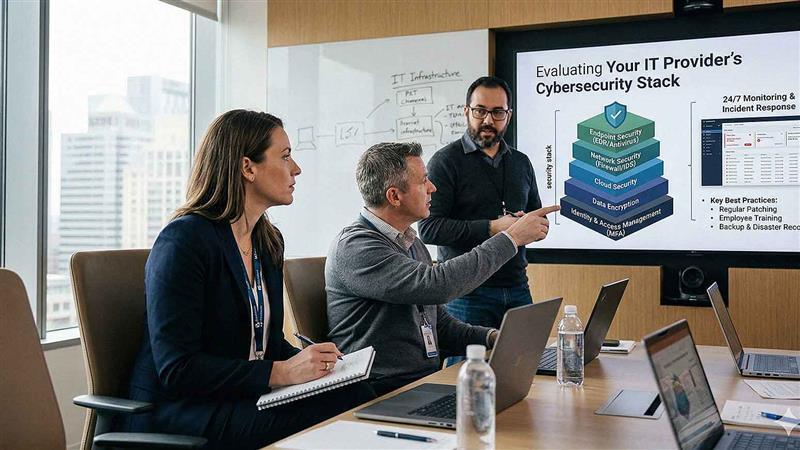
A cybersecurity stack is the full collection of tools, processes, and policies a provider uses to protect your business. Think of it less like a single product and more like a system — one where each layer addresses a different category of risk.
A complete stack typically covers:
- Endpoint Protection
- Network Security
- Email Security
- Identity and Access Management
- Backup and Disaster Recovery
- Security Monitoring and Threat Response
- Employee Security Awareness Training
No single tool handles all of this. A provider that leans on one or two tools and calls it a stack is not giving you real protection. Real security comes from coordination across multiple systems that work together.

Why a Layered Security Approach Is Non-Negotiable
Attackers do not depend on a single method. They probe for weaknesses wherever they exist — email inboxes, login portals, unpatched software, remote access points. A layered approach creates multiple barriers so that if one control fails, another one catches the threat before it spreads.
Think of it this way: a locked front door is good, but you also want motion-sensor lights, a monitored alarm system, and a safe for your most important items. Each layer adds friction. Each layer increases the cost for an attacker to succeed.
Businesses that rely on a single-layer approach — say, antivirus software alone — are operating with a false sense of security. The threat environment in 2026 is too sophisticated for that.
Core Components of a Strong Cybersecurity Stack
Endpoint Protection
Endpoint protection secures the devices your team uses every day — laptops, desktops, servers, and mobile devices. Strong endpoint protection includes:
- Malware and ransomware detection
- Behavioral threat analysis (detecting unusual activity, not just known signatures)
- Device monitoring and isolation
- Automatic threat response
Endpoints are the most common entry point for attackers. If your provider cannot tell you exactly how they protect devices at this layer, that is a red flag.
Email Security
Email remains the number one attack vector for businesses of every size. Phishing, business email compromise, and malicious attachments account for a significant percentage of breaches each year. Effective email security should include:
- Phishing detection and prevention
- Spam filtering
- Link and attachment scanning
- Impersonation and spoofing protection
Without strong email security controls, your users become your biggest vulnerability — not because they are careless, but because the attacks have become that convincing.
Identity and Access Management (IAM)
Compromised credentials are one of the leading causes of data breaches. Controlling who has access to what — and verifying that they are who they say they are — is one of the most important things a provider can do for you.
IAM capabilities to look for include:
- Multi-factor authentication (MFA) enforcement
- Role-based access controls
- Privileged access management
- Login activity monitoring
If a provider does not enforce MFA across your environment as a standard practice, ask why. There is no good answer.
Network Security
Network security protects how data moves between your systems, your users, and the outside world. Key components include:
- Next-generation firewalls
- Intrusion detection and prevention systems
- Network segmentation
- Secure remote access (VPN or zero-trust solutions)
Network security is especially important for businesses with remote or hybrid teams. Without proper controls, remote access points become easy targets.
Backup and Disaster Recovery
Backup is your last line of defense. When ransomware encrypts your data or a system failure takes you offline, a tested backup and recovery plan is the difference between a bad afternoon and a catastrophic loss.
Key features to require from any provider:
- Regular, automated data backups
- Offsite or cloud-based storage
- Periodic recovery testing (not just backups that sit untouched)
- Clearly defined recovery time objectives (RTOs)
Remember that stat: 37% of businesses experience a full day or more of disruption after a breach. Tested backup and recovery processes are what shorten that window.
Security Monitoring and Threat Response
Prevention is important. Detection and response are equally critical. A provider should be watching your environment continuously — not just running scheduled scans.
Look for:
- 24/7 monitoring capabilities
- Security information and event management (SIEM) tools
- Defined incident response procedures
- Clear communication protocols when a threat is detected
Ask specifically: what happens the moment a threat is identified? Who calls you, how fast, and what steps are taken? If the answer is vague, your security posture has a serious hole in it.
Employee Security Awareness Training
Technology alone cannot protect your business. Your team needs to recognize threats and know how to respond. A strong cybersecurity stack includes a training component that covers:
- Phishing simulation exercises
- Password hygiene and credential management
- Social engineering awareness
- Reporting procedures for suspected incidents
Human error remains a top contributor to breaches. Training reduces that risk significantly when it is ongoing — not a one-time checkbox.
Questions to Ask an IT Provider About Their Security Stack
When you are evaluating providers, ask direct questions. You are not looking for buzzwords. You are looking for specific, confident answers.
Here are the questions that matter most:
- What security tools are included in your service? Ask for a list, not a summary.
- How do you monitor systems for threats, and is it 24/7?
- Do you enforce multi-factor authentication for all users?
- How is backup managed, and how often is recovery tested?
- What is your incident response process if a breach occurs?
- Do you provide security awareness training for our team?
- How do you stay current with emerging threats?
Clear, specific answers indicate a structured approach. Vague responses — or answers that require a follow-up meeting just to explain — often point to gaps in both the stack and the communication.
As Forbes notes, "Determining that you need a cybersecurity service provider is likely one of the most important technology-related decisions a C-suite can make in regard to the well-being and security posture of their organization." Treat the evaluation process with the seriousness that deserves.
How to Identify Gaps in a Cybersecurity Stack
Not all providers offer complete coverage. Some are strong in one area and weak in others. Common gaps include:
- Limited or no email security tools
- No continuous monitoring (only reactive support)
- Weak identity controls with no MFA enforcement
- Infrequent or untested backup processes
- Outdated security tools that have not kept pace with current threats
- No formal incident response plan
- Missing employee training component
Each gap represents an open door. When you are comparing providers, ask them to walk you through each layer specifically. If they skip a layer or get evasive, that is your answer.
What a Complete Cybersecurity Stack Looks Like in Practice
A well-structured provider does not just check boxes. They integrate these layers into a cohesive system, document everything, and communicate clearly when something needs attention.
For SMBs in Las Vegas, Southern California, and surrounding regions, the challenge is often finding a provider that offers enterprise-grade security without enterprise-grade complexity or cost. The right managed IT partner makes security manageable — handling the tools, the monitoring, the training, and the response so your team can focus on the work that actually moves your business forward.
At AIS, our Managed IT Services are built around a layered security approach that addresses every component covered in this article. We do not leave gaps and then hope our clients do not notice. We document what is in place, test it regularly, and stay in communication so you always know exactly where you stand.
Frequently Asked Questions
What is a cybersecurity stack?
A cybersecurity stack is the combination of tools, processes, and policies used to protect a business from cyber threats. It typically includes endpoint protection, email security, identity and access management, network security, backup and recovery, and security monitoring — all working together.
Why does my business need a layered cybersecurity approach?
Attackers use multiple methods to breach a business. A layered approach means that even if one control fails, other controls are in place to catch and stop the threat. Single-tool solutions cannot provide that kind of coverage.
What should I ask an IT provider before signing a contract?
Ask specifically what tools are included, how monitoring is handled, whether MFA is enforced, how backups are tested, and what the incident response process looks like. Specific answers indicate a structured, reliable approach.
How often should backup and recovery be tested?
At minimum, quarterly. Many well-run providers test more frequently. The goal is to confirm that your data can actually be restored within an acceptable timeframe — not just that the backup is running.

Is employee training really part of a cybersecurity stack?
Yes. Human error is one of the most common contributors to breaches. A complete stack includes ongoing security awareness training and phishing simulations to reduce the risk that a well-intentioned team member becomes an entry point for attackers.
What are the most common gaps in an IT provider's cybersecurity stack?
The most frequent gaps are: no continuous monitoring, missing or weak email security, no MFA enforcement, infrequent backup testing, and no formal incident response plan. Each of these represents meaningful risk.
How do I know if my current IT provider's security stack is adequate?
Ask them to walk you through each layer — endpoint, email, identity, network, backup, and monitoring — and explain what specific tools they use for each. If they cannot answer clearly, or if they skip layers, it is worth getting a second opinion from a provider who can.
Ready to Evaluate Your Current Security Coverage?
Your IT provider should be able to explain every layer of your security stack without hesitation. If they cannot — or if you are not confident the coverage is complete — it is worth having a conversation.
Schedule a Free Consultation with the AIS team. We will walk through your current environment, identify any gaps, and show you exactly what a complete, layered security approach looks like for a business like yours.
Or reach out directly — Contact AIS Today and let us know what you are working with. No pressure, no sales pitch. Just a straightforward conversation about your security.
Topics:
