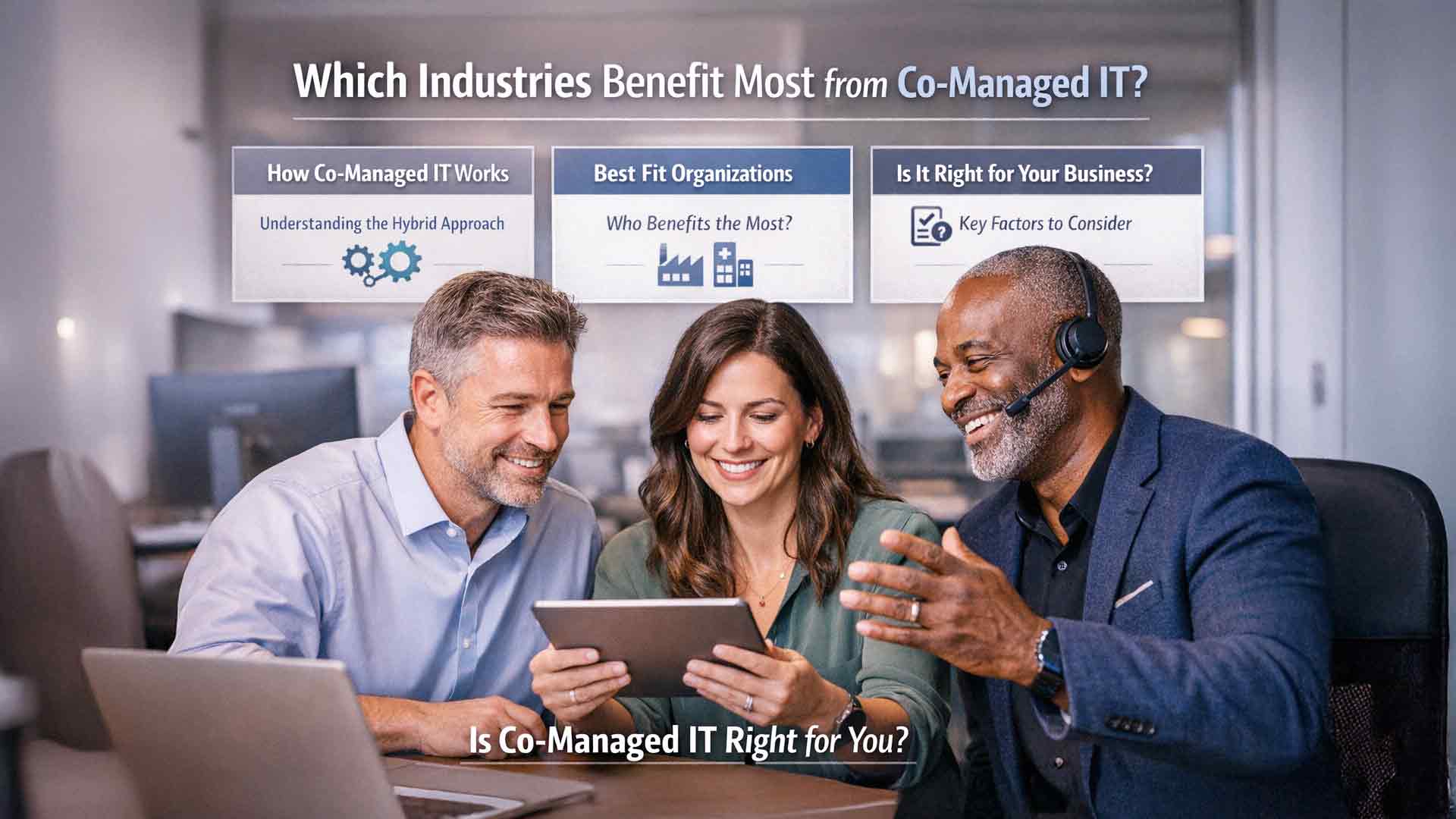
Many organizations reach a point where their internal IT team cannot handle everything alone. Systems grow more complex. Security threats multiply. Compliance requirements keep expanding. And leadership still wants to maintain internal control and institutional knowledge.
That tension — between needing more IT coverage and not wanting to lose what your team already knows — is exactly what co-managed IT is built to solve.
But here is the honest truth: co-managed IT is not the right fit for every business. Some organizations are perfect candidates. Others would be better served by a fully managed IT model or simply adding headcount. The difference often comes down to your industry, your team structure, and the specific pressures your organization faces.
This article breaks down which industries benefit most from co-managed IT, what makes them a strong fit, and what to ask yourself before making a decision.
What Co-Managed IT Actually Means
Before getting into industries, it helps to be clear about what co-managed IT is — and what it is not.
Co-managed IT is a partnership model. Your internal IT team continues handling day-to-day tasks, on-site support, and business-specific systems. The managed IT provider fills the gaps with services your team cannot easily cover on their own. According to Forbes, co-managed IT services allow businesses to combine in-house IT resources with those from a managed services provider, enabling internal teams to manage certain aspects of IT while outsourcing others.
The split looks different for every organization, but co-managed IT typically includes:
- Advanced cybersecurity monitoring and response
- 24/7 network monitoring and alerting
- Patch management and software updates
- Backup and disaster recovery
- Help desk overflow support
- Compliance documentation and audit preparation
- Strategic IT planning and vCIO services
- Project-based assistance for migrations, upgrades, and rollouts
The goal is not duplication of effort. It is coverage, depth, and resilience. Your internal team stays in control. The managed partner makes them stronger.
What Makes an Industry a Strong Fit?
Co-managed IT works best in environments with certain characteristics. Organizations that benefit most from this model tend to:
- Have at least one internal IT staff member who handles business-specific systems
- Operate in complex or regulated environments where compliance is non-negotiable
- Rely heavily on uptime and data availability to serve customers or clients
- Face growing cybersecurity threats that exceed what an internal team can handle alone
- Need advanced tools they cannot justify purchasing independently
- Want to reduce burnout and turnover on their existing IT staff
That last point matters more than most leaders realize. IT burnout is real. When your internal team is stretched too thin — handling tickets, managing infrastructure, supporting users, AND trying to keep up with security — mistakes happen. Co-managed IT gives your team breathing room and backup.

The Industries That Benefit Most from Co-Managed IT
Healthcare Organizations
Healthcare is one of the strongest fits for co-managed IT. Hospitals, clinics, specialty practices, and behavioral health organizations rely on internal IT staff who understand clinical workflows, electronic health record (EHR) systems, medical devices, and care delivery protocols. That institutional knowledge is irreplaceable.
At the same time, healthcare faces some of the most aggressive cybersecurity threats of any industry. Estimates indicate that cybercrimes affect the security of more than 80% of businesses globally, and healthcare is consistently among the highest-targeted sectors. Add strict HIPAA compliance requirements and the consequences of downtime — which can affect patient safety, not just productivity — and the stakes become very clear.
Co-managed IT works well here because internal teams retain control of clinical systems while the managed partner handles security monitoring, vulnerability management, compliance support, encrypted backups, and after-hours coverage. Risk goes down. Care delivery is not disrupted. Your team is not on call around the clock.
Legal Firms
Law firms handle some of the most sensitive data of any industry — client records, case files, privileged communications, financial information. Confidentiality is not optional. It is foundational.
Many firms operate with a small internal IT team or even a single IT manager who understands legal applications, document management systems, and user workflows. That person is excellent at what they do. But they cannot be everywhere at once, and they likely do not have the time to stay current on every emerging threat or compliance requirement.
Co-managed IT supports legal firms by layering in advanced security controls, continuous monitoring, and redundant backup protection — without pulling internal staff away from the systems and relationships they manage daily. It also helps firms meet client security expectations, pass third-party audits, and clearly document their security posture. In an industry where reputation is everything, that documentation matters.
Financial Services and Accounting Firms
Accounting firms, wealth managers, financial advisors, and insurance agencies face intense pressure around data protection, regulatory compliance, and uptime. Deadlines, audits, and reporting cycles leave little room for outages or security incidents.
These organizations are often subject to regulations like SOC 2, GLBA, or state-level financial data protection laws. Keeping up with those requirements while also managing day-to-day IT operations is a heavy lift for a lean internal team.
Co-managed IT fills that gap effectively. Internal staff manage the business applications, client-facing systems, and financial platforms they know well. The managed partner covers security monitoring, compliance tracking, patch management, and disaster recovery. When tax season hits or audit season begins, your team is not scrambling — the infrastructure is already solid.
Educational Institutions
Schools, colleges, and universities often operate with lean IT teams that support enormous user populations — students, faculty, staff, and administrators — across dozens or hundreds of devices and platforms.
The range of what education IT teams manage is wide: learning management systems, classroom technology, administrative software, network infrastructure, security cameras, and more. When a classroom projector goes down, IT handles it. When a server needs patching, IT handles that too. The volume is relentless.
Co-managed IT helps education IT teams by taking ownership of time-intensive backend tasks — network monitoring, cybersecurity, backup management, compliance with FERPA and state-level student data protection laws — so internal staff can focus on the user-facing work that requires their direct presence and knowledge of the campus environment.
Manufacturing and Distribution
Manufacturing companies depend on technology more than ever. Operational technology (OT), inventory systems, ERP platforms, shipping logistics software, and connected equipment all require reliable IT support. A system failure on a production floor is not an inconvenience — it is a costly shutdown.
Internal IT staff in manufacturing often have deep knowledge of proprietary systems, vendor relationships, and equipment integrations. But cybersecurity in manufacturing has become increasingly complex. Ransomware attacks targeting industrial systems have grown significantly, and many internal teams are not resourced to monitor threats around the clock.
Co-managed IT gives manufacturing IT teams a security and monitoring backbone while preserving their control over the operational systems they understand best.
Government and Municipal Organizations
Local governments, municipalities, and public agencies operate under public accountability, budget constraints, and strict data governance requirements. Internal IT staff in these environments often manage legacy systems, multiple departments, and citizen-facing services.
Co-managed IT supports government IT teams by adding cybersecurity depth, compliance documentation, and after-hours monitoring coverage without requiring the organization to hire additional full-time staff — which can be difficult given budget cycles and hiring processes.
Professional Services Firms (Marketing, Engineering, Architecture)
Professional services organizations — marketing agencies, engineering firms, architecture companies — often grow faster than their IT infrastructure can keep up with. A team of 40 people might have one IT generalist handling everything. As the firm adds employees, takes on more complex projects, and stores more sensitive client data, that model starts to break down.
Co-managed IT supports these firms by scaling coverage alongside growth. The internal IT person or small team retains ownership of the day-to-day. The managed partner handles security, backup, monitoring, and planning — so the firm can grow without IT becoming a bottleneck.
What Co-Managed IT Is Not a Good Fit For
Honesty is important here. Co-managed IT is not the right answer for every organization.
If your business has no internal IT staff, a fully managed IT service is likely a better fit. Co-managed IT assumes you have internal resources to partner with. Without that foundation, the model does not work as intended.
If your organization is very small — fewer than 10 employees with simple technology needs — the cost and structure of co-managed IT may not be justified. A break-fix or basic managed IT plan might be more appropriate.
And if your leadership wants to outsource IT entirely and remove the burden of internal management, co-managed IT is not the answer. That is what fully managed IT is for.
Knowing the difference before you commit saves time, money, and frustration.
Signs Your Internal IT Team Is Ready for a Co-Managed Partner
Even if your industry is on this list, it helps to look for specific signals that your team is ready for this kind of support. Common indicators include:
- Help desk tickets are backing up and response times are slipping
- Security incidents have increased or your team feels underprepared to handle them
- Compliance audits are creating stress and requiring significant staff time to prepare for
- Key IT staff have left or are likely to leave, creating coverage gaps
- Projects are stalling because your team does not have bandwidth for strategic work
- After-hours coverage is non-existent or falling on a single person
If three or more of these apply, it is worth having a conversation.
FAQ: Co-Managed IT Services
What is the difference between co-managed IT and fully managed IT?
Fully managed IT means an external provider handles all of your IT operations. Co-managed IT means you retain internal IT staff and partner with a provider to fill specific gaps. Co-managed IT is a shared model. Fully managed is a full handoff.

Do we need to have a dedicated IT person to use co-managed IT?
Yes. Co-managed IT is designed to support existing internal IT staff. If you have no internal IT resources, a fully managed IT service is the better fit.
How does billing typically work for co-managed IT?
Most providers, including AIS, structure co-managed IT as a flat monthly fee based on the scope of services provided. This makes budgeting predictable and avoids surprise invoices.
Will the managed provider interfere with our existing systems or workflows?
A good co-managed IT partner works alongside your team, not over them. The goal is to support your internal staff and fill gaps — not to change how your team operates or override their decisions.
What cybersecurity services are typically included in co-managed IT?
Co-managed IT commonly includes 24/7 monitoring, threat detection and response, patch management, vulnerability scanning, endpoint protection, and security awareness training for employees. The specific scope depends on your agreement.
Can co-managed IT help us with compliance?
Yes. This is one of the strongest use cases. Co-managed IT providers can assist with documentation, audit preparation, policy development, and ongoing compliance monitoring for frameworks like HIPAA, FERPA, GLBA, and SOC 2.
How do we know if AIS is a good fit for our organization?
AIS serves SMBs across Las Vegas, Southern California, and surrounding regions. We specialize in co-managed IT, fully managed IT, cybersecurity, and technology solutions for businesses across healthcare, legal, financial services, education, and more. The best way to find out if we are a fit is to schedule a conversation — no pressure, no commitment.
Is Your Industry on This List?
If your organization operates in healthcare, legal, financial services, education, manufacturing, government, or professional services — and you have internal IT staff who are stretched thin — co-managed IT is worth serious consideration.
You do not have to replace your team. You just have to give them the backup they need.
AIS has helped businesses across Las Vegas and Southern California build stronger IT operations through co-managed partnerships. Our clients average over seven years with us because we show up consistently, communicate clearly, and treat your business like it matters — because it does.
Ready to find out if co-managed IT is right for your organization?
Topics:
