

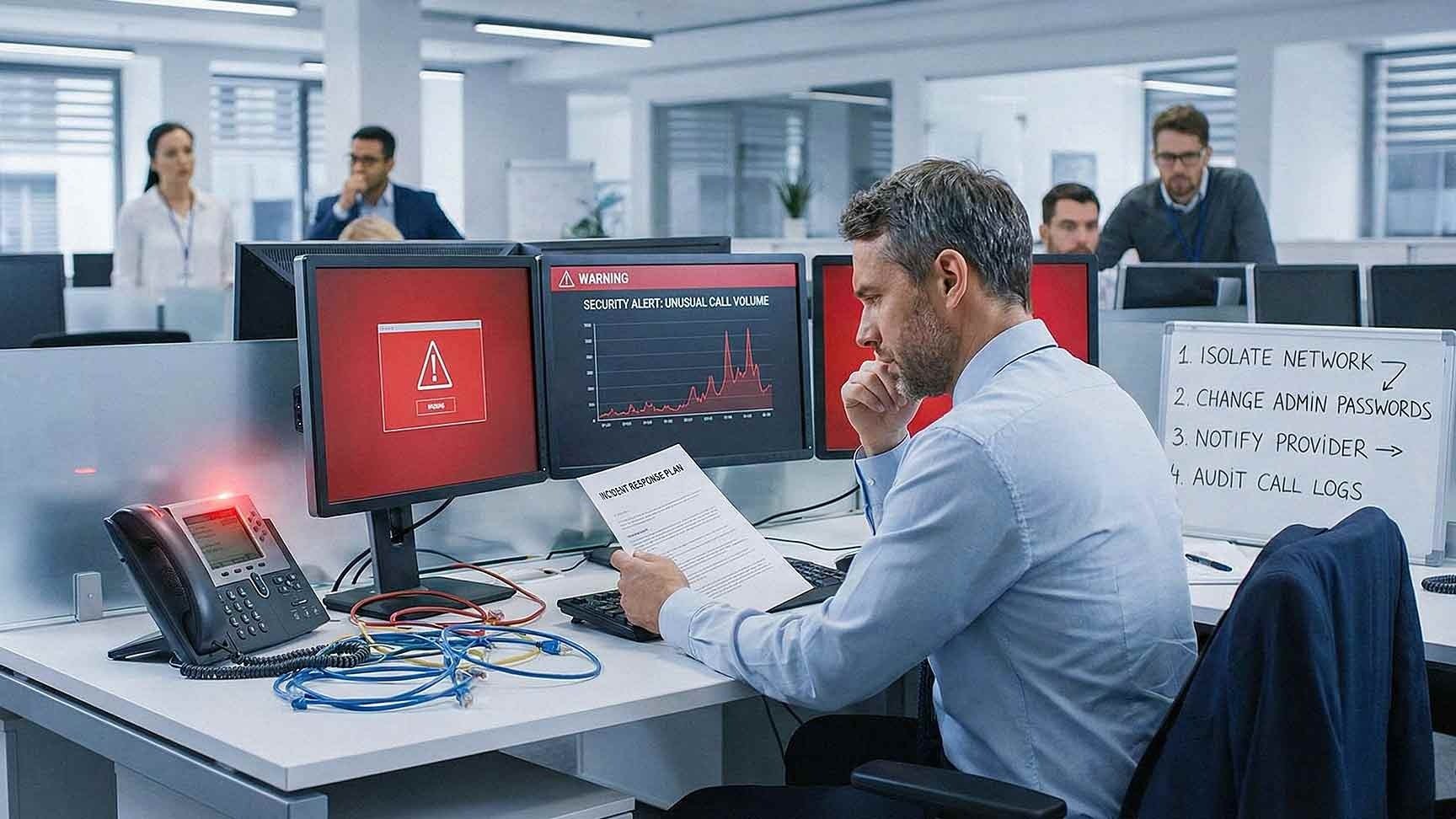
Many businesses think of cybersecurity in terms of email, servers, and cloud software. Phone systems are often overlooked.
Modern business phone systems, especially VoIP and Cloud PBX platforms, are internet-connected. That makes them potential targets.
A business phone system breach can lead to:
• Unauthorized international call charges
• Call interception
• Service disruption
• Stolen voicemail data
• Network access exposure
The financial and reputational damage can escalate quickly.
Knowing what to do after a business phone system breach reduces long-term impact and strengthens future protection.

Step 1: Contain the Breach Immediately
The priority is stopping ongoing damage.
Immediately:
• Disable compromised user accounts
• Reset all administrative passwords
• Block suspicious outbound call destinations
• Contact your VoIP provider
• Restrict international dialing if not required
If toll fraud is occurring, every minute matters. Attackers often place high-volume international calls to premium-rate numbers.
Rapid containment limits financial loss.
Step 2: Disconnect and Isolate Affected Systems
If the breach appears widespread, isolate the affected components.
This may include:
• Disconnecting compromised IP phones
• Segregating voice VLANs
• Blocking suspicious IP addresses
• Reviewing firewall rules
Isolation prevents attackers from pivoting into other parts of your network.
VoIP devices connect to your broader IT infrastructure. Isolation protects critical systems.
Step 3: Notify Key Stakeholders
Communication should happen quickly and clearly.
Notify:
• Internal IT leadership
• Your managed IT provider
• Your VoIP provider
• Finance or accounting
• Executive leadership
If customer data or voicemail recordings were exposed, legal and compliance teams may need to be involved.
Structured communication reduces confusion and prevents missed steps.
Step 4: Review Call Logs and Usage Reports
Call analytics becomes critical after a breach.
Review:
• Recent call activity
• International call spikes
• Unusual call duration patterns
• Repeated calls to unfamiliar numbers
• Off-hours activity
This helps determine:
• When the breach began
• Which accounts were affected
• The financial impact
• Whether the attack is ongoing
Cloud PBX reporting tools provide detailed historical data for investigation.
Step 5: Assess Financial Exposure
Phone system breaches often involve toll fraud.
Work with your provider to:
• Identify unauthorized call charges
• Document affected timeframes
• Dispute fraudulent charges if possible
• Monitor billing closely
Some providers offer fraud protection policies. Others do not.
Understanding exposure early prevents billing surprises later.
Step 6: Conduct a Full Security Audit
After containment, perform a broader review.
A business phone system breach often exposes deeper issues.
Audit:
• Password strength policies
• Multi-factor authentication usage
• Firewall configuration
• Network segmentation
• Firmware versions
• VoIP admin permissions
If the root cause is not identified, future breaches are likely.
Common Causes of Business Phone System Breaches
Understanding how breaches occur helps strengthen defenses.
Frequent causes include:
• Weak or reused passwords
• Exposed VoIP admin portals
• Open SIP ports
• Outdated firmware
• Lack of multi-factor authentication
• Unsecured remote access
Many breaches are preventable with proper configuration.
Step 7: Update Firmware and Patch Vulnerabilities
Outdated VoIP firmware increases exposure.
Immediately:
• Update device firmware
• Patch router and firewall software
• Disable unused services
• Close unnecessary ports
Firmware updates often address known vulnerabilities.
Regular maintenance reduces attack surface significantly.
Step 8: Strengthen Authentication and Access Controls
Strong access control is essential after a breach.
Implement:
• Complex password policies
• Multi-factor authentication for admin access
• Role-based permissions
• Account lockout policies
• Removal of unused accounts
Administrative access should be limited to essential personnel only.
Step 9: Review Network Segmentation
Voice traffic should be separated from general data traffic.
Proper segmentation includes:
• Dedicated voice VLANs
• Firewall rules limiting SIP exposure
• Restricted external access
• Intrusion detection monitoring
If your phone system shares unrestricted access with core IT systems, risk increases significantly.
Segmentation limits breach impact.
Step 10: Notify Law Enforcement or Regulatory Bodies If Required
If financial fraud occurred or sensitive data was exposed, external reporting may be necessary.
This depends on:
• Industry regulations
• Data sensitivity
• Legal requirements
• Financial impact
Consult legal counsel to determine reporting obligations.
Documentation during the incident will support compliance.
How to Prevent Future Phone System Breaches
Prevention requires structured security practices.
Recommended safeguards include:
• Multi-factor authentication
• Strong password policies
• Continuous call monitoring
• International call restrictions
• Regular firmware updates
• Firewall hardening
• VoIP quality and security monitoring
Proactive oversight reduces risk significantly.
The Role of Managed VoIP and IT Services
Managed VoIP services provide ongoing protection.
This often includes:
• Real-time fraud monitoring
• Automated alerts for unusual call activity
• Firmware management
• Secure configuration oversight
• Incident response coordination
AIS supports businesses across Las Vegas and Southern California with managed VoIP and IT services designed to reduce phone system breach risk.
Security should be continuous, not reactive.
What Recovery Should Feel Like
After recovery, your phone system should feel stable and controlled.
You should have:
• Clear documentation of the breach
• Updated security controls
• Improved monitoring
• Stronger authentication
• Visibility into call activity
Confidence returns when systems are secured and monitored properly.

Common Mistakes After a Phone System Breach
Businesses sometimes make preventable errors, such as:
• Changing passwords without reviewingthe root cause
• Failing to update firmware
• Ignoring billing reconciliation
• Leaving ports exposed
• Assuming the breach was isolated
An incomplete response leaves vulnerabilities open.
Next Steps: Secure Your Phone System Before the Next Incident
If your business has experienced a phone system breach or if you are unsure about your VoIP security posture, AIS offers a VoIP Security and Risk Assessment. This review evaluates authentication, network configuration, firmware, call monitoring, and fraud prevention controls.
Prevention costs less than recovery.
Topics:
