

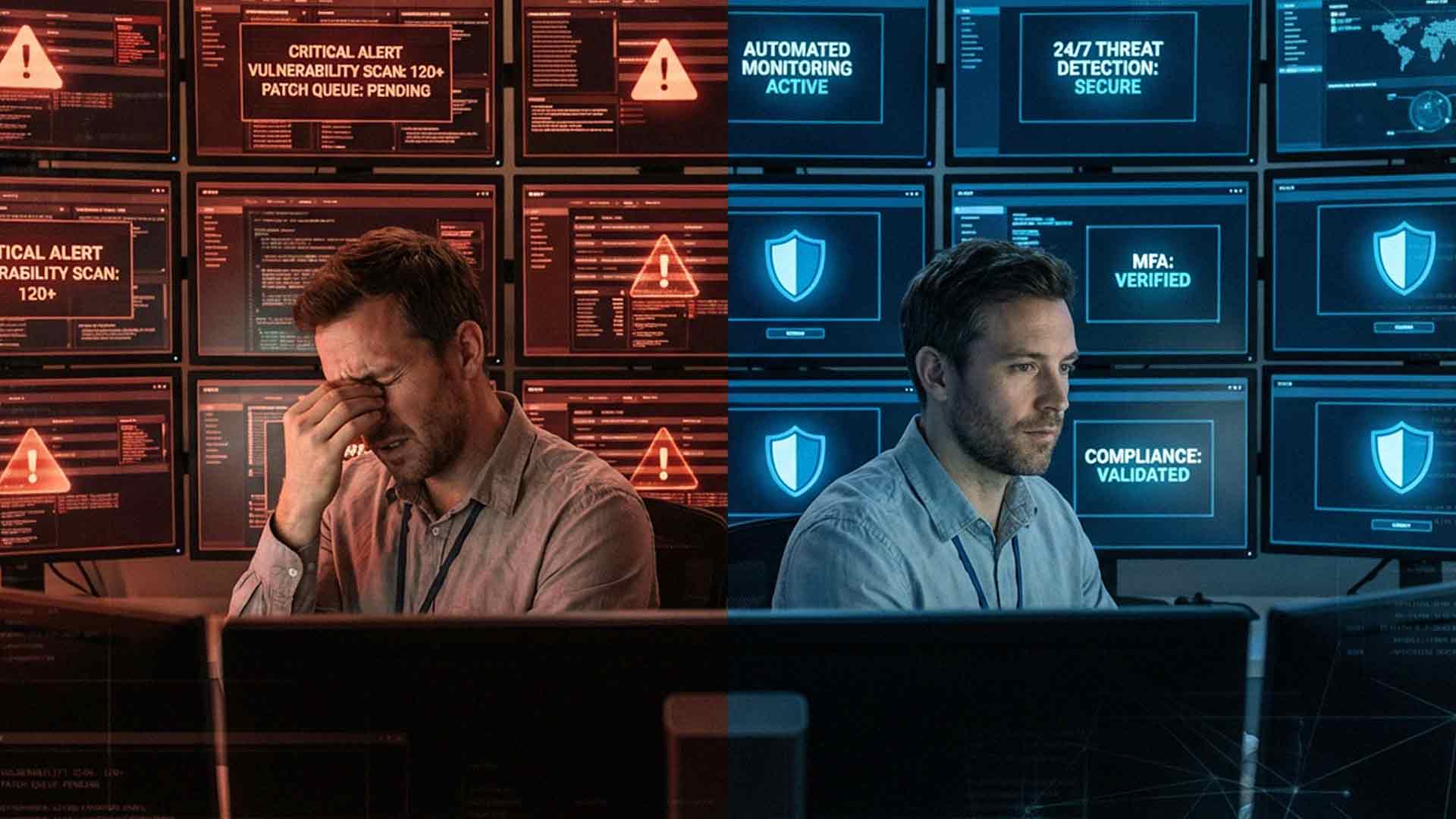
Cybersecurity is no longer optional for any business. Attacks are more frequent, more aggressive, and more damaging than they were even a few years ago. Small and mid-sized companies are heavily targeted because attackers know they often lack the staff, tools, and protections that larger organizations have in place.
To stay protected, every business has to make a decision: who is responsible for your cybersecurity, and how will they handle it?
Some companies hire internal staff. Others rely on a Managed Security Services Provider — often called an MSSP. Both models can work, but each comes with real strengths and genuine limitations. Choosing the wrong approach affects your risk exposure, your team's productivity, and your budget in ways you may not feel right away — until something goes wrong.
This article breaks down both options honestly so you can make the decision that actually fits your business.
What Does In-House Cybersecurity Mean?
In-house cybersecurity means relying on employees who work directly for your company to handle security responsibilities. That includes threat monitoring, incident response, patch management, security policies, tool selection, and long-term planning.
Companies with larger budgets sometimes build dedicated internal security teams because they want direct control and immediate access to their staff. There's a real appeal to having someone in the building you can walk up to and ask a question.
But building that capability is expensive and time-consuming. Cybersecurity professionals are in high demand. Salaries have continued to climb. Certifications require ongoing training and renewal. For many small or mid-sized businesses, hiring even one full-time security specialist is a stretch — and one specialist is rarely enough.
What Does Managed Security Services Mean?
Managed Security Services means outsourcing some or all of your cybersecurity responsibilities to an external provider. A qualified MSSP monitors threats around the clock, manages security tools, responds to incidents, tests backups, keeps systems updated, and provides strategic guidance on reducing your overall risk.
The goal is to protect your data and operations continuously — not just during business hours.
A managed approach gives you access to enterprise-level tools, deep specialist expertise, and 24/7 monitoring at a predictable monthly cost. Many businesses choose this model because it delivers consistent protection without the overhead of building an internal team.
According to Forbes, the managed security service market is projected to reach $61.64 billion by 2029, growing at 12.24% annually from 2024. That growth reflects how many businesses — of all sizes — are moving toward this model.
Key Differences Between In-House Cybersecurity and Managed Security Services
Both options aim to protect your data and systems. But they operate very differently in practice. Here's where those differences matter most.

1. Expertise and Skill Depth
Cybersecurity changes constantly. New attack methods appear every week. Tools evolve, compliance requirements shift, and threat actors grow more sophisticated. Staying current is a full-time job — and then some.
An MSSP employs specialists whose entire focus is security. Collectively, their expertise typically covers:
- Threat intelligence and monitoring
- Incident response and containment
- Network and endpoint protection
- Cloud security configurations
- Compliance frameworks (HIPAA, PCI-DSS, CMMC, and others)
- Backup integrity testing and disaster recovery
An in-house employee — even a skilled one — often juggles general IT responsibilities alongside security. That split attention makes it harder to stay ahead of emerging threats. One person cannot realistically match the depth of a full security team.
2. Cost and Resource Requirements
This is where the comparison gets concrete fast.
Building in-house cybersecurity requires budgeting for:
- Competitive salaries (cybersecurity engineers frequently command six figures)
- Benefits and payroll taxes
- Ongoing training and certification renewals
- Security tools and software licensing
- Recruitment costs when someone leaves
A single mid-level cybersecurity engineer in markets like Las Vegas or Southern California can cost as much as a full managed security plan — and that one person won't cover nights, weekends, or vacations.
Managed security services roll all of that into a predictable monthly fee. You gain access to a full team, a stack of enterprise-grade tools, and continuous monitoring without the hiring risk or overhead.
For most small and mid-sized businesses, the math strongly favors the managed model — especially when you factor in the cost of a breach. The average cost of a data breach continues to rise, with IBM's 2024 Cost of a Data Breach Report placing the global average at $4.88 million. Even a fraction of that figure dwarfs years of managed security costs.
3. Availability and Response Time
Cyber threats don't keep business hours. Ransomware doesn't wait until Monday morning.
If your internal team works a standard schedule, your business has coverage gaps — overnight, on weekends, and during holidays. Extended coverage means paying overtime or hiring additional staff.
A managed security team monitors your network 24 hours a day, seven days a week. When something suspicious is detected, they respond immediately — not the next morning when someone checks their email.
That response time matters. The longer a threat goes undetected, the more damage it causes. Early detection and rapid containment are two of the biggest factors in limiting the impact of a cyberattack.
4. Scalability
Your security needs will change. You may open a new location, add remote workers, migrate systems to the cloud, or take on a large client with specific compliance requirements. Each of these changes affects your security posture.
Scaling an in-house team means hiring, training, and onboarding new staff — a slow and expensive process. With a managed security provider, your coverage scales alongside your business. You get the security capacity you need when you need it, without scrambling to fill headcount.
5. Consistency and Process Maturity
Security isn't a one-time project. It requires consistent processes: regular patching, vulnerability scanning, log review, policy updates, and employee awareness training. These things fall through the cracks when security is handled reactively or by a stretched internal team.
MSSPs operate with documented processes and accountability structures. They've built repeatable workflows across dozens or hundreds of clients. That operational maturity is difficult to replicate internally — especially in a smaller organization where security competes with other IT priorities.
Who Is the Right Fit for Each Model?
Neither option is universally better. The right choice depends on your business size, budget, risk tolerance, and existing internal capabilities.
In-house cybersecurity may make sense if you:
- Have a large internal IT department with dedicated security resources
- Operate in a highly regulated industry that requires on-site security personnel
- Have the budget to hire, train, and retain multiple specialists
- Need complete control over every aspect of your security posture
Managed security services are typically the stronger fit if you:
- Are a small or mid-sized business with limited IT staff
- Cannot afford (or cannot find) qualified full-time security professionals
- Need 24/7 monitoring but don't want to pay for around-the-clock staffing
- Want predictable monthly costs instead of unpredictable security events
- Are growing quickly and need security that scales with you
NIST's guidance on building cybersecurity teams acknowledges this reality directly, noting that a significant portion of small businesses rely on managed service providers to deliver the full range of IT and security services rather than trying to build those capabilities internally.
What to Look for in a Managed Security Services Provider
If you decide that managed security is the right direction, choosing the right provider is critical. Not all MSSPs are created equal.
Here's what to evaluate before you sign anything:
- Response time guarantees — How fast will they respond to an incident? Get specifics, not vague promises.
- Monitoring scope — Are they monitoring endpoints, cloud environments, email, and network traffic — or just one layer?
- Compliance experience — Do they understand the regulations relevant to your industry?
- Transparency and reporting — Will you receive regular reports that actually explain what's happening in your environment?
- Local support — Can you reach a real person quickly, or does everything go through a ticket queue?
- Client references — Ask for references from businesses similar in size and industry to yours.
- Incident response plan — Do they have a documented process for what happens when an attack occurs?
At AIS, our Managed IT Services clients benefit from dedicated account managers, 24/7 local support, and a 96% Net Promoter Score — the highest client satisfaction rating in North America. Our average client relationship spans more than seven years, which tells you something about what it's like to work with us long-term.
A Note on the Hybrid Approach
Some businesses land somewhere in the middle. They maintain a small internal IT team for day-to-day support while partnering with an MSSP for specialized security monitoring and response. This hybrid model can work well when you already have internal IT staff but recognize that security requires a deeper level of expertise than they can reasonably provide on their own.
If you're considering this approach, clarity is essential. Define exactly which responsibilities sit with your internal team and which belong to your MSSP. Overlapping or ambiguous ownership is one of the most common ways security gaps develop.
Frequently Asked Questions
1. Is managed security the same as managed IT services?
Not exactly, though there's significant overlap. Managed IT services typically cover a broad range of technology support — help desk, device management, network maintenance, and more. Managed security services focus specifically on protecting your systems from threats. Many providers offer both, which creates a more integrated approach.

2. Can a small business really afford managed security services?
Yes — and in most cases, it's far more affordable than the alternative. Hiring even one qualified cybersecurity professional often costs more annually than a full managed security plan. When you factor in tools, training, and 24/7 coverage, managed services deliver significantly more value per dollar for most small and mid-sized businesses.
3. What happens if there's a security incident? Who handles it?
With an MSSP, incident response is part of the service. Your provider should have a documented process for detection, containment, and recovery. Make sure you understand that process — and the communication expectations — before you sign a contract. You should always know who to call and what they'll do.
4. How do I know if an MSSP is actually protecting me, or just billing me?
Ask for regular reporting. A good MSSP provides transparent, readable reports that show what was monitored, what was detected, and what was done about it. You should also receive a clear summary of your current risk posture and any recommended improvements. If a provider can't explain what they're doing in plain language, that's a red flag.
5. Does managed security replace my internal IT team?
It depends on your setup. For businesses without a dedicated IT team, an MSSP can handle the full security function. For businesses that do have internal IT staff, an MSSP usually complements that team by adding specialized security expertise and 24/7 monitoring that internal staff can't realistically provide.
6. What industries benefit most from managed security services?
Any business that stores sensitive data or operates in a regulated environment benefits significantly. That includes healthcare, legal, financial services, real estate, manufacturing, and retail. But honestly, any business that depends on its systems and data — which is nearly every business — has a stake in getting security right.
7. How long does it take to get started with an MSSP?
Onboarding timelines vary by provider and the complexity of your environment. A straightforward setup might take a few weeks. More complex environments with multiple locations or compliance requirements may take longer. Ask your prospective provider for a realistic timeline before you commit.
Ready to Figure Out Which Model Fits Your Business?
There's no single right answer that applies to every organization. But for most small and mid-sized businesses in Las Vegas, Southern California, and surrounding regions, managed security services deliver stronger protection, better coverage, and lower total cost than trying to build an internal team from scratch.
If you're not sure where to start — or you're worried your current approach has gaps — we're here to help. AIS has been supporting businesses like yours for years, and we're happy to walk through your specific situation with no pressure and no jargon.
Schedule a Free Consultation to talk through your options with someone who actually knows your region and your industry.
Or if you'd rather reach out directly, Contact AIS Today and we'll get back to you fast.
Topics:
