

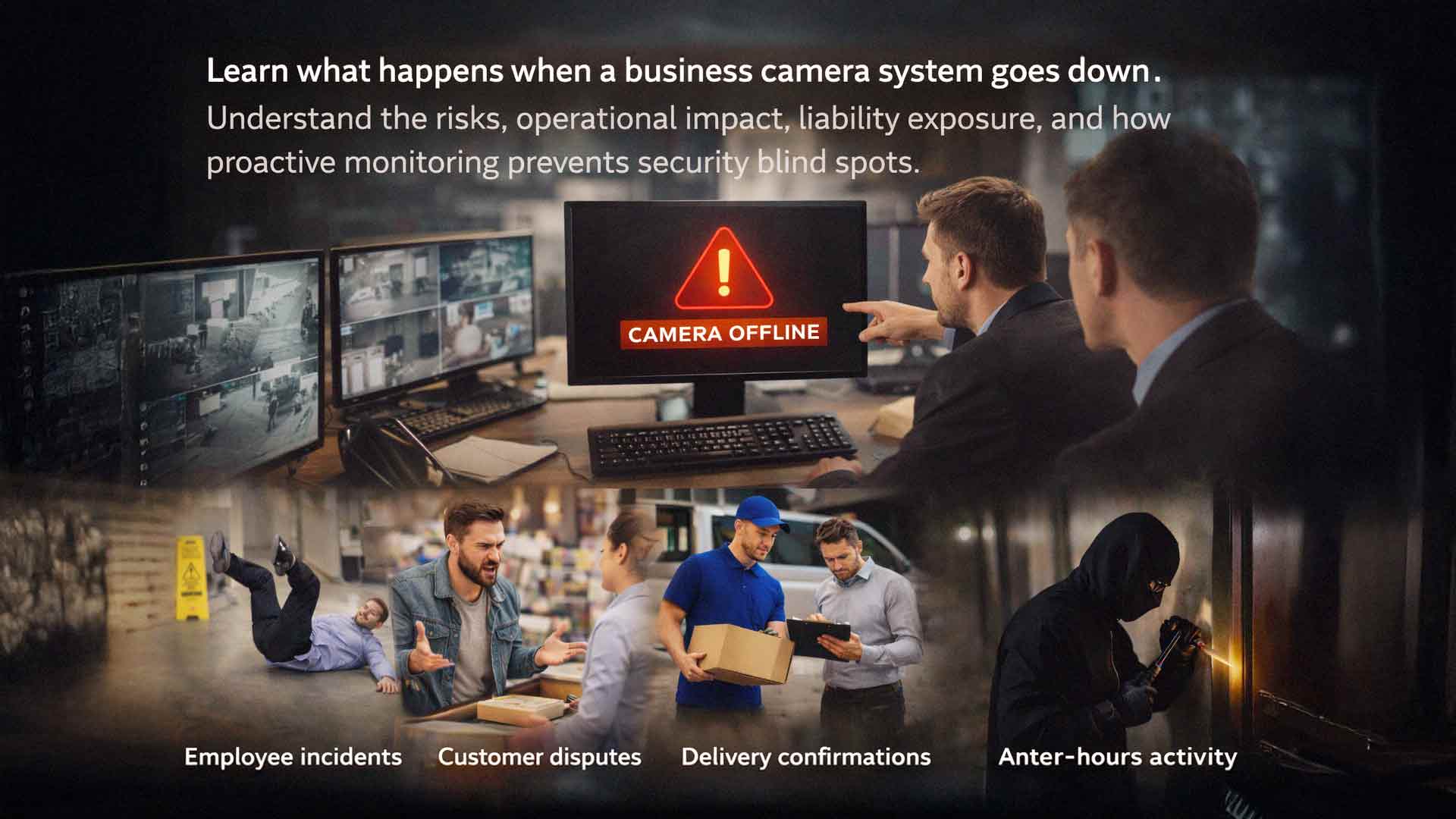
Security cameras have a strange relationship with attention. When they work, nobody thinks about them. They hang on walls and ceilings, quietly doing their job, and everyone moves on with their day. When they fail, the silence is deafening—but only in hindsight.
That's the real danger. A business camera system going down doesn't sound alarms. There are no flashing warnings, no automated phone calls, and no obvious signs that anything is wrong. Days or even weeks later, something happens—a theft, a slip-and-fall, a dispute with an employee—and you go to pull the footage. It isn't there. At that point, the damage is already done.
Understanding what actually happens when a camera system goes down helps you take smarter, more proactive steps to protect your business, your people, and your bottom line.
What "Camera System Down" Actually Means
Here's something a lot of business owners don't realize: camera downtime doesn't always mean every screen goes dark. In many cases, failure is partial or completely silent. The camera appears to be running. The light is on. The monitor shows a picture. But nothing is being recorded, stored, or retrievable.
Common camera system failures include:
- Cameras recording but not storing footage
- Footage recording but not retrievable due to corruption
- One or more cameras going offline without notification
- Network video recorder (NVR) failure
- Storage that is full or corrupted, triggering overwrites of older footage
- Power interruptions disabling recording without triggering visible alerts
- Firmware or software failures that break cloud sync or local backup
These failures share one thing in common: they often go unnoticed until footage is urgently needed. By then, the window to recover that evidence has closed.
The Immediate Operational Impact
Loss of Real-Time Visibility
The moment cameras stop recording, your business loses its ability to review events, confirm timelines, or verify what happened in a given space. That might not feel significant on a normal day. But consider what you can no longer verify:
- Employee incidents or disputes
- Customer behavior or complaints
- Delivery confirmations and inventory handling
- After-hours access or activity
- Contractor behavior on your property
Without footage, you're left with memory, statements, and assumptions—none of which hold up well in a formal dispute or legal proceeding.

Delayed Detection Compounds Losses
When a camera system fails silently, the incidents that follow don't pause to wait for your system to come back online. Theft, vandalism, and unsafe behavior continue—often repeatedly—before anyone realizes the cameras weren't working. This delay doesn't just create a single gap. It creates a window of ongoing exposure. What might have been a single incident becomes a pattern of losses that were entirely preventable.
Legal and Liability Consequences
No Evidence When You Need It Most
Camera footage is often the most important piece of evidence a business can have during:
- Insurance claims
- Employee injury investigations
- Customer slip-and-fall incidents
- Theft or vandalism cases
- Law enforcement requests
When that footage doesn't exist—because the system was down—businesses are immediately at a disadvantage. Claims become harder to contest. Settlements increase. Legal costs rise. And in many cases, insurance providers will specifically ask whether cameras were operational at the time of an incident. A system failure weakens your position before the conversation even starts.
Increased Liability Exposure Across Industries
In certain environments, video surveillance isn't just a good idea—it supports safety standards, regulatory requirements, and basic duty-of-care expectations. When camera systems fail, that coverage disappears, and assumptions can shift against the business.
This risk is especially pronounced in:
- Warehouses and distribution centers — where safety incidents are frequent and liability is high
- Retail environments — where theft, customer disputes, and employee claims are common
- Healthcare facilities — where patient and staff safety monitoring is expected
- Education settings — where security obligations are explicit
- Multi-tenant commercial buildings — where shared liability adds complexity
The absence of footage doesn't prove innocence. In many cases, it raises questions about whether reasonable security controls were in place at all.
Compliance and Regulatory Risks
Some industries carry specific expectations around video retention periods, system uptime, and the ability to produce footage during audits or investigations. When camera systems fail silently, those compliance gaps appear without warning.
Common compliance risks include:
- Missing required footage retention windows
- Inability to produce recordings during audits or investigations
- No documentation showing system uptime or monitoring history
- Failure to detect outages before they create coverage gaps
The National Institute of Standards and Technology (NIST) is clear that security systems must be actively monitored and maintained to function as effective safeguards. A camera system that is installed but not monitored creates a false sense of security—and false compliance. Being able to point to a camera on a wall is not the same as being able to demonstrate that it was recording and functional when an event occurred.
The Financial Impact Goes Deeper Than You Think
Downtime Is Expensive—Even for Small Businesses
Downtime costs are typically discussed in the context of large enterprises, and the numbers are significant. According to research cited by TechRepublic and CIO.com, unplanned downtime costs the world's largest companies an estimated $400 billion annually—roughly 9% of annual profits. For large enterprises specifically, that figure averages around $200 million per year.
Small and mid-sized businesses face lower absolute numbers, but the proportional impact is often worse. A single undetected camera outage can lead to unrecovered losses, an unsuccessful insurance claim, or a legal settlement that a larger company might absorb—but that your business cannot.
The Cost of Repeated, Undetected Incidents
When cameras are down, the same vulnerabilities that enabled a first incident remain wide open. Without footage to identify patterns or offenders, businesses often experience repeat losses from the same source—the same exit point being exploited, the same individual returning, the same shift where monitoring was absent. These compounding losses are preventable when systems are functional and monitored.
Emergency Repairs and Rushed Replacements
Camera failures that go undetected don't usually get addressed through planned, budget-friendly maintenance. They get discovered in a crisis, which means emergency service calls, after-hours technician rates, and rushed parts procurement. These costs are almost always higher than what proactive management and monitoring would have cost over the same period.
What Proactive Camera System Management Looks Like
The businesses that avoid these consequences aren't necessarily spending more money on security. They're spending it smarter—on systems that are actively monitored, regularly maintained, and designed to surface issues before they become crises.
Effective camera system management includes:
- Health monitoring with automated alerts — knowing when a camera goes offline, storage fills, or firmware needs updating
- Cloud-based video storage — eliminating single points of failure tied to on-site NVRs
- Regular system audits — confirming that footage is being recorded, stored, and retrievable
- Defined retention policies — ensuring footage is kept long enough to be useful in delayed claims
- Partner support with fast response SLAs — so when something does go wrong, you're not waiting days for a technician
Modern surveillance platforms like Verkada are built specifically to address these gaps. Verkada's cloud-managed cameras provide real-time health alerts, automatic firmware updates, and centralized visibility across all locations—all managed from a single dashboard. When a camera goes offline or storage reaches capacity, administrators are notified immediately, not weeks later when footage is already gone.
How AIS Supports Business Surveillance in Las Vegas and Southern California
AIS works with SMBs across Las Vegas, Southern California, and surrounding regions to design, deploy, and support surveillance and access control systems that actually perform when it matters. As a Verkada partner, AIS helps businesses move away from reactive, break-fix camera management toward proactive monitoring and managed support.
With a 96% NPS score and an average client relationship of over seven years, AIS brings local expertise, 24/7 support, and dedicated account managers who know your system—not just your ticket number.
Whether you're evaluating your current camera infrastructure or starting from scratch, the right conversation starts before an incident happens, not after.
Frequently Asked Questions: Business Camera System Downtime
How do I know if my business cameras have stopped recording?
Most traditional camera systems don't alert you when something goes wrong. Without active monitoring, the only way to discover a failure is to manually check footage—which most businesses only do after an incident. Cloud-managed systems like Verkada send automated alerts when cameras go offline, storage thresholds are reached, or connectivity is lost, so you know right away rather than after the fact.
Can I recover footage after a camera system failure?
It depends on the nature of the failure and how your system is configured. If footage was overwritten because storage filled up, it is typically unrecoverable. If the failure was a connectivity issue and footage was stored locally, some recovery may be possible. Cloud-based storage significantly improves recovery options because footage is written to off-site servers independently of local hardware.

Does a camera system outage affect my business insurance?
It can. Insurance providers often ask whether security systems were operational at the time of an incident. If your cameras were down and you're filing a claim that depends on video evidence, your insurer may view the missing footage unfavorably—or deny portions of the claim. Some policies include provisions around maintaining functional security infrastructure.
How long should business camera footage be retained?
Retention requirements vary by industry and jurisdiction. Most general commercial businesses benefit from a minimum 30-day retention window, though industries like healthcare, finance, and education may face longer requirements or specific regulatory standards. Your retention policy should be defined based on your industry, your legal exposure, and how quickly incidents are typically reported.
What's the difference between a camera going offline and a camera system going down?
A single camera going offline is a localized hardware or connectivity failure—one device stops recording while the rest of the system continues. A system-level failure affects recording infrastructure more broadly: the NVR fails, storage becomes full or corrupted, or a network issue takes multiple cameras offline simultaneously. Both are serious, but system-level failures create larger coverage gaps and are often harder to detect without active monitoring.
How often should a business camera system be audited?
At minimum, businesses should conduct a quarterly review of their camera system—confirming that all cameras are recording, footage is being stored correctly, storage capacity is adequate, and firmware is current. High-risk environments like warehouses, retail locations, and multi-tenant buildings may benefit from monthly checks or continuous automated monitoring.
What should I look for in a business surveillance partner?
Look for a partner who offers more than equipment installation. You want a provider with proactive monitoring capabilities, a defined service-level agreement for response times, local technicians who can respond quickly, and experience working in your industry. Ask specifically how they handle failure detection—whether the system alerts them or whether you're responsible for discovering issues yourself.
Topics:
