
Businesses face a wide range of liability risks every single day. A customer slips in your lobby. An employee reports a workplace injury. A delivery driver claims property damage happened during unloading. In many of these situations, the truth is not immediately clear.
Without evidence, liability disputes often come down to conflicting statements. Investigations drag on longer. Legal costs climb. Insurance claims get complicated fast.
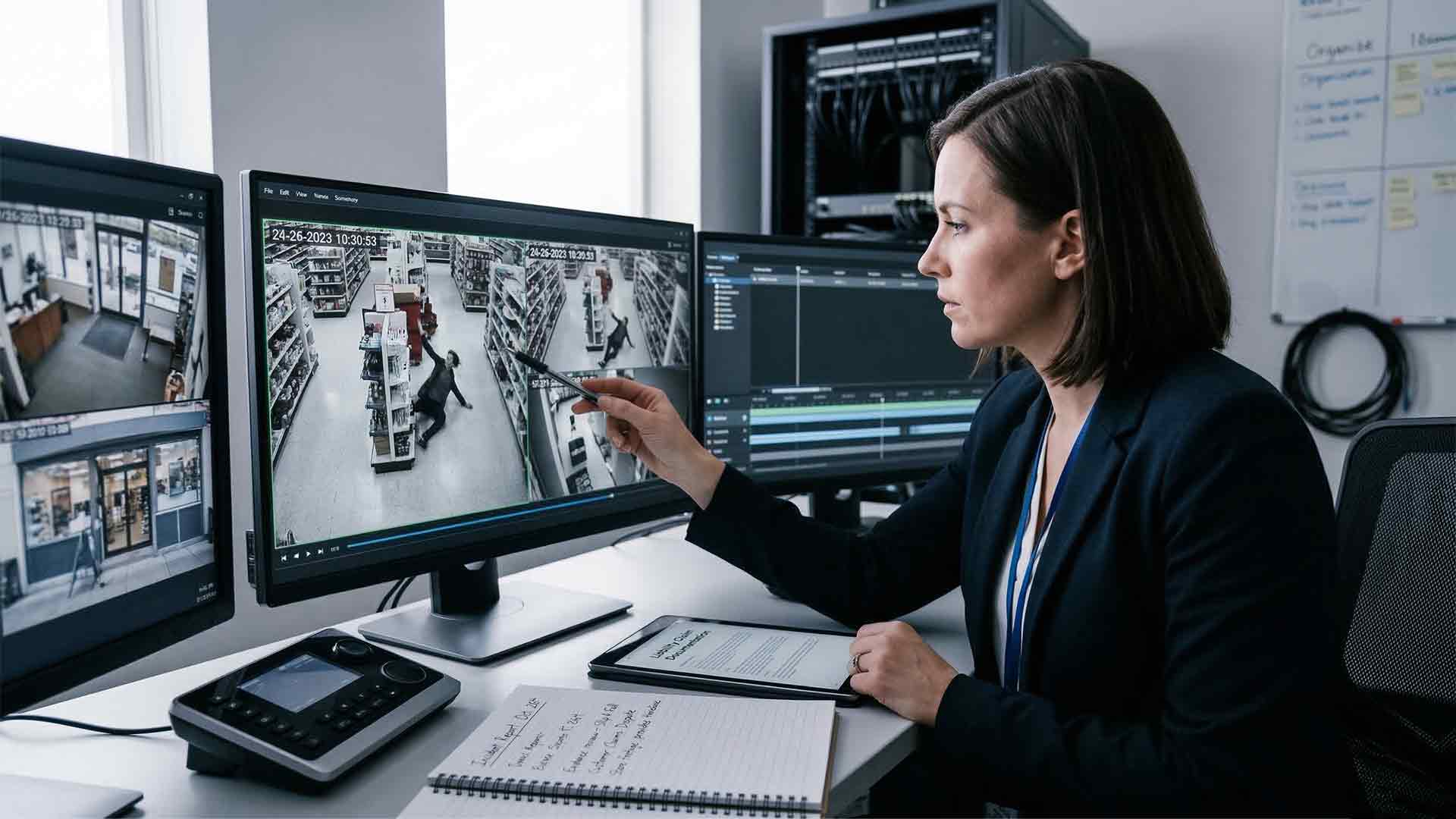
Business video surveillance helps reduce that uncertainty by providing objective, visual evidence of what actually occurred. For many organizations, security cameras serve not only as a safety tool but as a primary means of protection against costly liability claims — and in 2026, that function has never been more important.
What Types of Liability Claims Do Businesses Commonly Face?
Before we look at how surveillance helps, it's worth understanding what you're actually protecting yourself against. Several types of incidents frequently lead to liability claims:
- Customer slip-and-fall accidents
- Workplace injury reports
- Property damage claims
- Theft or loss allegations
- Employee conduct disputes
- Delivery or vendor incidents
- Parking lot altercations
- Harassment or discrimination allegations
When these situations occur, businesses must quickly determine exactly what happened — and more importantly, prove it. Video surveillance provides an accurate, time-stamped record of events that becomes critical during insurance investigations and legal proceedings.
How Does Video Surveillance Provide Objective Evidence?
One of the most valuable benefits of commercial surveillance is objectivity. Human memory is unreliable, especially in stressful or high-pressure situations. Witnesses may remember events differently, miss key details, or provide incomplete information — not necessarily out of dishonesty, but simply because that's how memory works.
Video recordings don't have that problem. Footage captures events as they happen and can confirm:
- The exact sequence of events
- The behavior of everyone involved
- Environmental conditions at the time (lighting, wet floors, debris)
- Whether safety procedures were followed
- The precise time and date of the incident
Clear, documented footage helps investigators, insurers, and legal teams understand what actually occurred without relying solely on subjective accounts.
What About AI-Powered Surveillance?
It's worth noting that as surveillance systems become more sophisticated in 2026, many businesses are moving toward AI-enhanced cameras that can automatically flag unusual activity, detect falls, or identify restricted-area access violations in real time.
However, as Forbes noted in a 2026 analysis of AI surveillance adoption, many organizations still evaluate these systems primarily on features, dashboards, and price — without fully accounting for the legal and operational responsibilities that come with them. If your business is considering AI-powered surveillance, it's important to understand not just what the technology can do, but how footage is stored, who can access it, and what your legal obligations are in your jurisdiction.
That's a question your security provider should be helping you answer.
How Do Security Cameras Help Prevent False Claims?
Unfortunately, not every liability claim is legitimate. Some are exaggerated. Some are entirely fabricated. Without evidence, businesses may feel pressured to settle disputes simply to avoid the cost and complexity of legal action — even when the claim is false.
Security cameras provide a powerful defense against fraudulent claims. Video footage can reveal situations such as:
- Individuals intentionally staging a fall or injury
- Accidents that occurred outside your business property or hours
- Customers deliberately ignoring posted safety warnings
- Incidents that simply did not happen the way they were described
When visual evidence contradicts a claim, your legal and insurance positioning improves significantly. The footage does not argue. It does not have a stake in the outcome. It just shows what happened.
For businesses in high-traffic environments — retail floors, warehouses, parking lots, lobbies — this kind of protection is not a luxury. It's a practical necessity.

How Does Surveillance Support Insurance Investigations?
Insurance providers rely on accurate documentation during claims investigations. Video surveillance helps insurers evaluate incidents more quickly and with greater confidence.
Footage may provide insight into:
- The exact time and location of the incident
- Environmental hazards that were present
- Whether warning signs were visible and properly placed
- Actions taken immediately after the event by staff or bystanders
This evidence can accelerate claims resolution and reduce disputes between insurers and policyholders. Businesses that consistently maintain usable video evidence often experience smoother, faster insurance processes — and over time, that track record may influence their coverage costs.
It's also worth noting: if your business cannot produce footage because it was overwritten, corrupted, or simply never recorded properly, that gap can actually work against you. Insurers and courts may draw negative inferences when documentation that should reasonably exist is unavailable.
Your surveillance system is only as valuable as its reliability. That means adequate storage, proper camera positioning, and regular system maintenance are not optional considerations.
Documenting Workplace Safety Compliance
Workplace safety plays a major role in liability protection, and video surveillance allows organizations to verify whether safety protocols were actually followed during an incident — not just whether they were documented on paper.
For example, footage may confirm:
- Proper equipment usage by employees
- Compliance with training procedures
- Safe operating practices in high-risk areas
- Restricted area access control and whether protocols were respected
This matters because workplace injury claims often hinge not just on whether an injury occurred, but on whether the employer met their duty of care. Having video evidence that demonstrates your team followed proper safety procedures can be the difference between a defensible claim and a costly settlement.
Protecting Your Business From Property Damage Claims
Property damage claims may arise from:
- Vendor or supplier deliveries
- Contractor work on-site
- Equipment movement or installation
- Parking lot incidents
Without visual records, determining responsibility is genuinely difficult. Security cameras positioned around loading docks, parking areas, entryways, and active workspaces can clearly document what happened and when.
Footage may show:
- When damage actually occurred
- Who was present at the time
- Whether equipment was operated properly
- Whether your property was already damaged before a vendor arrived
This kind of documentation shifts liability disputes from "he said, she said" to clear factual records — which benefits everyone involved.
What Are the Legal Considerations for Business Video Surveillance?
This is an area many businesses overlook when setting up surveillance systems. Recording video in commercial spaces is generally permitted, but there are important legal boundaries to understand.
Deloitte's legal guidance on employer video surveillance reinforces a key principle: surveillance use should be tied to legitimate business purposes — such as employee safety, property protection, or operational oversight — and should not extend into areas where individuals have a reasonable expectation of privacy.
In practice, this means:
- Cameras in public-facing areas (lobbies, retail floors, parking lots, warehouses) are generally acceptable
- Cameras in restrooms, changing areas, or private offices are not
- Employees should typically be informed that video surveillance is in use
- Data retention policies should be documented and followed consistently
As surveillance systems grow more capable in 2026 — including AI features like behavioral analysis and facial recognition — the legal framework around their use is still catching up. Working with an experienced security provider helps ensure your system is not only effective but legally defensible.
How Long Should You Retain Surveillance Footage?
Retention policies vary depending on your industry, location, and the nature of your business. As a general guideline:
- 30 days is the minimum most businesses should maintain
- 60–90 days is common for retail, healthcare, and high-traffic commercial spaces
- Longer retention may be appropriate if you're in a regulated industry or have experienced prior claims
The key is having a documented retention policy and following it consistently. Ad hoc deletion or inconsistent storage practices create gaps that can hurt you in a dispute.
Cloud-based surveillance platforms — like those offered through Verkada — make retention management significantly easier, with scalable storage that does not rely on on-site hardware that can fail or be tampered with.
Choosing the Right Surveillance System for Liability Protection
Not all camera systems are created equal when it comes to protecting against liability claims. When evaluating options, look for:
- High-definition video quality — footage that is too grainy to be useful defeats the purpose
- Wide coverage angles with minimal blind spots in key areas
- Reliable, redundant storage (cloud-based or hybrid)
- Accurate timestamps and metadata
- Easy retrieval for specific incidents without requiring IT expertise
- Integration with access control systems for a complete picture of who was where
At AIS, we help businesses across Las Vegas, Southern California, and surrounding regions design and deploy surveillance systems built specifically for their risk profile. We work with Verkada — a cloud-managed platform trusted by thousands of organizations — to deliver systems that are both easy to manage and built to hold up when you need them most.
FAQ: Business Video Surveillance and Liability Claims
1. Can video surveillance footage be used as evidence in court?
Yes. Video footage is routinely admitted as evidence in civil and criminal proceedings. For footage to be most useful, it needs to be properly authenticated — meaning you can demonstrate it has not been altered and that it accurately represents the time and location of the incident.
2. Do I need to tell employees they are being recorded?
In most U.S. jurisdictions, employers are required to inform employees that surveillance is in place, particularly in workplaces. The specific requirements vary by state. Your legal counsel or a knowledgeable security provider can help you understand the rules in your area.
3. What happens if my camera didn't capture the incident clearly?
Poor footage quality, camera blind spots, or storage failures can weaken your defense significantly. In some cases, the absence of footage that should reasonably exist can be used against you. This is why regular system maintenance, proper camera positioning, and adequate storage are so important.
4. How does cloud-based surveillance improve liability protection?
Cloud-based systems reduce the risk of footage being lost due to hardware failure, theft of on-site recording equipment, or tampering. They also typically offer better retention management and easier remote access when you need to pull specific footage quickly.
5. Can surveillance cameras reduce my business insurance premiums?
Possibly. Many insurers view documented security measures — including video surveillance — favorably when assessing risk. You should speak directly with your insurance provider about how your security infrastructure may affect your policy.

6. What areas of my business should have cameras for liability protection?
Focus on high-traffic and high-risk areas: building entrances and exits, lobbies and waiting areas, parking lots, loading docks, warehouses, retail floors, and any location where cash or valuable inventory is handled. Your security provider can help you conduct a site assessment to identify gaps.
7. How do I choose between an on-premise and cloud-based surveillance system?
On-premise systems give you direct control over hardware and storage but require ongoing maintenance and are vulnerable to physical damage or theft. Cloud-based systems offer remote access, automatic updates, and more reliable storage — making them a practical choice for most SMBs. Many businesses use a hybrid approach.
Protect Your Business Before the Next Claim Happens
Liability claims are unpredictable. They can arise from a routine delivery, a rainy afternoon in your parking lot, or a misunderstanding between an employee and a customer. The businesses that handle these situations best are not the ones that react fastest — they are the ones that already have the documentation in place.
Business video surveillance is one of the most cost-effective ways to protect your organization from the financial, legal, and reputational consequences of liability disputes. It provides objective evidence, supports your insurance process, and gives your team a clear record to work from when something goes wrong.
At AIS, our team helps SMBs across Las Vegas, Southern California, and the surrounding region build surveillance systems that are designed for real-world liability protection — not just perimeter security. We combine expert site assessments, trusted hardware from Verkada, and ongoing support from a local team that knows your business.
Ready to protect your business? Let's talk.
Topics:
