If you're still handing out physical keys to employees, you already know the headaches that come with it. Someone loses a key. A former employee walks off with one. You have no idea who entered the server room last Tuesday at 9:47 p.m. The anxiety adds up fast.
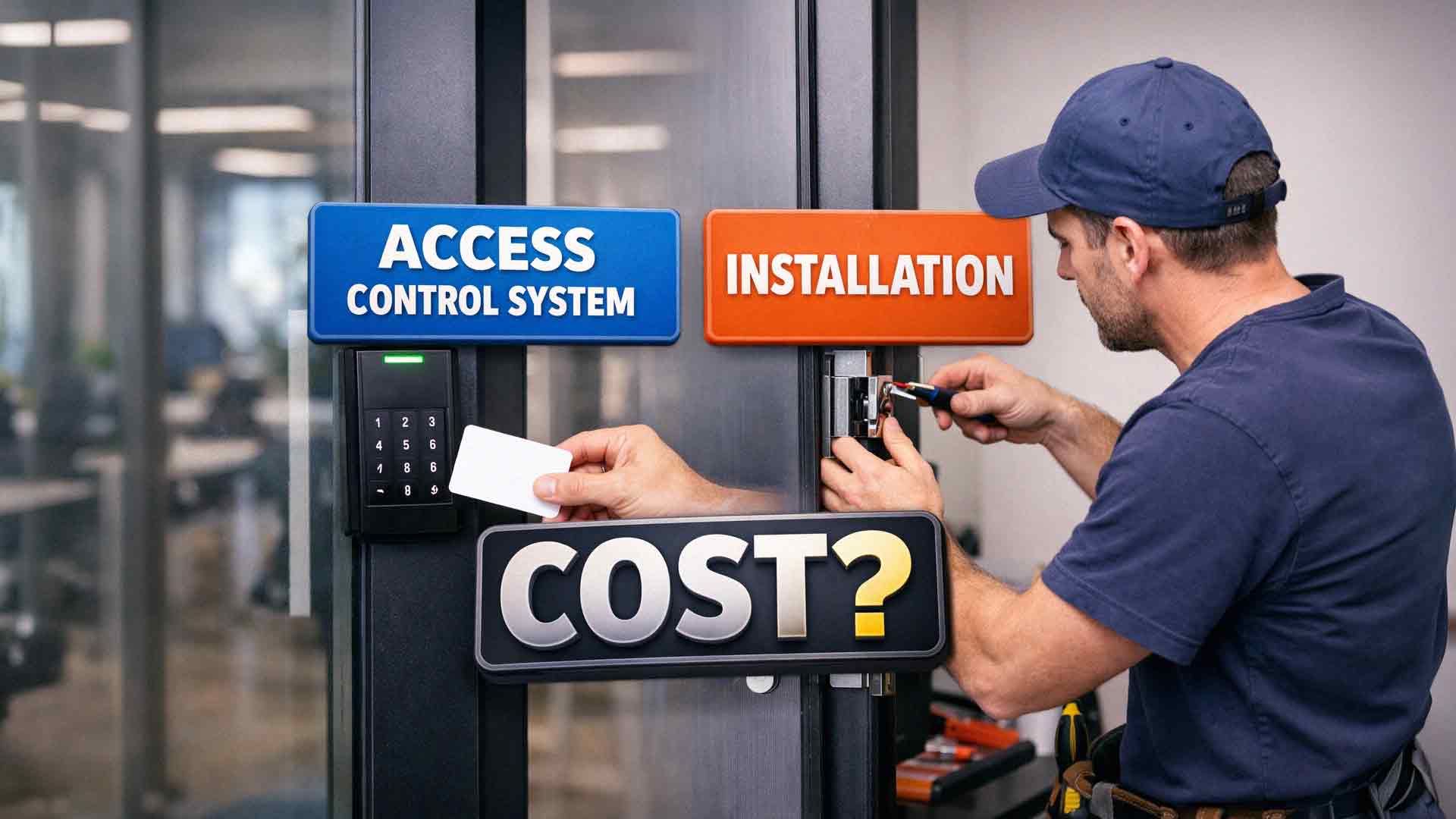
Access control systems are the direct answer to all of that. But before you commit to anything, you need to understand one critical number: what does business access control actually cost per door?
That's exactly what this article covers. You'll get a realistic breakdown of hardware, installation, software licensing, credentials, and ongoing support—everything that factors into the total price. No vague ranges. No buried fine print.
What Is a Business Access Control System?
An access control system replaces traditional keys with electronic authentication methods. Instead of metal keys, your employees and contractors use credentials like:
- Key cards or fobs
- Mobile phone credentials
- PIN codes
- Biometric scanners (fingerprint or facial recognition)
The system reads those credentials, verifies permissions, and unlocks the door—all in a fraction of a second. Administrators manage everything from a central dashboard, often from anywhere with an internet connection.
Modern commercial access control systems are used across industries:
- Office buildings and corporate campuses
- Warehouses and distribution centers
- Healthcare facilities and clinics
- Schools and universities
- Retail locations and data centers
The most important thing to understand is that the cost per door is not a single fixed number. It depends on the hardware you choose, how your building is wired, what software platform you run, and whether you're securing one door or fifty.
What Does Business Access Control Cost Per Door in 2026?
Here's the honest answer: most businesses spend between $1,500 and $5,000+ per door when you factor in all the components—hardware, installation, and software. Some simple, low-security doors can come in below that. High-security environments with biometric readers and multi-factor authentication can run significantly higher.
To make sense of why the range is so wide, let's break each cost category down individually.

Hardware Costs for Access Control Systems
Hardware is typically the largest upfront expense. Every controlled door needs its own set of components. Depending on the system you choose, a standard door setup might include:
- Electronic door lock or electrified lockset
- Card or credential reader
- Door controller (sometimes called an access panel)
- Electric strike or magnetic lock
- Power supply and backup battery
- Request-to-exit (REX) sensor
- Door position sensor
For a basic single-door setup with a cloud-managed reader, hardware costs alone often fall between $500 and $1,500 per door. Add biometric readers, dual-authentication devices, or ruggedized outdoor hardware, and you can push well past that range.
Cloud-Based vs. On-Premise Systems
Cloud-based platforms like Verkada have changed how businesses think about access control hardware. Verkada's access control readers are purpose-built for cloud management—they're PoE (Power over Ethernet) enabled, which simplifies installation by eliminating the need for separate power runs to each door. That architectural decision can meaningfully reduce both hardware costs and installation time.
On-premise systems typically require dedicated server hardware, which adds cost at the infrastructure level even if per-door reader prices look competitive on the surface.
Installation Costs Per Door
Installation is where costs can swing dramatically depending on your building's age, layout, and existing infrastructure.
A typical door installation involves:
- Running low-voltage wiring to the reader and lock
- Installing the locking hardware on the door and frame
- Mounting and configuring the credential reader
- Connecting to the network or control panel
- Programming credentials and testing the door
In a newer commercial building with accessible ceilings and structured wiring already in place, installation per door might run $300 to $700. In an older building where walls need to be opened, conduit needs to be run, or door frames need to be modified, you could see $800 to $1,500+ per door just in labor.
Retrofit projects are almost always more expensive than new construction. If your building predates electronic access infrastructure, budget accordingly.
Software and Licensing Costs
Most modern access control systems are software-driven. The management platform is where you control user permissions, review entry logs, issue or revoke credentials, and integrate with other security systems like cameras.
Software pricing structures vary:
- Subscription (SaaS) model: Monthly or annual fee per door or per user. Common in cloud-based platforms. You always have the latest features and firmware without managing updates yourself.
- One-time license purchase: Higher upfront cost, but no recurring software fees. You may pay separately for updates or support.
For cloud platforms, expect to budget $10 to $30+ per door per month for software licensing, depending on the platform and feature tier. Some vendors bundle licensing into the hardware price for a set term.
Verkada, for example, uses a licensing model that includes cloud management, remote access, real-time alerts, and video intercom integration when paired with their camera ecosystem. That bundled approach can simplify total cost-of-ownership math for growing businesses.
Over a 5-year window, software licensing can represent 20–35% of your total access control investment. Don't overlook it when comparing systems upfront.
Credential Costs
Every person who needs access needs a credential. Your main options:
- Key cards (HID, MIFARE, etc.): Typically $3–$10 per card
- RFID fobs: Similar range to key cards, slightly higher for ruggedized versions
- Mobile credentials: Often managed through a per-user subscription or included in the platform license
Mobile credentials are increasingly preferred because they eliminate the cost and hassle of physical cards. Employees use their smartphone as their badge. Lost phone? Revoke the credential remotely in seconds—no rekeying, no reissuing cards, no security gap.
For a 50-employee company using physical cards, initial credential costs might be $150–$500. It's not a budget-breaker on its own, but factor in card replacements over time.
Ongoing Maintenance and Support Costs
Access control isn't a set-it-and-forget-it purchase. Ongoing costs include:
- Software updates and firmware patches
- Hardware inspections and preventive maintenance
- Credential management (adding/removing users)
- Technical support
- Battery replacements for wireless locks
Cloud-managed systems handle software updates automatically, which reduces one maintenance burden. But physical hardware still needs attention over time.
Budgeting $100 to $300 per door annually for maintenance and support is a reasonable baseline for most SMBs. Managed service agreements—where a provider like AIS handles all of this for you—can simplify the process and keep costs predictable.
What Affects Total Access Control Cost the Most?
Several variables have an outsized impact on where your project lands in the pricing range:
1. Number of doors
More doors generally lower the per-door cost. Vendors offer volume pricing on hardware and software. A 20-door project almost always costs less per door than a 3-door project.
2. Building type and age
Older buildings with no existing infrastructure cost significantly more to wire and retrofit.
3. Security level required
Standard card readers cost far less than biometric readers or multi-factor authentication setups.
4. Outdoor vs. indoor installations
Outdoor readers require weatherproofing, vandal resistance, and sometimes additional power considerations—all of which add cost.
5. Integration requirements
Integrating access control with your IP camera system, visitor management platform, or HR directory adds complexity and cost but also delivers meaningful operational value.
6. Cloud vs. on-premise
Cloud systems trade higher recurring software costs for lower IT infrastructure investment and easier remote management. On-premise systems may suit organizations with specific data sovereignty requirements.
Is Access Control Worth the Investment?
Let's be direct: access control is not cheap. A 10-door system could easily run $20,000–$40,000 installed, depending on specifications. That's a real number.
But consider the alternative costs:
- Rekeying your entire building after a key is lost or an employee is terminated can cost $500–$3,000+ per incident
- A single security breach in a commercial setting can result in far greater losses—theft, liability, regulatory fines depending on your industry
- The time your office manager spends manually tracking who has which key, issuing replacements, and chasing down unreturned keys
Modern access control also delivers capabilities that traditional keys simply can't match: real-time entry logs, remote door unlocking, scheduled access windows, immediate credential revocation, and integration with surveillance cameras for visual verification of who accessed what and when.
For most SMBs, the question isn't really *if* they'll upgrade to access control—it's *when* and *how to budget for it.*
Frequently Asked Questions About Business Access Control Costs
How much does access control cost per door for a small business?
For a small business securing 1–5 doors with a cloud-based system, expect to pay $1,500 to $3,500 per door all-in, including hardware, installation, and first-year software licensing. Simple interior doors fall at the lower end; exterior or high-security doors land at the higher end.
Is there a monthly fee for access control systems?
Most modern cloud-based access control platforms charge a monthly or annual subscription fee. This typically runs $10 to $30+ per door per month depending on the platform and features. Some vendors offer multi-year prepay options at a discount.
Can I add access control to existing doors without major renovation?
Yes, in many cases. Wireless access control readers and smart locks can be retrofitted to existing doors with minimal wiring. However, hardwired systems offer more reliability and are generally preferred for commercial environments. The feasibility depends on your door hardware and building infrastructure.
What's the difference between cloud-based and on-premise access control?
Cloud-based systems (like Verkada) store access data and management software on remote servers. You manage everything through a web or mobile app, and updates happen automatically. On-premise systems store data locally on a dedicated server. Cloud systems have lower upfront costs but ongoing subscription fees. On-premise systems have higher upfront costs but may have lower long-term software costs.
How long does it take to install an access control system?
A single-door installation typically takes 2–4 hours for a standard commercial door with accessible wiring paths. A multi-door enterprise project can span several days to weeks depending on scope. Cloud-based systems often reduce commissioning time because there's no on-site server to configure.

What credentials are most secure for commercial access control?
Mobile credentials on modern smartphones are generally considered more secure than traditional key cards because they leverage the phone's built-in encryption and can be instantly revoked. Biometric readers (fingerprint or facial recognition) offer the highest security level but come at a significant hardware premium.
Does AIS provide access control installation and support in Las Vegas and Southern California?
Yes. AIS serves businesses throughout Las Vegas, Southern California, and surrounding regions. We partner with Verkada for enterprise-grade access control and provide local installation, ongoing support, and managed service options. Our team can assess your building, provide a detailed quote, and help you build a system that fits your security needs and budget.
Ready to Get Real Pricing for Your Building?
Understanding access control costs on paper is a good start. Getting an accurate quote for *your* specific building, door count, and security requirements is what actually moves the needle.
The team at AIS has helped hundreds of SMBs across Las Vegas and Southern California design and deploy access control systems that match their budgets and security goals. We don't do one-size-fits-all recommendations. We do honest assessments and real numbers.
Schedule a Free Consultation — Walk through your building's needs with an AIS security specialist at no cost.
Contact AIS Today — Have a quick question or want to get the process started? Reach out and we'll get back to you fast.
Topics:
