
Security cameras are no longer optional for most businesses. They protect property, support liability claims, deter theft, and give you visibility you simply cannot get any other way. But when you start comparing systems, one question comes up almost immediately: should you choose CCTV or IP cameras?
At a glance, both record video. In practice, they operate in fundamentally different ways. The technology behind each system affects everything — image quality, installation complexity, storage options, remote access, and long-term scalability.
This article breaks down what each system actually is, where each one performs well, and what you need to weigh before making a decision for your business.
What Is a CCTV Camera System?
CCTV stands for closed-circuit television. These systems use analog cameras that transmit video signals through physical coaxial cables to a central recording device — typically a Digital Video Recorder (DVR).
The term "closed-circuit" means the video feed is contained within a specific system. It is not broadcast publicly. That isolation is actually one of CCTV's traditional security advantages.
Key characteristics of CCTV systems include:
- Analog video transmission
- Direct connection to DVR units
- Dedicated coaxial cabling for each camera
- Localized video storage
- Lower hardware costs at entry level
CCTV technology has been used for decades and has a proven track record. In fact, NIST has documented extensive real-world examples of CCTV supporting law enforcement, including the identification and apprehension of suspects in high-profile cases in the United Kingdom — a country with one of the largest CCTV deployments in the world.
CCTV is not obsolete. For certain business environments, it remains a practical and cost-effective choice.
What Is an IP Camera System?
IP cameras use digital technology. Instead of transmitting an analog signal over coaxial cable, they send video data as digital packets across a network — the same type of network your computers and phones use every day.
Key characteristics of IP camera systems include:
- Digital video transmission
- Network-based connectivity via Ethernet or WiFi
- Power over Ethernet (PoE) capability — meaning one cable handles both data and power
- Integration with cloud storage, Network Video Recorders (NVRs), or hybrid storage models
- Remote access through mobile devices and web browsers
- Higher resolution and advanced image processing
IP cameras are the dominant choice for modern business security installations. Their flexibility, image quality, and integration capabilities make them a strong fit for businesses that are growing, managing multiple locations, or want more control over their security data.

Key Differences Between CCTV and IP Cameras
Let's get specific. Here is how these two systems compare across the factors that matter most to business owners.
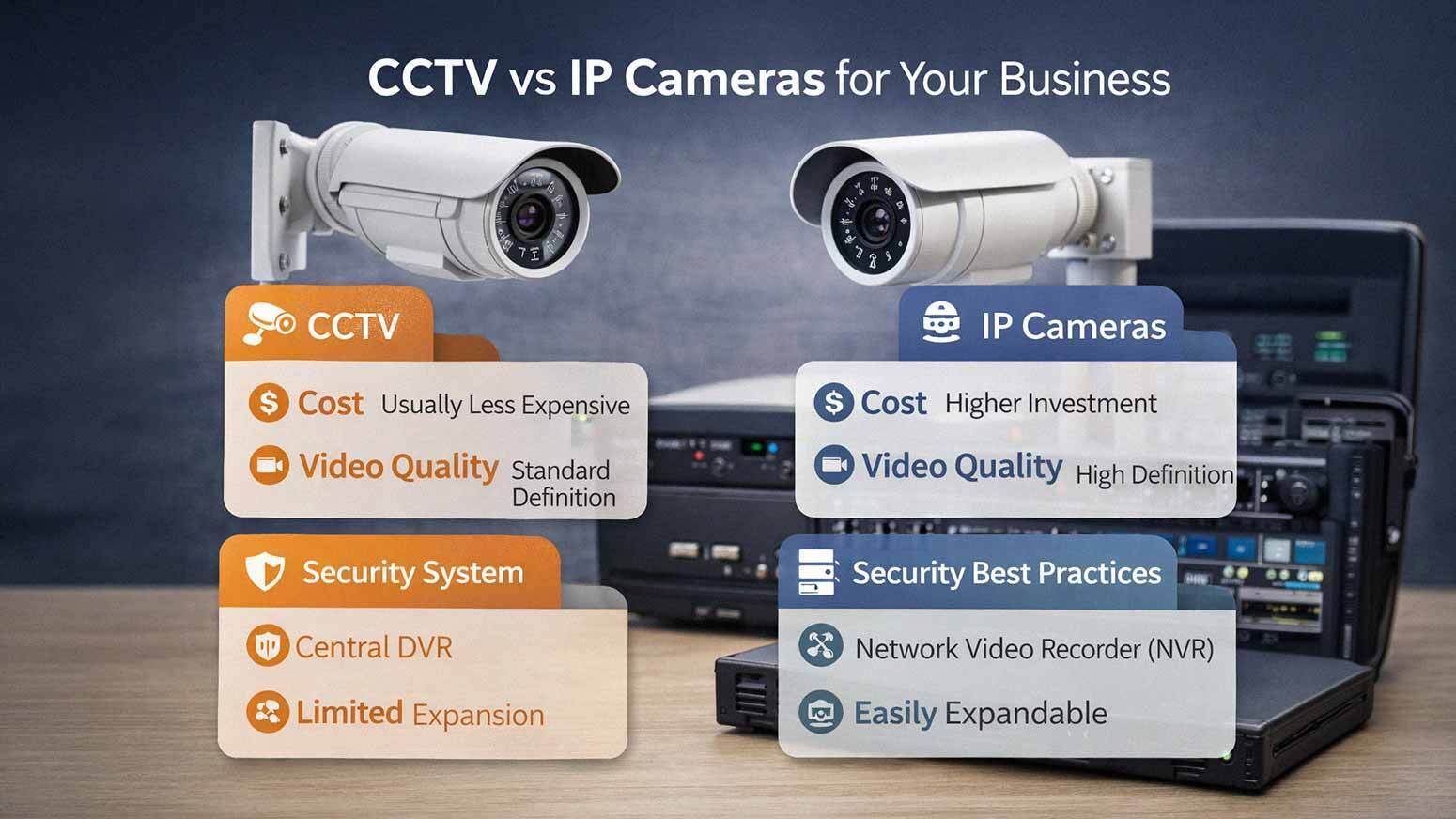
Video Quality
This is where the gap is most obvious
CCTV systems typically deliver:
- Standard definition footage (often 700–1000 TVL analog resolution)
- Limited detail when zooming in on recorded footage
- Acceptable clarity for general monitoring, less useful for identifying individuals at a distance
IP camera systems deliver:
- Full HD, 4K, or even higher resolution depending on the camera
- Significantly better image clarity, especially in wide-angle coverage areas
- Advanced image processing features like wide dynamic range (WDR) and low-light performance
- Reliable zoom with retained detail
If you ever need to use footage for a legal claim, insurance dispute, or employee investigation, image quality matters enormously. Grainy, low-resolution footage that cannot clearly identify a face or a license plate is far less useful than crisp, high-definition video.
Installation and Cabling
Installation complexity is a real cost factor that often gets overlooked in initial quotes.
CCTV installation requires:
- Dedicated coaxial cable run from every single camera to the DVR
- Separate power connections for each camera
- More labor-intensive installation in large or multi-floor environments
IP camera installation typically uses:
- A single Ethernet cable per camera that carries both data and power (PoE)
- Network switches that connect multiple cameras efficiently
- Existing network infrastructure when available, which can significantly reduce installation costs
According to Forbes, wired security cameras that use PoE cabling receive both power and data through one cable connected to the central hub — a cleaner, more efficient approach than the traditional coaxial setup. In environments where network infrastructure already exists, IP camera deployment can be meaningfully faster and less disruptive than running CCTV cabling.
Scalability
If your business grows, your security system needs to grow with it.
CCTV scalability challenges:
- Every new camera requires a new dedicated cable run to the DVR
- DVR units have fixed channel limits, so expansion may require a full hardware upgrade
- Adding cameras across a second location means duplicating the entire infrastructure
IP camera scalability advantages:
- New cameras connect to existing network switches
- NVR systems and cloud platforms can often accommodate additional cameras with minimal hardware changes
- Multi-location management is far more practical — one platform can monitor cameras across different sites simultaneously
For businesses that anticipate growth or manage more than one physical location, the scalability advantage of IP cameras is substantial.
Remote Access and Monitoring
This is one of the most requested features businesses ask about in 2026.
CCTV remote access:
- Limited and often requires additional hardware or third-party software
- Setup can be technically cumbersome
- Not designed natively for remote viewing
IP camera remote access:
- Built-in remote viewing through dedicated mobile apps or web portals
- Live video streaming from anywhere with an internet connection
- Real-time alerts based on motion detection, unusual activity, or camera tampering
- Cloud-based monitoring options that require no on-site viewing station
If you travel frequently, manage a team remotely, or want your security team to have real-time visibility without being physically present, IP cameras are the clear choice.
Storage Options
How and where you store video footage affects both your operating costs and your ability to retrieve footage when you need it.
CCTV storage:
- Relies almost entirely on DVR-based local storage
- Storage capacity is fixed by the DVR's hard drive
- Expanding storage means physically replacing or upgrading hardware
IP camera storage:
- Network Video Recorders (NVRs) for local storage
- Cloud storage with flexible retention periods
- Hybrid models that combine local and cloud storage for redundancy
- Easier to scale storage capacity without replacing cameras
Cloud storage options in particular give businesses the ability to retrieve footage even if on-site equipment is damaged, stolen, or tampered with — a meaningful advantage in a theft or break-in scenario.
Security and Cybersecurity Considerations
This is a factor that has drawn more attention as IP systems have become more prevalent.
CCTV security profile:
- Isolated, closed-circuit design limits exposure to network-based attacks
- Harder to access remotely because it is not connected to an open network
- Physical tampering remains the primary vulnerability
IP camera security profile:
- Network-connected systems do carry cybersecurity risk if not properly secured
- Default passwords, unpatched firmware, and unsecured networks are the most common vulnerabilities
- Reputable IP camera platforms (like Verkada, which AIS partners with) include enterprise-grade encryption, automatic firmware updates, and zero-trust architecture to mitigate these risks
- Proper network configuration by a qualified provider dramatically reduces exposure
The cybersecurity concern with IP cameras is real, but it is manageable with the right system and the right installation partner. It should not be a reason to default to CCTV if IP cameras are otherwise the better fit.
Which System Is Right for Your Business?
There is no single right answer. It depends on your situation.
CCTV may be the better fit if:
- You have an existing analog infrastructure you are not ready to replace
- Your budget is very limited and basic monitoring is sufficient
- Your environment is small, single-location, and unlikely to expand
- You do not need remote access or high-resolution footage
IP cameras are likely the better fit if:
- You want HD or 4K video quality
- You manage multiple locations or plan to grow
- Remote access and real-time alerts are important to you
- You want flexible, scalable storage options
- You are starting a new installation with no existing infrastructure to preserve
For most businesses evaluating a new or upgraded security system in 2026, IP cameras offer a better long-term investment. The gap in capability, flexibility, and image quality has widened considerably over the past several years.
Frequently Asked Questions: CCTV vs IP Cameras
1. Are CCTV cameras completely obsolete?
Not entirely. CCTV systems still function and are used in many businesses, particularly those with older infrastructure already in place. However, for new installations, IP cameras offer meaningful advantages in almost every category. If you are starting fresh, CCTV is rarely the recommended path.
2. Can I mix CCTV and IP cameras in the same system?
In some cases, yes. Hybrid DVR/NVR systems exist that can accommodate both analog and IP cameras. This can be a practical option if you want to modernize gradually without replacing everything at once. An AIS security specialist can assess your current setup and recommend the most cost-effective transition approach.
3. Are IP cameras harder to install than CCTV?
IP cameras can actually be simpler to install in environments that already have network infrastructure. The PoE cabling eliminates the need for separate power connections, and wireless IP cameras can be deployed without running any new cabling at all. That said, proper configuration — especially for security and remote access — benefits from professional installation.
4. How much do IP camera systems cost compared to CCTV?
IP cameras generally carry a higher per-unit cost than analog CCTV cameras. However, installation costs can offset this difference in modern buildings with existing network infrastructure. Over a 3–5 year window, the total cost of ownership is often comparable once you factor in the higher quality footage and lower ongoing maintenance needs of modern IP systems.
5. What happens to my footage if the internet goes down?
This depends on your storage setup. If you use an NVR for local storage, your cameras continue recording even without an internet connection. Cloud-only setups would be interrupted during an outage. Most enterprise IP camera platforms, including Verkada, offer local edge storage as a backup to ensure continuous recording regardless of connectivity.

6. How do I know if my business needs a security camera system at all?
If you have physical assets, employees, customers, or inventory on-site, a security camera system adds a meaningful layer of protection and accountability. Beyond theft prevention, cameras support insurance claims, HR investigations, compliance documentation, and general operational oversight. The question for most businesses is not whether to have cameras, but which type fits their needs.
7. Does AIS offer surveillance and security camera installation?
Yes. AIS partners with Verkada to provide cloud-managed IP camera systems for businesses across Las Vegas, Southern California, and surrounding regions. AIS handles the full installation, configuration, and ongoing support. If you want to understand what a system would look like for your specific environment, schedule a free consultation and an AIS specialist will walk you through the options
Make a Decision That Serves Your Business Long-Term
Choosing between CCTV and IP cameras is not just a technology question — it is a business decision. The right system should match where your business is today *and* where you expect it to be in three to five years.
CCTV served businesses well for decades. IP cameras have expanded what security systems can do, at a quality level that was not available at mainstream price points until recently. For most businesses evaluating their options right now, IP cameras represent the stronger long-term choice.
If you are not sure where to start, or if you want a professional to evaluate your current setup and give you an honest recommendation, AIS is here to help.
Schedule a Free Consultation — No pressure. Just answers.
Contact AIS Today — Talk to a local security specialist who knows your market.
*Marissa Poston is a Content Writer at AIS (Advanced Imaging Solutions), helping businesses across Las Vegas and Southern California make smarter technology decisions. AIS holds a 96% Net Promoter Score and has maintained an average client relationship of 7+ years.*
Topics:
