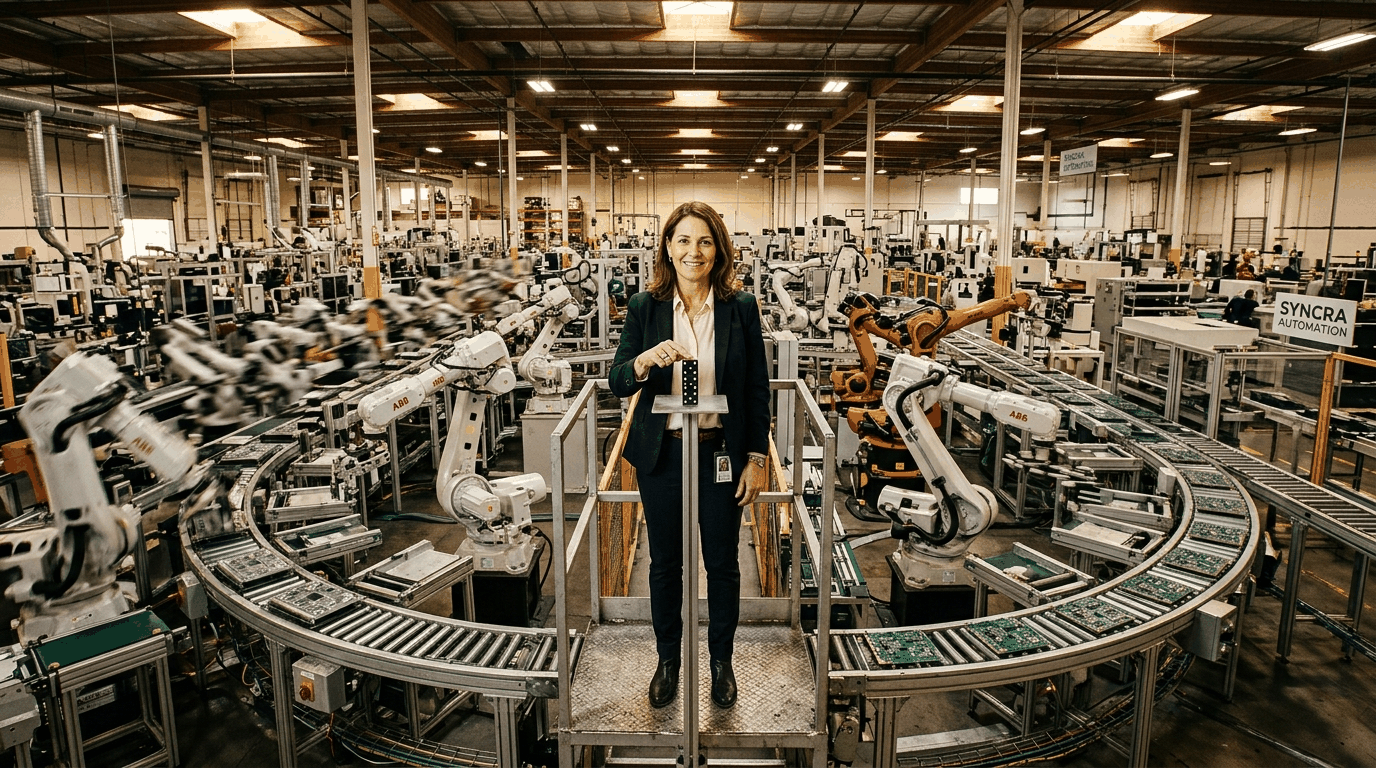
Manufacturing in Southern California is moving faster than most plant managers expected. AI workflow automation has gone from a conference-room buzzword to a real operational tool, one that's compressing cycle times, cutting rework, and handing mid-size shops a competitive edge they simply didn't have three years ago. If you run a manufacturing operation in Los Angeles, Riverside, San Bernardino, Orange, or San Diego County, this guide was built specifically for you.
Here's the good news: you don't need a Fortune 500 budget or an in-house development team to get started. AIS offers software solutions and AI tailored for manufacturers across Southern California, from agentic AI workflows to process automation built on Microsoft, powered by Claude, OpenAI, and n8n. This guide walks you through the current state of the market, the highest-value use cases, the most common mistakes to avoid, and what a realistic path to scaled deployment actually looks like in 2026.
Why AI Workflow Automation Is a Manufacturing Priority in 2026
The adoption curve has bent sharply upward. According to Parsec Automation's 2026 State of Manufacturing Industry Report, 72% of manufacturers have adopted AI in some form, but only 10% have deployed it at scale. That gap between adoption and scale is exactly where the opportunity sits for Southern California firms right now.
The manufacturers who move from "we use a little AI" to "AI runs our core workflows" are the ones cutting costs, keeping customers, and winning new contracts. The ones who stay in the 72% without progressing face growing risk of being outpaced. Understanding why that scale gap exists is the first step toward closing it for your operation.
What Manufacturing AI Adoption Really Looks Like Today
Most manufacturers start with one or two disconnected AI tools, a predictive maintenance dashboard here, a quality control alert there. These point solutions are useful, but they don't talk to each other, and they don't eliminate the manual handoffs that slow everything down. True AI workflow automation means those tools connect, trigger each other, and reduce or remove the human steps between them.
This is the difference between using AI and *running* AI. And it's why so many firms stay stuck at adoption without ever reaching the operational scale that generates real ROI.
The Business Automation 2026 Shift Across Southern California Manufacturing
Southern California's manufacturing sector spans aerospace components in Anaheim, food and beverage in the Inland Empire, electronics in San Diego, and custom fabrication across Los Angeles County. Every one of these industries shares the same core pressure: labor costs are high, margins are tight, and customers expect shorter lead times. Business automation in 2026 isn't a nice-to-have anymore, it's a margin protection strategy, plain and simple.
AI-driven workflows are helping local manufacturers process more orders with existing staff, reduce documentation errors, and respond to supply chain disruptions before they become full-blown problems. The manufacturers leaning into automation aren't just surviving the pressure, they're growing through it.

The Top AI Workflow Automation Use Cases for Manufacturers
Not every use case delivers equal value. Before you commit time and budget, you need to know where automation actually pays off in a manufacturing context. Johnson Controls' 2026 AI & Digitalization Report for Manufacturing found that 54% of manufacturing leaders using AI cite workflow automation as their top current use case, ahead of predictive analytics, energy management, and quality control. That's a meaningful signal about where the proven returns are.
Let's break down the use cases with the strongest ROI track record for Southern California manufacturers in your size range.
Production Scheduling and AI Workflow Automation
Manual scheduling is one of the most error-prone, time-consuming tasks in any manufacturing operation. AI workflow automation can pull data from your ERP, inventory system, and customer orders simultaneously, generating optimized production schedules in seconds rather than hours. When a rush order drops in or a machine goes down, the schedule re-optimizes automatically instead of triggering a spreadsheet rebuild.
Manufacturers in Rancho Cucamonga and across the Inland Empire running custom fabrication have seen scheduling time drop dramatically after connecting AI-driven scheduling to their existing systems. The downstream effect, fewer production delays, stronger on-time delivery rates, directly impacts customer retention in ways that are easy to measure.
Quality Control Workflows and Manufacturing AI in Southern California
Manual inspection processes are slow, inconsistent, and expensive at scale. AI-powered vision systems and workflow triggers can flag defects in real-time, automatically route nonconforming parts, and generate SPC (Statistical Process Control) reports without anyone touching a spreadsheet. For Southern California manufacturers in aerospace or electronics, where quality documentation is contractually required, this automation also protects you during audits.
The AI doesn't replace your QC team; it handles repetitive data capture and routing so your people can focus on root cause analysis and corrective action. That's a smarter use of skilled labor in a market where finding it is already hard enough.
Procurement and Vendor Communication Automation
Every manufacturer knows the grind of purchase orders, supplier confirmations, invoice matching, and delivery follow-ups. AI workflow automation can handle routine vendor communication, auto-generate POs based on inventory triggers, and match invoices to POs with exception-only human review, freeing up a significant chunk of administrative time each week for a mid-size shop in San Diego or Pasadena. When you tie procurement automation into your accounts payable process, you also reduce duplicate payments and late fees, both of which are measurable, immediate cost savings.
Why Most Manufacturing Firms Stall at AI Adoption, And How to Push Through
The Parsec data showing only 10% of manufacturers at scale isn't an accident. There are predictable stall points that trip up firms of every size, and understanding them before you hit them is a genuine competitive advantage.
Most stalls happen at one of three points: tool selection without integration planning, implementation without change management, or deployment without a feedback loop. Each one is fixable, with the right partner and the right approach.
Integration: The Hidden Challenge of Business Automation in 2026
The single biggest reason AI workflow automation projects stall is integration failure. Manufacturers often run legacy ERP systems, disconnected inventory platforms, and shop floor tools that weren't built with API connectivity in mind. When AI tools can't access real-time data across your stack, workflows break down and teams revert to manual processes out of sheer frustration.
The fix is starting with an honest integration audit before you select any AI tool. You need to know which systems can connect, which will require middleware or custom development, and which may need to be replaced altogether. AIS helps manufacturers in the Inland Empire and across Southern California work through exactly this kind of technology assessment as part of managed IT services.
Change Management and Manufacturing AI Southern California Adoption
Technology doesn't fail, adoption does. When production supervisors or line managers feel like AI is being done *to* them rather than *with* them, they find workarounds and the automation never sticks. Firms that succeed at scaling AI involve floor-level staff in the design phase, run transparent pilots, and share results openly.
This is a cultural investment, not just a technical one. Building a change management plan alongside your technical deployment is what separates the 10% who scale from the 72% who don't.
Choosing the Right AI Platform for Your Operation
n8n, Microsoft Power Automate, and custom agentic workflows built on Claude or OpenAI each come with different strengths and cost structures. A manufacturer running 50 employees on Dynamics 365 has very different needs than a 200-person operation on a legacy custom system, and any vendor who tells you there's a one-size-fits-all answer isn't being straight with you.
The right starting point is a workflow audit that maps your highest-friction, highest-volume processes first. Build and prove ROI there before you expand. AIS builds custom AI and application development solutions that start from your actual workflow map, not a pre-packaged template.
How to Build Your AI Workflow Automation Roadmap in 2026
A roadmap keeps you from buying a tool and then hunting for a problem to apply it to. It also gives you a defensible business case for budget approval, whether you're the owner of a 30-person shop in Palm Desert or the operations director of a 200-person facility in Anaheim.
A practical 2026 roadmap for Southern California manufacturers has four stages: audit, pilot, scale, and optimize.
Stage One, AI Workflow Automation Audit and Prioritization
Start by documenting your five most time-consuming, error-prone, or costly manual workflows. Quantify them, hours per week, error rate, rework cost, staff time. This gives you a prioritized list where automation ROI is easiest to project and prove, and most manufacturers are genuinely surprised how fast a single automated workflow pays for itself once you run that math honestly.
Your audit should also flag the systems those workflows touch, the data they rely on, and the exceptions that require human judgment. Exceptions aren't a reason to avoid automation, they're inputs that shape the workflow design.
Stage Two, Piloting Business Automation 2026 with Measurable Goals
Pick one workflow from your prioritized list and run a 60-to-90-day pilot with clear before-and-after metrics. Don't try to automate five things at once. A focused pilot lets you prove the ROI, surface integration gaps you didn't anticipate, and build internal confidence before a broader rollout.
Document everything during the pilot, what worked, what didn't, what the team's feedback was. That documentation becomes your internal playbook for the next workflow. According to McKinsey, companies that run structured pilots before scaling automation consistently achieve higher long-term ROI than those who attempt enterprise-wide rollouts from the start.
Stage Three, Scaling Manufacturing AI Southern California Operations
Once your pilot proves ROI, you have the evidence to fund and expand. Scaling isn't just running the same workflow across more departments, it's connecting workflows so they trigger each other. A quality alert automatically generates a corrective action ticket. A PO approval automatically updates the production schedule. This is where automation starts to compound.
At this stage, you also need proactive IT infrastructure support to ensure your systems can handle increased data flow and API calls without performance degradation. AIS provides managed IT services across Los Angeles, Riverside, San Bernardino, Orange, and San Diego Counties to keep your infrastructure stable as automation scales.
-------------------------
FAQs
What is AI workflow automation and how does it apply to manufacturing?
AI workflow automation uses artificial intelligence to handle repetitive, rule-based, or data-intensive tasks in your operations, like scheduling, QC documentation, procurement, and reporting. In manufacturing, it means fewer manual handoffs, faster cycle times, and less rework without adding headcount.
How much does AI workflow automation cost for a small to mid-size manufacturer in Southern California?
Costs vary significantly depending on the scope, the systems you're connecting, and whether you need custom development or can use existing platforms like Microsoft Power Automate or n8n. A focused pilot on a single workflow can often be built and deployed for less than you'd expect, the key is starting with a workflow audit so you're not paying for features you don't need.
What manufacturing AI Southern California use cases deliver the fastest ROI?
Production scheduling, procurement automation, and quality control documentation typically deliver the fastest, most measurable ROI for Southern California manufacturers. These are high-frequency, high-error-rate workflows where automation savings are easy to quantify.
Is business automation in 2026 realistic for manufacturers without a large IT team?
Absolutely. Most Southern California manufacturers in the 30-to-300 employee range don't have in-house developers, and they don't need them. The right technology partner handles the development, integration, and ongoing support so your team focuses on operations, not IT.
How long does it take to deploy AI workflow automation in a manufacturing environment?
A focused single-workflow pilot typically takes 60 to 90 days from kickoff to live deployment, including integration testing. Broader multi-workflow deployments are typically phased over six to twelve months to allow for proper testing, staff training, and feedback loops.

Your Next Steps with AI Workflow Automation as a Southern California Manufacturer
The gap between the 72% who've started and the 10% who've scaled isn't a technology gap, it's a strategy and execution gap. Southern California manufacturers who close it in 2026 will build a durable operational advantage that compounds year over year as their workflows grow more connected and more intelligent. The ones who wait will find that gap increasingly difficult to close.
If you're ready to move from pilot to scale, or if you haven't started yet and want a clear path forward, AIS works with manufacturing firms across Los Angeles, Riverside, San Bernardino, Orange, and San Diego Counties to design and deploy AI workflow automation that fits your actual operation. Talk to a Tech at AIS today and let's build your 2026 automation roadmap together.
Topics:
