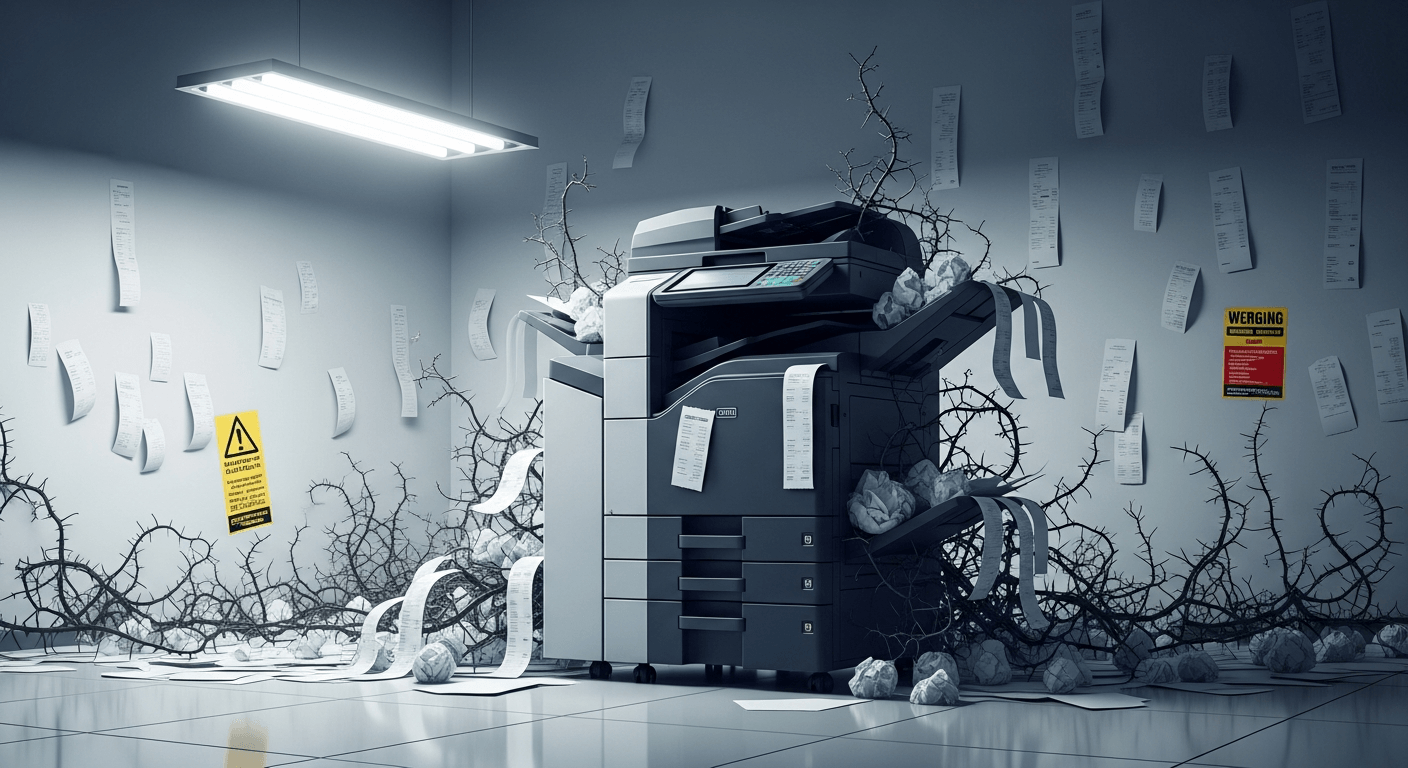
Copier lease payments change because most agreements combine fixed equipment costs with variable charges tied to usage, service, and contract escalation clauses. The fixed portion — the monthly equipment lease — stays the same throughout the term. The variable portions, including cost-per-page charges, overage fees, and annual service rate increases, can cause your invoice to rise month after month even when you do not change how you use the machine.
Understanding which parts of your payment are fixed and which are variable is the starting point for controlling what you actually pay.
What Is Actually Included in a Copier Lease Payment?
A copier lease payment is not a single charge. It is typically a bundle of four distinct cost components: the equipment lease payment, a service and maintenance agreement fee, a cost-per-page (CPP) charge, and supply costs. Each component is governed by different terms, and not all of them behave the same way over time.
The four components of a typical copier lease payment:
- Equipment lease payment — the monthly charge for using the physical machine, set at signing and fixed for the lease term
- Service and maintenance agreement — covers technician labor, parts, and repairs; may carry an annual escalation clause
- Cost per page (CPP) — a per-print charge applied to every page produced, variable based on actual volume
- Supplies — toner and consumables, either bundled into CPP or billed separately
When a business reports that their copier payment went up, the increase almost always originates from one or more of these last three components — not the base equipment charge.

What Is the Difference Between Fixed and Variable Costs in a Copier Lease?
Fixed costs are locked in at signing and do not change during the original lease term. Variable costs fluctuate based on usage, market conditions, and contract-defined escalation schedules.
Fixed costs include:
- Monthly equipment lease payment
- Base service agreement fee (if structured as a flat rate with no escalation clause)
Variable costs include:
- Cost-per-page charges that scale with print volume
- Overage charges when monthly print volume exceeds the contracted allowance
- Annual service agreement rate increases tied to escalation clauses
- Toner and supply charges when billed separately from CPP
Most businesses focus on the fixed equipment payment when evaluating a copier lease. The variable components are where unexpected costs accumulate.
How Do Overage Charges Work in a Copier Lease?
Overage charges apply when a business prints more pages in a month than the volume specified in the lease contract. These charges are billed at a per-page rate that is typically higher than the standard CPP rate included in the base agreement.
Most copier lease contracts establish a monthly page allowance — for example, 2,000 black-and-white pages and 500 color pages. If your office prints 2,800 black-and-white pages in a given month, the additional 800 pages are billed as overages. Color overage rates are consistently higher than black-and-white rates, sometimes by a factor of five to ten times.
Key facts about overage charges:
- Overages are calculated and billed at the end of each billing cycle
- Color overage CPP rates commonly range from $0.08 to $0.15 per page or higher, depending on the contract
- Black-and-white overage CPP rates typically range from $0.01 to $0.02 per page
- Some contracts include a grace buffer before overage rates apply; most do not
- Print volume tends to increase organically as businesses grow, making overages more frequent over time without a corresponding contract adjustment
Businesses that experience seasonal spikes in print volume — end-of-quarter reporting, open enrollment periods, event production — are especially susceptible to recurring overage charges.
What Are Annual Escalation Clauses in Copier Maintenance Agreements?
An escalation clause is a contract provision that allows the service agreement portion of a copier lease to increase by a set percentage each year. These clauses are common in copier and multifunction printer (MFP) service contracts and are designed to account for rising labor costs, parts prices, and general inflation.
Annual escalation rates in copier maintenance agreements typically range from 5% to 15% per year, depending on the vendor and contract structure. A service agreement that costs $75 per month at signing could cost between $79 and $86 per month after year one under a standard escalation clause — and compound upward from there over a five-year lease term.
What escalation clauses usually cover:
- Increased technician labor rates
- Rising costs of replacement parts and components
- Higher toner and consumable input costs
- General CPI-linked adjustments written into the contract language
Escalation clauses are legal and standard practice in the industry. They are also frequently buried in contract addenda rather than highlighted in the main agreement. Requesting a full copy of the service agreement before signing — separate from the equipment lease document — is the only way to confirm whether an escalation clause exists and what its cap is.
What Hidden Fees Appear in Copier Lease Contracts?
Hidden fees in copier lease contracts are charges that are contractually valid but not clearly communicated during the sales process. The most common ones include automatic renewal provisions, property tax pass-throughs, end-of-lease return fees, and mandatory supply purchase requirements.
Common hidden fees to review before signing:
- Automatic renewal clauses — if written notice is not provided within a specific window (often 30 to 90 days before lease end), the contract automatically renews for an additional term, typically 12 months, at the same or higher rate
- Property tax pass-throughs — some lessors pass the personal property tax assessed on the equipment directly to the lessee as a separate annual or monthly charge
- End-of-lease return shipping fees — returning the copier at lease end may require the business to pay freight and packaging costs, which can range from $150 to $500 or more depending on equipment size and location
- Mandatory toner purchase requirements — certain contracts require toner to be purchased exclusively through the lessor or a designated supplier, preventing businesses from sourcing lower-cost alternatives
- Administrative fees — processing fees, billing fees, or technology surcharges that appear on invoices without clear explanation in the original agreement
Reviewing every addendum and schedule attached to a copier lease agreement — not just the main contract page — is the only reliable way to identify these charges before they appear on an invoice.
How Does ASC 842 Affect Copier Lease Payments and Financial Reporting?
ASC 842 is an accounting standard issued by the Financial Accounting Standards Board (FASB) that requires most operating leases, including copier leases, to be recorded on a company's balance sheet as both a right-of-use (ROU) asset and a corresponding lease liability. This standard took effect for private companies for fiscal years beginning after December 15, 2021.
Before ASC 842, operating leases like copier leases were treated as off-balance-sheet obligations and recorded only as monthly expenses on the income statement. Under ASC 842, the full present value of remaining lease payments must be recognized on the balance sheet.
Practical implications for businesses leasing copiers:
- A 60-month copier lease at $300 per month creates a balance sheet liability of approximately $15,000 at inception (before present value discounting)
- This liability increases reported debt levels, which can affect loan covenants, credit applications, and financial ratios
- Businesses with multiple equipment leases — copiers, printers, postage machines, vehicles — may carry significant aggregate lease liabilities they were not previously tracking
- Companies subject to audited or reviewed financial statements are most directly affected; smaller businesses using cash-basis accounting may not be required to apply ASC 842
Businesses reviewing copier lease options should account for ASC 842 implications when deciding between lease structures and lease terms. Shorter lease terms reduce the balance sheet liability but may increase the monthly payment.
Can You Negotiate Copier Lease Terms to Control Payment Changes?
Yes. Many elements of a copier lease agreement are negotiable before signing, including escalation clause caps, overage rate structures, and contract renewal terms. Vendors rarely advertise this flexibility, but it exists in most standard agreements.
Specific terms worth negotiating:
- Escalation cap — request a hard cap on annual service agreement increases, such as a maximum of 4% per year, regardless of what the standard clause allows
- Overage rate lock — negotiate a fixed overage CPP rate for the duration of the lease term rather than allowing the vendor to adjust it at renewal
- Volume adjustment provision — ask for a clause that allows the contracted monthly page volume to be adjusted once per year without penalty, accommodating growth or contraction in print needs
- Automatic renewal opt-out — request that the automatic renewal clause be removed or that the notice window be shortened to 30 days
- Return logistics — clarify in writing who is responsible for return shipping costs at lease end and whether the vendor provides packaging materials
Getting any negotiated terms documented in the contract itself — not in a verbal agreement or email — is essential. Verbal commitments made during the sales process are not enforceable once the lease is signed.
Should a Business Lease or Buy a Copier?
Whether leasing or buying a copier is the better financial decision depends on cash flow, print volume, equipment refresh cycles, and how the business accounts for capital expenditures. There is no single correct answer for all businesses.
Leasing advantages:
- Preserves working capital by spreading costs over time
- Provides access to current equipment without a large upfront purchase
- Maintenance is typically bundled into the agreement
- Equipment can be upgraded at lease end without managing resale
Buying advantages:
- No long-term payment obligation once the purchase is complete
- No escalation clauses or overage structures to manage
- Full ownership allows for resale or trade-in
- Total cost of ownership is often lower over a five-to-seven-year horizon for stable, predictable print environments
Cost comparison example:
A copier purchased outright for $8,000 with a separate service contract at $60 per month costs approximately $11,600 over five years in service fees alone, plus the $8,000 purchase price, for a total of $19,600. A leased equivalent at $250 per month (equipment) plus $75 per month (service) plus CPP charges at $0.01 per page for 2,000 pages monthly totals approximately $24,900 over the same five-year period — before any escalation increases or overage charges.
For businesses that need predictable cash flow, require regular equipment upgrades, or lack capital for upfront purchases, leasing is a practical structure. For businesses with stable, predictable print needs and available capital, purchasing often produces a lower total cost of ownership.
Learn more about copier and printer solutions for businesses to compare current equipment options and contract structures available in Las Vegas and Southern California.

How Can a Business Monitor and Control Copier Lease Costs Over Time?
Controlling copier lease costs over time requires tracking actual print volume against contracted volume, reviewing invoices line by line each billing cycle, and calendaring key contract dates such as renewal notice windows and lease end dates.
Practical steps for ongoing cost control:
- Pull a monthly meter read report from the machine and compare it to your contracted volume allowance before the billing cycle closes
- Separate the equipment lease line item from the service and CPP line items on every invoice to identify which component is changing
- Set a calendar reminder 120 days before your lease end date to begin evaluating renewal, upgrade, or return options — this provides enough time to avoid automatic renewal
- Request an itemized breakdown of any invoice increase in writing from your vendor
- Review whether your current contracted volume still reflects your actual usage, and ask your vendor about volume adjustment options if there is a consistent mismatch
Businesses managing managed IT services alongside print environments may also benefit from print management software that tracks page counts, assigns costs by department, and flags usage anomalies before they result in overage charges.
Summary: Why Copier Lease Payments Change
Copier lease payments change for four primary reasons: overage charges from exceeding contracted print volume, annual escalation clauses built into the service agreement, hidden fees that activate at specific contract milestones, and cost-per-page rate adjustments at renewal. The equipment lease payment itself is fixed. All other components are subject to change based on usage, contract terms, and vendor-initiated rate adjustments.
Businesses that read their full contract before signing, negotiate escalation caps and overage structures, and track usage monthly are best positioned to avoid unexpected payment increases over the life of a copier lease.
Topics:
