
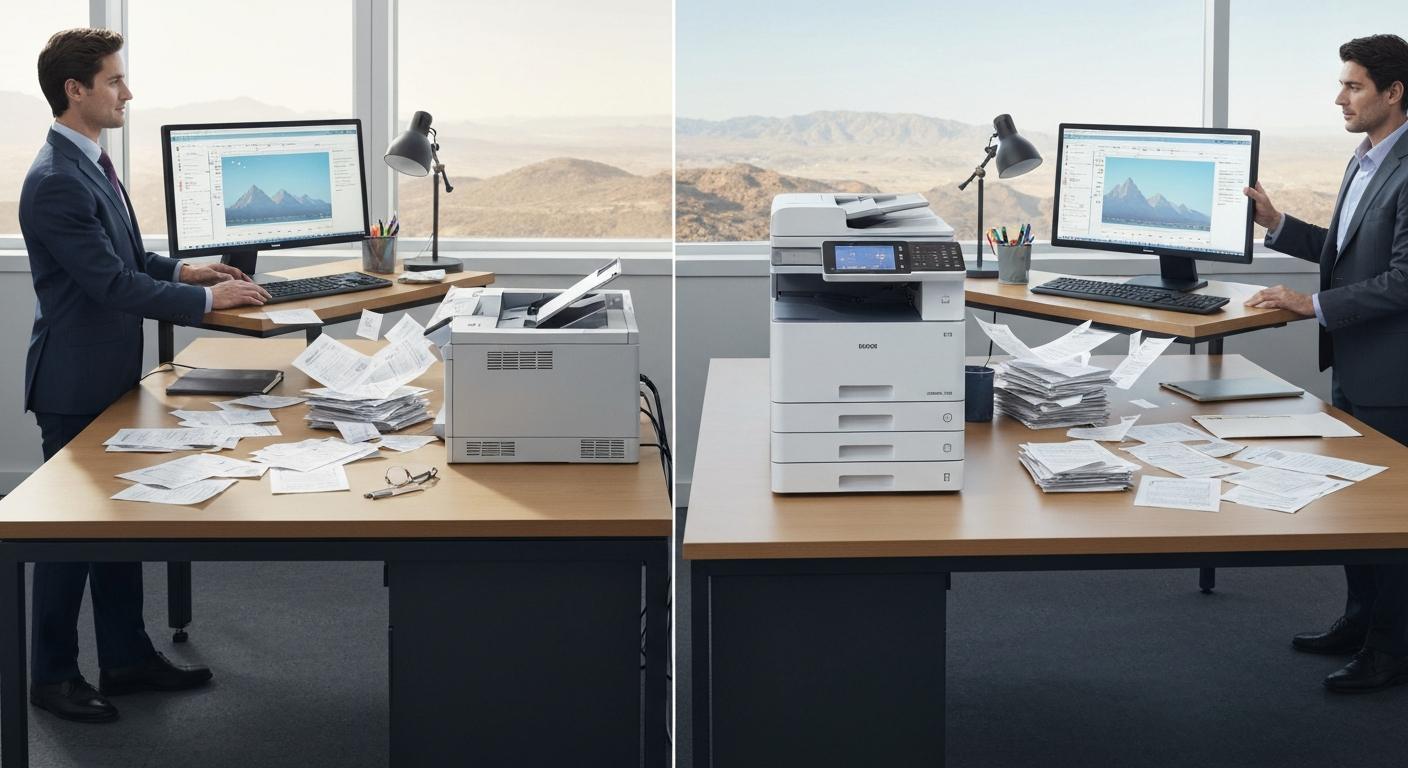
You're sitting in your North Las Vegas office watching employees walk back and forth between three different devices—one to print, another to scan, and a third to copy. Meanwhile, your office manager just delivered another stack of invoices for toner, maintenance calls, and service contracts. If this sounds familiar, you're not alone in questioning whether there's a better way.
The debate between multifunction printers (MFPs) and standalone printers isn't just about features anymore—it's about real dollars and operational efficiency. For Nevada businesses managing tight budgets and limited office space, understanding the true cost difference can mean saving thousands annually. AIS provides copiers and printers across Las Vegas and Southern California, and we've helped hundreds of offices calculate these costs firsthand.
This Nevada copier buyers guide breaks down the upfront expenses, ongoing costs, and hidden fees that separate MFPs from standalone printers in 2026.

Understanding the MFP vs Printer Nevada Cost Landscape
The first question most Nevada office managers ask is about the sticker price. Standalone printers appear cheaper upfront, with desktop laser printers ranging from $200 to $800 for basic models. MFPs, by contrast, typically start around $2,000 for entry-level models and climb to $15,000 or more for production-grade equipment.
But upfront cost tells only a fraction of the story. According to Forbes, "Over a printer's product life cycle, the cost per page with an MFP is substantially lower than with a desktop printer." This per-page calculation includes toner, maintenance, repairs, and energy consumption—expenses that accumulate rapidly over a device's 3-5 year lifespan.
The real office printer comparison 2026 requires examining total cost of ownership (TCO) across several categories. These include acquisition costs, consumables, maintenance agreements, energy usage, and the often-overlooked labor costs of managing multiple devices. Nevada businesses face additional considerations around service availability and response times given the region's unique geography.
Acquisition Costs: Purchase vs Lease Models
Most Nevada offices purchase standalone printers outright for $300-$800 per device. A typical 20-person office might deploy 4-6 standalone units, creating an upfront investment of $1,200-$4,800. These devices require immediate capital expenditure with no flexibility for upgrades or technology refresh cycles.
MFPs, conversely, are frequently leased rather than purchased. A standard 5-year lease for a mid-range MFP runs $150-$400 monthly, including service, toner, and maintenance. This converts large capital expenses into predictable operating expenses while ensuring regular technology updates.
The Hidden Multiplication Factor
Here's what the standalone printer math obscures: you need multiple devices to match one MFP's functionality. One MFP replaces a printer, copier, scanner, and potentially a fax machine. Forbes notes that "to produce the same results with separate products would cost up to twice as much and eat up a lot more of your office real estate."
When Nevada offices deploy 4-6 standalone printers plus a separate copier and scanner, the real equipment count reaches 6-8 devices. Each requires its own maintenance plan, consumables inventory, and troubleshooting attention. The multiplication effect extends far beyond purchase price into ongoing operational complexity.
Breaking Down Per-Page Costs in Your Nevada Office Printer Comparison 2026
Per-page cost represents the truest measure of printing expense over time. This metric combines toner or ink consumption, drum replacement, maintenance kits, and proportional service costs. For most Nevada offices printing 5,000-20,000 pages monthly, per-page expenses dwarf acquisition costs within the first year.
Standalone inkjet printers deliver the worst per-page economics, ranging from $0.15 to $0.35 per page when accounting for high-yield cartridge replacement. Laser printers improve this to $0.05-$0.12 per page for black-and-white and $0.15-$0.25 for color. MFPs achieve $0.01-$0.03 per page for monochrome and $0.05-$0.10 for color through higher-capacity toner cartridges and more efficient printing mechanisms.
The difference compounds rapidly. An office printing 10,000 pages monthly with standalone lasers at $0.08 per page spends $9,600 annually on consumables alone. The same volume on an MFP at $0.02 per page costs just $2,400—a $7,200 annual saving that quickly justifies higher upfront investment.
Nevada-Specific Supply Chain Considerations
Nevada offices face unique supply logistics compared to denser metropolitan areas. Consumable availability and shipping times matter when your printer runs dry mid-workday. Standalone printers often require proprietary cartridges with limited local inventory, forcing either expensive overnight shipping or productivity-killing delays.
MFPs typically connect to automated supply programs that monitor toner levels remotely. AIS's smart supply automation, for example, ships replacement cartridges before devices run empty. This predictive approach eliminates emergency supply runs and ensures Nevada offices never face unexpected downtime due to consumable shortages.
Energy Consumption Adds Up
Energy costs constitute another often-ignored expense category. A standalone printer draws 30-50 watts during active printing and 3-10 watts in standby mode. Multiply this across six devices running 50 hours weekly, and annual energy costs reach $150-$250 in Nevada's commercial electricity market.
A single MFP draws 400-600 watts active and 15-30 watts standby. Despite higher peak consumption, consolidated usage typically reduces total energy costs 20-40% compared to multiple standalone devices. Modern MFPs also incorporate aggressive sleep modes and scheduling features that minimize always-on energy waste.
Maintenance and Support: The MFP vs Printer Nevada Reality Check
Standalone printers rarely include service agreements at purchase. When devices fail, Nevada offices face three options: DIY troubleshooting with unpredictable results, hauling equipment to repair shops with 3-7 day turnarounds, or simply replacing failed units. Each approach carries hidden costs in staff time, downtime, and replacement frequency.
MFP leases and service contracts bundle maintenance, repairs, and on-site support. AIS handles 29,800+ service calls annually with 95% first-call resolution and 92% resolved in one visit. This responsiveness eliminates the productivity loss that accompanies multi-day printer outages.
The service cost difference becomes stark over a device's lifespan. Standalone printers averaging one service event yearly at $150-$300 per incident cost $750-$1,500 across five years per device. Six devices generate $4,500-$9,000 in repair expenses—often exceeding the original purchase price.
Downtime Costs Nobody Calculates
When your only printer fails during a deadline, the cost transcends repair bills. A paralyzed 10-person office losing four hours of productivity at an average $35/hour loaded labor rate hemorrhages $1,400. These incidents occur 2-3 times annually in typical standalone printer environments, creating $2,800-$4,200 in invisible annual costs.
MFP redundancy through multiple paper trays, backup systems, and faster service response cuts this downtime 60-80%. Many MFPs continue basic functions even when one component fails. AIS's 95% first-call resolution means most Nevada offices resume normal operations within hours, not days.
The Parts and Compatibility Problem
Standalone printers from consumer brands often face parts obsolescence within 2-3 years. Manufacturers discontinue models rapidly, leaving Nevada offices unable to source replacement fusers, drums, or feed mechanisms. This forced obsolescence creates unexpected replacement cycles that destroy long-term budgeting.
Enterprise-grade MFPs maintain parts availability and manufacturer support for 7-10 years. Xerox, Kyocera, and HP commercial lines prioritize serviceability and backward compatibility. This longevity lets Nevada offices maximize their equipment investment without surprise replacement expenses.
Space, Workflow, and Labor: The Intangible Costs in Your Office Printer Comparison 2026
Commercial real estate in North Las Vegas averages $1.50-$2.00 per square foot monthly. Six standalone printers occupying 30 square feet consume $540-$720 annually in rent-equivalent space costs. One MFP fits in 10-12 square feet, reducing this footprint expense by 60% while freeing valuable workspace.
Workflow efficiency carries measurable labor costs. Employees walking between separate print, scan, and copy devices waste 5-10 minutes daily navigating device locations, waiting for availability, and troubleshooting separate interfaces. Across a 20-person office, this totals 1,600-3,200 lost work hours annually—equivalent to one full-time employee.
MFPs centralize these functions at a single location with unified interfaces. Users complete multi-step jobs (scan-to-email, copy-to-folder, print-staple-collate) in one interaction. This consolidation recovers 40-60% of the time employees previously spent device-hopping.
IT Management and Help Desk Load
Every device on your network requires configuration, driver installation, security updates, and troubleshooting support. Standalone printers multiply this burden across 6-8 endpoints, each potentially running different firmware versions and driver packages. Nevada offices without dedicated IT staff lose hours monthly managing this complexity.
A single MFP presents one network endpoint, one security profile, and one management interface. Integration with print management software lets administrators set policies, track usage, and troubleshoot from central dashboards. For offices using managed IT services, this simplified device footprint reduces help desk tickets 50-70%.
Document Security and Compliance
Healthcare, legal, and financial offices in Nevada face strict document security requirements under HIPAA, GLBA, and other regulations. Standalone printers typically lack encryption, user authentication, or secure print release features. Documents sit in output trays visible to anyone passing by, creating compliance vulnerabilities and privacy risks.
Modern MFPs include user authentication via card readers or PIN codes, encrypted hard drives, secure print release, and detailed audit logs. These features align with Nevada's professional compliance standards while protecting sensitive client information. The compliance value alone often justifies MFP investment for regulated industries.
Real Nevada Office Scenarios: Total Cost of Ownership Over Five Years
Let's model three typical Nevada office scenarios with actual numbers. We'll calculate five-year TCO including acquisition, consumables, service, energy, and space costs.
Scenario 1: 10-Person Professional Office (Legal/Accounting)
Monthly print volume: 5,000 pages (70% black, 30% color)
*Standalone Approach:*
- 3 laser printers purchased: $1,800
- Consumables (5 years): $28,800
- Service/repairs: $2,250
- Energy costs: $750
- Space costs (15 sq ft): $1,800
- Total 5-Year Cost: $35,400
*MFP Approach:*
- Lease ($200/month including service): $12,000
- Consumables included in lease: $0
- Energy costs: $400
- Space costs (10 sq ft): $1,200
- Total 5-Year Cost: $13,600
- Savings: $21,800 (62% reduction)
Scenario 2: 25-Person Office (Healthcare/Education)
Monthly print volume: 12,000 pages (60% black, 40% color)
*Standalone Approach:*
- 6 printers + 1 copier purchased: $4,200
- Consumables (5 years): $72,000
- Service/repairs: $5,400
- Energy costs: $1,500
- Space costs (30 sq ft): $3,600
- Total 5-Year Cost: $86,700
*MFP Approach:*
- Lease ($350/month including service): $21,000
- Consumables included in lease: $0
- Energy costs: $600
- Space costs (12 sq ft): $1,440
- Total 5-Year Cost: $23,040
- Savings: $63,660 (73% reduction)
Scenario 3: 50-Person Office (Manufacturing/Corporate)
Monthly print volume: 25,000 pages (50% black, 50% color)
*Standalone Approach:*
- 10 printers + 2 copiers purchased: $8,000
- Consumables (5 years): $150,000
- Service/repairs: $12,000
- Energy costs: $3,000
- Space costs (50 sq ft): $6,000
- Total 5-Year Cost: $179,000
*MFP Approach:*
- Two MFP leases ($550/month total): $33,000
- Consumables included in lease: $0
- Energy costs: $1,200
- Space costs (24 sq ft): $2,880
- Total 5-Year Cost: $37,080
- Savings: $141,920 (79% reduction)
These scenarios demonstrate that cost savings scale with volume—higher-volume offices see even greater MFP advantages. The numbers also exclude productivity gains, reduced downtime, and improved document security that further tilt economics toward MFPs.
When Standalone Printers Make Financial Sense
Despite MFP advantages, specific situations favor standalone printers. Satellite offices with 2-3 employees printing under 500 pages monthly don't generate volume to justify MFP investment. Similarly, specialized applications requiring specific paper handling (check printing, label production) may need dedicated standalone devices.
Home offices and remote workers also benefit from standalone printers costing $150-$300 with modest consumable expenses. These low-volume scenarios don't trigger the per-page cost multipliers that penalize standalone printers in higher-volume environments. For Nevada businesses supporting hybrid work models, a combination approach—MFPs at headquarters, standalones for remote staff—often delivers optimal economics.
FAQs
What's the real cost difference between MFP vs printer Nevada offices should expect?
Nevada offices typically save 60-80% over five years with MFPs compared to multiple standalone printers when accounting for total cost of ownership. The savings come primarily from lower per-page costs, included maintenance, reduced energy consumption, and smaller equipment footprints.
How do I calculate the break-even point for my Nevada office printer comparison 2026?
Calculate your monthly print volume, multiply by per-page costs for each option, and add monthly lease or purchase amortization plus service costs. Most Nevada offices break even on MFP investment within 12-18 months when printing 3,000+ pages monthly.
Does this Nevada copier buyers guide apply to small offices under 10 employees?
Yes, but volume matters more than headcount. Offices printing 2,000+ pages monthly benefit from MFPs regardless of size, while those under 1,000 pages monthly may find standalone printers more economical.
What hidden costs should Nevada offices include in MFP vs printer comparisons?
Include consumables, service agreements, energy consumption, real estate footprint, IT management labor, downtime costs, and supply chain logistics. These hidden expenses often exceed the equipment purchase price over a device's lifespan
Are lease costs for MFPs negotiable in the Nevada market?
Yes, lease terms, service inclusions, buyout options, and per-page overages are all negotiable. Nevada offices should compare multiple proposals and clarify exactly what's included—toner, maintenance, repairs—before signing agreements.

Is an MFP vs Printer Nevada Decision Right for Your Office?
The financial case for MFPs strengthens with every page your Nevada office prints. For most businesses printing 3,000+ pages monthly, the combination of lower per-page costs, bundled service, and operational efficiency creates savings that dwarf higher upfront investment. The five-year scenarios above demonstrate that typical Nevada offices save $20,000 to $140,000 by choosing MFPs over standalone printer fleets
Beyond pure economics, MFPs deliver workflow consolidation, superior reliability, better security, and reduced management burden. These intangible benefits compound the financial advantages, especially for growing Nevada businesses that need scalable, professional-grade document solutions. This Nevada copier buyers guide should give you the framework to calculate your specific costs and make data-driven equipment decisions.
Our team at AIS helps Nevada and Southern California businesses navigate these office printer comparison 2026 decisions daily. Contact us today to get a customized cost analysis based on your actual print volumes, workflow requirements, and budget parameters.
