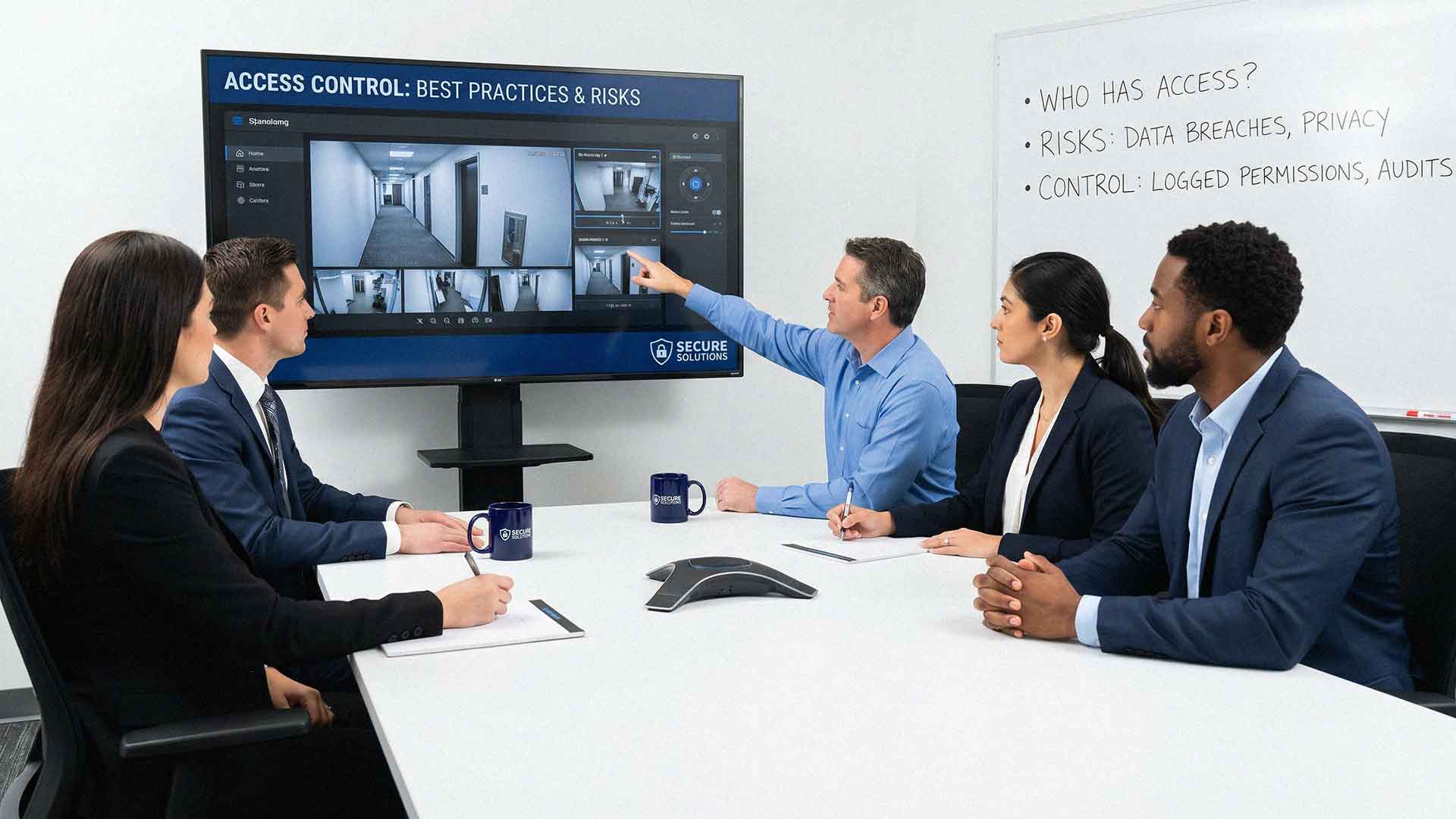
Most businesses spend a lot of time choosing the right cameras. They think carefully about coverage areas, video resolution, and storage capacity. What often gets skipped — or at least deprioritized — is access control. And that gap can quietly create serious risk.
Security footage isn't just video. It's a detailed record of your daily operations, your employees, your customers, and in some cases, your most sensitive business moments. When the wrong person can access that footage — intentionally or accidentally — the system you put in place to protect your business can end up creating new vulnerabilities.
Here's how to think through who should have access to your security footage, what permission levels make sense, and how to build a structure that actually holds up over time.
What Security Footage Actually Contains
It's easy to think of camera footage as simple, passive recordings. In reality, it captures a lot more than most people realize.
Depending on where your cameras are placed, footage may include:
- Employee behavior and movement patterns throughout the workday
- Customer interactions at service counters, entrances, or transaction areas
- Access patterns showing who enters or exits restricted areas and when
- Internal processes that may be proprietary or competitively sensitive
- Sensitive incidents such as disputes, accidents, thefts, or misconduct
Because of this, video surveillance data deserves the same level of protection you'd give any other sensitive business asset. It's not just a recording — it's a liability if mishandled.
Why Uncontrolled Access Creates Real Risk
When too many people have access to your camera system, problems compound quickly. Here's what can go wrong:
- Footage gets viewed without a valid reason. Curiosity isn't a business need. Broad access opens the door to casual misuse.
- Clips get shared improperly. An employee who can download footage can also send it — to a personal device, over social media, or to an outside party.
- Sensitive incidents get exposed. HR investigations, legal disputes, and workplace incidents require careful handling. Uncontrolled access undermines that.
- Footage can be tampered with. Users with excessive permissions may delete or alter recordings — sometimes accidentally, sometimes not.
According to Forbes, access control is a four-step process built around identification, authentication, authorization, and accountability. All four steps matter. Skipping any one of them — especially accountability — means you may not know a problem occurred until it's too late.

The Core Principle: Access Should Match Responsibility
The foundation of a solid access control policy is straightforward: access should be determined by role and responsibility, not by seniority or convenience.
This is called role-based access control (RBAC). Rather than asking "who wants access?" you ask "who needs access to do their job effectively?"
The National Institute of Standards and Technology (NIST) frames physical access control as a system designed to protect personnel, property, and activities — not just to restrict movement, but to create accountability for who interacts with sensitive resources. That same logic applies directly to your surveillance footage.
Limiting access does three things:
1. Reduces the risk of misuse, whether intentional or accidental
2. Improves accountability, because fewer people with access means a cleaner audit trail
3. Protects your business legally, by demonstrating due diligence if a footage-related incident ever comes into question
Who Should Typically Have Access to Security Footage?
There's no single universal answer here — it depends on your organization's size, structure, and industry. But most businesses follow a tiered model. Here's a practical breakdown:
Senior Leadership and Business Owners
Owners and C-suite leaders typically have broad access. They carry ultimate accountability for the business, and they may need to review footage for high-level incidents, compliance reviews, or executive-level investigations.
That said, even leadership access should be logged. "Having access" and "having unchecked access" are two different things.
Security Personnel
If your business has a dedicated security team or on-site security staff, they're the most natural candidates for real-time monitoring and footage review. Their job function is directly tied to surveillance. Access should be scoped to their responsibilities — live monitoring, incident review, and escalation.
Designated IT Administrators
IT teams manage the technical infrastructure — camera firmware, network integration, storage systems, and user permissions. This gives them significant access by necessity.
Here's an important distinction though: managing the system is not the same as reviewing footage. In many organizations, IT handles configuration and access management while security personnel or leadership handles footage review. Separating these responsibilities adds a meaningful layer of control.
HR and Compliance Officers (As Needed)
HR professionals may legitimately need to review footage during workplace investigations. Legal and compliance teams may need access for regulatory or litigation-related purposes. This access should generally be granted on a case-by-case, temporary basis — not as a standing permission.
Managers (With Conditions)
Middle management is a common area of debate. Managers often feel they should have access because they oversee the people and spaces being recorded. That's understandable. But open-ended, permanent access for all managers can expand your exposure unnecessarily.
A better approach: purpose-driven, temporary access. If a manager needs to review footage related to a specific incident — a safety concern, a performance issue, a customer dispute — that access can be granted, logged, and revoked once the need is resolved.
General Employees
In most cases, general employees should not have access to recorded surveillance footage. There are exceptions — front desk staff or operations coordinators might need access to live camera views for legitimate operational reasons, like monitoring a lobby or loading dock.
Even in those cases, limit the scope. A front desk employee might be able to view a live feed from a specific camera without being able to export footage, access historical recordings, or view cameras in other areas of the facility.
Understanding Permission Levels: Not All Access Is the Same
Modern surveillance platforms — including cloud-based systems like those powered by Verkada — support granular permission levels. This is a significant advantage over older, closed-circuit systems where access was essentially all-or-nothing.
Common permission tiers include:
- Live view only — User can watch real-time feeds but cannot access or export recordings
- Recorded footage review — User can view historical footage within a defined timeframe
- Clip export — User can download or share specific video segments
- Administrative control — User can manage cameras, settings, users, and permissions
The most sensitive tier — administrative control — should be limited to the smallest possible group. Actions like deleting footage, modifying retention settings, or adding/removing users carry significant risk and should require strong authentication and a clear audit trail.
Logging and Monitoring Access: The Accountability Layer
Access control policies only work if you can verify they're being followed. That's why access logging is not optional — it's a core part of a responsible surveillance program.
Your system should record:
- Who accessed footage, and under what credentials
- When they accessed it and for how long
- What they did — viewed, exported, deleted, or modified
- Which cameras or footage segments were accessed
This audit trail does several things. It deters misuse — people behave differently when they know their actions are tracked. It helps you catch problems early. And it gives you documentation if footage access ever becomes a point of legal or HR dispute.
Reviewing access logs periodically — not just after incidents — is a sign of a mature security program.
Policies, Training, and Documentation
Technology alone doesn't create a secure environment. The human side matters just as much.
Every organization should have a written surveillance and footage access policy that covers:
- Who is authorized to access footage and under what circumstances
- How access requests are submitted and approved
- How temporary access is granted and revoked
- Consequences for unauthorized access or misuse
- How long footage is retained before deletion
Once the policy exists, employees and managers need to be trained on it — not just at onboarding, but periodically. Policies that sit in a shared drive and never get reviewed tend to drift out of alignment with actual practice.
Practical Steps to Audit Your Current Access Controls
If you're not sure who currently has access to your security footage, now is a good time to find out. Here's a simple starting point:
1. Pull a current user list from your camera management platform
2. Map each user to a role and a business justification for their access
3. Identify anyone who no longer works at the company — former employees with lingering credentials are a common and serious vulnerability
4. Review permission levels for each user and ask whether they're appropriate
5. Enable or verify access logging so future activity is tracked
6. Schedule a recurring review — quarterly or semi-annually — to keep the list current
This audit doesn't take long, but it often surfaces issues that would otherwise go unnoticed for years.
How AIS Helps Businesses Build Smarter Surveillance Systems
At AIS, we work with SMBs across Las Vegas, Southern California, and the surrounding region to design and manage surveillance systems that go beyond just "putting up cameras." We help you think through access control, permission structures, and ongoing monitoring so the system actually serves your business — and doesn't become a liability.
Our team uses platforms like Verkada, which offers cloud-based management with built-in role-based access controls, audit logging, and remote visibility. It's built for the way modern businesses operate, and it makes managing footage access significantly easier than traditional on-premise systems.
With a 96% NPS score and an average client relationship of 7+ years, we're not here to sell you equipment and walk away. We stay involved, so your security environment grows with your business.
Schedule a Free Consultation — we'll help you evaluate your current setup and identify any gaps in your access control structure.
Frequently Asked Questions
1. How many people should have access to security footage in a small business?
There's no fixed number, but most small businesses do well with three to five individuals having any level of access — typically an owner, a designated IT administrator, and one or two senior managers. The key is that every person with access should have a clear business reason for that access.
2. Should I use the same login credentials for multiple users?
No. Shared credentials eliminate accountability. If two people use the same login, you can't determine who accessed footage when an incident occurs. Every user should have their own unique credentials with permissions matched to their specific role.
3. What happens if a former employee still has access to our security system?
This is one of the most common and overlooked vulnerabilities in business security. Former employees — especially those who left on bad terms — can still log in and view, export, or delete footage if their credentials haven't been revoked. Offboarding procedures should always include removing access to all systems, including cameras.

4. Can employees legally view footage of their coworkers?
This depends on your jurisdiction, your company's written policies, and the employee's role. Generally speaking, employees do not have a right to view surveillance footage of their coworkers. Unauthorized viewing can create HR issues or legal liability. Access should always be role-specific and policy-governed.
5. What's the difference between role-based access control and just giving everyone a password?
A shared password gives every user the same level of access with no individual accountability. Role-based access control assigns specific permissions to each user based on their job function. It limits what they can see and do, and it creates an individual audit trail. It's a fundamentally more secure and manageable approach.
6. How long should businesses retain security footage?
Retention periods vary based on industry, local regulations, and business needs. Most SMBs retain footage for 30 to 90 days as a baseline. Higher-risk environments — financial services, healthcare, or businesses with active legal matters — may need longer retention. Your IT or legal team can help you determine what's appropriate for your situation.
7. Does a cloud-based camera system make access control easier to manage?
Generally, yes. Cloud-based platforms like Verkada allow administrators to manage user permissions remotely, review access logs from any device, and make real-time changes without being on-site. This is a significant practical advantage over traditional on-premise DVR/NVR systems, which often require physical access to manage settings.
