

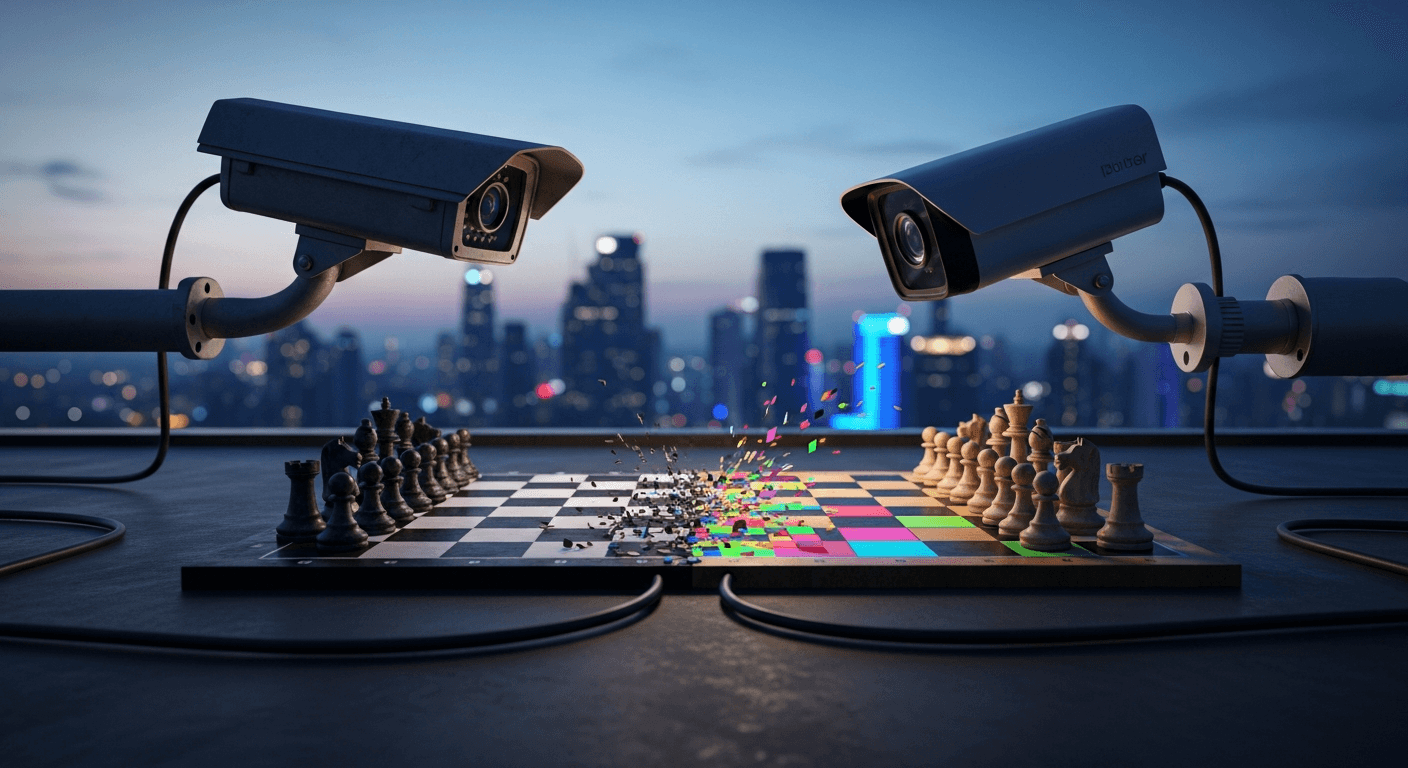
Business security cameras fall into two primary categories: CCTV (analog) systems and IP (digital) camera systems. These two technologies record video using fundamentally different methods, which affects image quality, cabling, storage, remote access, cybersecurity risk, and total cost. Understanding those differences helps businesses select a system that matches their actual operational needs.
What Is a CCTV Camera System?
A CCTV (closed-circuit television) system uses analog cameras that transmit video signals through coaxial cables to a central Digital Video Recorder (DVR). The term "closed-circuit" means the video feed stays within a contained, private system — it is not broadcast over a public network. CCTV has been deployed commercially for decades and remains a functional, cost-accessible option for many business environments.
Key technical characteristics of CCTV systems:
- Analog video signal transmitted over coaxial cable
- One dedicated coaxial cable run per camera
- Video stored locally on a DVR
- Resolution typically ranges from 700 TVL (television lines) to 1080p on newer HD-analog models
- No internet connection required for core operation
CCTV technology is not obsolete. The United Kingdom operates one of the largest CCTV deployments in the world, and the U.S. National Institute of Standards and Technology (NIST) has documented CCTV footage as a reliable tool in law enforcement investigations, including suspect identification in high-profile criminal cases.
What Is an IP Camera System?
An IP (Internet Protocol) camera converts video into a digital data stream and transmits it over a standard Ethernet network to a Network Video Recorder (NVR) or directly to cloud storage. Each camera has its own IP address, functions as an independent network device, and can be accessed remotely through a web browser or mobile application.
Key technical characteristics of IP camera systems:
- Digital video encoded and transmitted over Ethernet (Cat5e or Cat6 cable)
- Power over Ethernet (PoE) allows a single cable to carry both data and power to the camera
- Video stored on an NVR, local server, or cloud platform
- Resolution starts at 1080p (2MP) and scales to 4K (8MP) and beyond
- Remote access and live streaming supported natively
IP cameras process image data locally within the camera unit before transmission, which enables features like on-camera motion detection, analytics, and compression — capabilities that analog cameras cannot perform independently.

How Do CCTV and IP Cameras Differ in Image Quality?
IP cameras consistently deliver higher resolution than traditional analog CCTV systems. Standard analog CCTV resolution tops out around 700 TVL, which equates to roughly 0.4 megapixels. Modern IP cameras begin at 2 megapixels (1080p) and scale to 12 megapixels or higher in commercial-grade models.
Higher resolution directly affects the usability of recorded footage. When footage is used to identify a person, read a license plate, or document a specific incident, image clarity determines whether the footage is actionable.
Resolution comparison by camera type:
| Camera Type | Typical Resolution | Megapixels |
|---|---|---|
| Standard analog CCTV | 700 TVL | ~0.4 MP |
| HD-analog CCTV (HD-TVI, AHD) | 1080p | 2 MP |
| Entry-level IP camera | 1080p | 2 MP |
| Mid-range IP camera | 4MP - 5MP | 4 - 5 MP |
| High-end IP camera | 4K | 8 MP |
Wide dynamic range (WDR) performance — the camera's ability to handle scenes with both bright and dark areas simultaneously — is also more advanced in IP cameras, making them more suitable for entrances, loading docks, and mixed-lighting environments.
How Do Installation Requirements Differ Between CCTV and IP Cameras?
CCTV installation requires a dedicated coaxial cable run from each camera to the DVR, along with a separate power cable for each camera. IP camera installation uses a single Ethernet cable per camera when PoE is available, which carries both data and power from a PoE switch or NVR to the camera.
CCTV installation requirements:
- Coaxial cable (RG59 or RG6) per camera
- Separate power supply or power cable per camera
- Centralized DVR with enough inputs for each camera
- Analog-to-digital conversion handled by the DVR
IP camera installation requirements:
- Single Cat5e or Cat6 Ethernet cable per camera
- PoE switch or PoE-capable NVR
- Network infrastructure (router, switch) if integrating with a business LAN
- IP address assignment for each camera
For businesses with existing structured Cat6 cabling — such as those already running a managed network — IP cameras can often be added to the existing infrastructure without pulling entirely new cable runs. CCTV systems always require dedicated coaxial runs regardless of existing network infrastructure.
Businesses replacing an older CCTV system should be aware that coaxial cabling from a legacy CCTV installation is not compatible with IP cameras. New cable runs are required when switching systems.
What Are the Storage Differences Between CCTV and IP Camera Systems?
CCTV systems store footage locally on a DVR using hard drives. IP camera systems store footage on an NVR, a local server, or a cloud-based storage platform — or a combination of all three.
CCTV storage characteristics:
- Local DVR storage only
- Storage capacity limited by DVR hard drive size
- No native cloud storage without third-party hardware additions
- Footage retrieval requires physical access to the DVR
IP camera storage characteristics:
- NVR-based local storage
- Cloud storage integration available natively on most systems
- Redundant storage options (local plus cloud simultaneously)
- Remote footage retrieval via internet connection
Cloud storage for IP cameras introduces ongoing subscription costs. Pricing varies by provider and retention period, but SMBs should budget for monthly or annual cloud storage fees in addition to hardware costs if cloud backup is required by their industry or insurance provider.
Which System Costs More: CCTV or IP Cameras?
CCTV systems have lower upfront hardware costs at the entry level. IP camera systems carry higher initial hardware costs but offer lower long-term infrastructure costs when PoE cabling is already available. The total cost difference narrows significantly over a 3-5 year period when factoring in storage, maintenance, and scalability.
Approximate cost ranges for a small business system (8 cameras):
| Cost Category | CCTV System | IP Camera System |
|---|---|---|
| Camera hardware | $30 - $80 per camera | $80 - $250 per camera |
| Recorder (DVR/NVR) | $150 - $400 | $200 - $600 |
| Cabling and installation labor | $500 - $1,500 | $400 - $1,200 |
| Cloud storage (annual) | Not standard | $100 - $600+ per year |
These are general market ranges. Final pricing depends on camera resolution, brand, installation complexity, and whether existing cabling can be reused.
For businesses that need high-resolution footage, remote access, and scalability, the total cost of an IP system over five years is often comparable to or lower than running a CCTV system that requires significant upgrades to meet those same requirements.
How Scalable Are CCTV vs IP Camera Systems?
IP camera systems are significantly more scalable than CCTV systems. Adding cameras to an IP system requires available network ports and IP addresses — both of which can be expanded with additional switches. Adding cameras to a CCTV system requires adding DVR inputs and running new coaxial cable runs, which limits expansion based on physical DVR capacity.
CCTV scalability constraints:
- DVR input channels cap the total number of cameras (common models: 4, 8, 16, 32 channels)
- Expansion beyond DVR capacity requires purchasing an additional DVR unit
- Each new camera requires a new coaxial cable run to the DVR
IP camera scalability advantages:
- Cameras can be added to an existing PoE switch without running new cable to a central recorder
- NVR software licenses can be expanded digitally on many platforms
- Camera feeds from multiple physical locations can be managed on a single NVR or cloud platform
For businesses planning future expansion — adding locations, adding coverage zones, or integrating with access control or video analytics systems — IP camera infrastructure accommodates that growth more efficiently.
What Are the Cybersecurity Risks of IP Cameras That Businesses Should Know?
IP cameras are network-connected devices and carry cybersecurity risks that CCTV systems do not. Because IP cameras have their own IP addresses and transmit data over a network, they can be targeted by unauthorized access if not properly secured. CCTV systems, which operate on closed analog circuits, are not exposed to internet-based threats in the same way.
Documented IP camera security vulnerabilities include:
- Default factory credentials that users fail to change, allowing easy unauthorized access
- Unpatched firmware with known exploits
- Exposure on public-facing IP addresses without firewall protection
- Insecure remote access configurations
- Man-in-the-middle attacks on unencrypted video streams
Research published on arxiv.org has documented network-based attack vectors targeting IP surveillance cameras in enterprise environments, noting that improperly secured cameras can serve as entry points into broader business networks.
Steps to reduce IP camera cybersecurity risk:
- Change all default usernames and passwords immediately after installation
- Apply firmware updates on a defined schedule
- Place cameras on a dedicated VLAN (virtual LAN) isolated from primary business traffic
- Disable UPnP (Universal Plug and Play) on the router
- Use encrypted transmission protocols (HTTPS, TLS) where supported by the camera firmware
- Conduct periodic network audits to identify unauthorized devices
Businesses in regulated industries — healthcare, finance, legal services — should document their IP camera security configurations as part of their broader compliance practices.
Are There Environmental Factors That Affect Whether CCTV or IP Cameras Perform Better?
Yes. Environmental conditions including lighting, temperature range, weather exposure, and physical installation location affect how each camera type performs. Neither system is universally superior across all environments — the right choice depends on the specific deployment conditions.
Lighting considerations:
- IP cameras with WDR and low-light sensors (e.g., Sony Starvis) perform better in variable or low-light conditions than most analog CCTV cameras
- HD-analog CCTV cameras have improved in low-light performance but generally lag behind comparable IP models
Weather and temperature:
- Both CCTV and IP cameras are available in weatherproof enclosures rated to IP66 or IP67 standards
- Operating temperature ranges vary by manufacturer and model — verify specifications for outdoor deployments in extreme heat (Las Vegas averages exceed 110°F in summer) or cold climates
Long cable runs:
- Analog CCTV signals degrade over long coaxial cable runs — typically above 300 feet without a signal amplifier
- IP camera signals over Ethernet are reliable up to 328 feet (100 meters) per cable segment; longer runs require a midspan PoE extender or additional switch
Bandwidth-limited environments:
- In locations with limited or unreliable internet connectivity, IP cameras can still record locally to an NVR without cloud dependence
- CCTV systems operate entirely offline and are unaffected by network outages

What Compliance and Legal Considerations Apply to Business Surveillance Cameras?
Businesses deploying surveillance cameras must comply with applicable federal, state, and local laws governing video monitoring. Requirements vary by jurisdiction and industry. Non-compliance can result in civil liability or regulatory penalties.
Common legal requirements for business surveillance:
- Notification: Many U.S. states require visible signage notifying individuals they are being recorded in common areas. Audio recording carries additional restrictions under wiretapping laws in two-party consent states, including California.
- Data retention: Some industries (healthcare, banking, gaming in Nevada) have specific requirements for how long surveillance footage must be retained and how it must be secured.
- Employee monitoring: Recording employees in private spaces (restrooms, changing areas) is prohibited under federal law and most state laws.
- Access control: Footage access should be logged and restricted to authorized personnel, particularly in regulated industries.
Businesses operating in Nevada should review NRS 200.650 (unlawful recording) and consult with legal counsel if deploying audio-capable cameras or monitoring employees.
CCTV and IP camera systems each have different implications for data security compliance. IP camera systems that store footage in the cloud must address data storage jurisdiction, encryption standards, and vendor access policies as part of any compliance review.
CCTV vs IP Cameras: A Side-by-Side Comparison
| Feature | CCTV (Analog) | IP Camera |
|---|---|---|
| Signal type | Analog | Digital |
| Cable type | Coaxial | Ethernet (Cat5e/Cat6) |
| Power delivery | Separate power cable | PoE (single cable) |
| Resolution range | Up to 1080p (HD-analog) | 1080p to 4K and beyond |
| Remote access | Limited / requires add-ons | Native / mobile and browser |
| Cloud storage | Not standard | Supported natively |
| Scalability | Limited by DVR inputs | Flexible via network expansion |
| Cybersecurity risk | Low (closed circuit) | Higher (requires active management) |
| Entry-level hardware cost | Lower | Higher |
| Best for | Budget-focused, simple layouts | High resolution, remote access, growth |
Choosing between CCTV and IP cameras depends on resolution requirements, budget structure, cybersecurity readiness, planned growth, and the physical environment of the installation. Both systems can provide reliable business surveillance when properly specified and installed.
Topics:
